
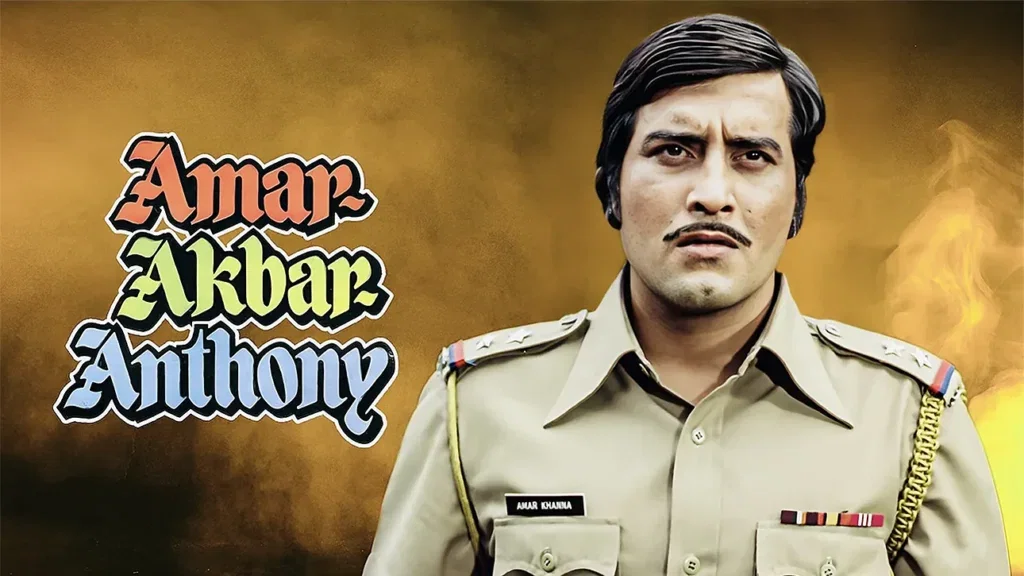
Forty years have passed since director Manmohan Desai’s Indian Hindi-language feature film Amar Akbar Anthony was first released, and it is finally receiving the scrutiny it deserves. Read in our political present, the film is an enduring prophylactic. Sidharth Bhatia’s Amar Akbar Anthony: Masala, Madness and Manmohan Desai (2013) provides a biography of the film. The behind-the-scenes approach Bhatia adopts helps us look beyond its mythology to see it for what it is: a media assemblage. The construction of the component parts of the episodic narrative, loosely patched together, conveys a sense of the film as a creative mess that somehow coheres. Bhatia’s ontological study is the first book-length study of the film.
More recently, William Elison, Christian Lee Novetzke, and Andy Rotman’s Amar Akbar Anthony: Bollywood, Brotherhood and the Nation (2016) – with an equally indulgent subtitle to match the trilateral pluralism the film invokes – is the combined work of three scholars of religion: a philologist, a historian, and an ethnographer. Consonant with the film’s theme, all three disciplines methodologically dovetail to produce a cultural history of a Bollywood icon. The film, we are told, “offers a glimpse into the imaginary of a viewing public, a kind of bellwether for the public mood.” Amar Akbar Anthony‘s richly polysemic narrative, according to the book’s writers, aims to “salvage the dream of an idealized nation in post-Emergency India.”