

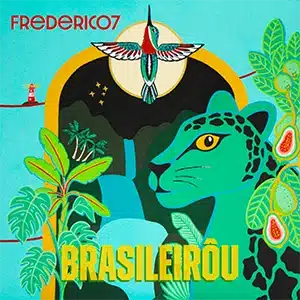
On his new album Brasileirôu, singer-songwriter Frederico7 (the musical moniker of Frederico Forte) turns inward and outward at once. He channels deeply personal experiences, emotional and perceptual alike, into exuberant music. Inspired by the bossa nova and funk legends of his home country, Brazil, and the varied scenes of his current headquarters in Austin, Texas, Frederico7 is an artist in motion. He draws on memories and feelings without navel-gazing, offering instead vivid sounds and sensuously charged lyrics that keep the nostalgic moments of Brasileirôu from being overly wistful. Frederico’s vision here is as vibrant and wild as real life itself, and as he takes us through it, he clearly loves every moment.
Sweeping violins and warm echoes set an impassioned tone from the album’s first note. The opening song, “O Infinito é Logo Ali”, revels in the inextricability of macrocosm and microcosm in life, embracing a dynamic sense of place in the universe over a luscious pop melody. Frederico’s viewpoint blossoms further into a psychedelic exploration of the natural world on “Alma Natureza” over fittingly soulful samba. The driving bass underpinning the track calls to mind the work of Tim Maia, albeit with a gentler sway in the mix.
Themes of movement mark the album’s next few tracks. “Filhos de Xangô” invokes deities of Brazil-rooted religion Candomblé and cosmologies of Indigenous Wixárika communities based in Mexico and farther north, reaching perhaps as far as Frederico’s stomping grounds in Texas. He sings of journeying from one tropic to the other, holding pain, love, and resilience all at once. Sonically, it’s a celebration, with horns and flitting guitar work lifting the grit of Frederico’s voice as he narrates his struggles and the rewards that follow.
A more dramatic telling of the experience follows on “40 Días”, in which Frederico does not despair but certainly does not hold back in describing the lonelier moments of migration and the dreams that have sustained him. The title track follows, an anthem for the people of Brazil that pays tribute to the cities, favelas, arts, and musical forms they have built on the ground.
Love and desire mark the following songs, “Chamêgo”, “Selvagem”, and “A Forest”, the latter a cover of the Cure‘s song of the same name. In the first two, Frederico continues to draw on natural imagery with clear cultural significance. In “Chamêgo”, he yearns in Spanish and Portuguese for a lover he refers to as Diosa Maya–Maya Goddess–calling her to the Brazilian Atol das Rocas and comparing their affection to un colibrí en el jardín del jaguar: a hummingbird in the garden of the jaguar. Tucked in the more intimate sizzle of “Selvagem” are references to the famed Brazilian poet Carlos Drummond de Andrade.
Brasileirôu ends with a suite of vulnerable pieces. A father misses and tries to reassure his daughter on “Antonella”. “Learning to Live Without You” insists on hope even in times of parting, a theme that continues in “A Goiabeira”. The album ends with “Dilemas Demais”, a stripped-down, vaguely bluesy reflection on what it means to surrender to the universe even when it seems to lead us down difficult paths. The song fades into gulls and water, a truly open ending.
Frederico7’s best quality as a performer might best be summed up as a willingness: to give all, to express without reservation. Sometimes, the music here feels raw; it never feels like artifice. We hear Frederico’s whole heart here, in full color. That and very good music make for a beautiful thing on Brasileirôu.