

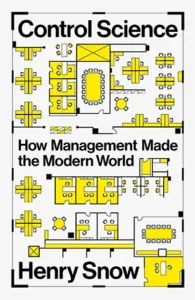
Writing a history of something has to start somewhere, and Henry Snow’s Control Science starts at a point that is indicative of how the author conceives of the object of this history. Histories of modern management usually begin with the Industrial Revolution. The narrative typically develops along these lines: with the appearance of large factories, deepening of mines, and ever-expanding transportation networks, the need to organize and control large numbers of workers produces the profession and science of management.
More often than not, F. W. Taylor will be mentioned early on as the founder of scientific management. The story would then unfold with a certain optimism, showing how later management thinkers found that the benefit of the employer is not necessarily in opposition to the benefit of the employee and how, finally, all can enjoy the blessings of an enlightened industrial civilization.
Henry Snow opens Control Science: How Management Made the Modern World with slavery, making it immediately clear that what follows is not a tale of humanity’s industrial successes but of its moral failures. F. W. Taylor isn’t even mentioned in the first half of the book.
The first prominent actor in Snow’s narrative is William Petty, the author of Political Arithmetic (1690)—a book whose central thesis suggests that all of human life can be quantified and calculated, “selectively removing the unpleasant context.” The “unpleasant context” in this case was land confiscations in Ireland, the massive and violent reduction of Ireland’s population, and the earnest proposition for lost workers to be “conveniently” replaced on the other side of the ocean by slaves.
Control Science is obviously not a typical history of management; it tackles a considerably broader spectrum of phenomena. The name “control science” was chosen for a reason, as Snow’s work moves beyond the history of organizing workers and into a temporal exploration of the modes of total control. Most laudably, he demonstrates clearly how the former grows to become the latter. Control Science acknowledges that the control of economic production, in a capitalist order, necessarily morphs into the conquest of all aspects of social life.
Most chapters have a protagonist, each of them representing a further step in the development of the theory or practice of control science. After Petty, we encounter John Locke in an insightful chapter that describes how the well-respected “father of liberalism” earned a somewhat less flattering title: the “ear-chopping advocate of child labor.” Following this moral dichotomy come Bernard Mandeville and Helvétius, who firmly establish Hobbesian psychological egoism as a core theoretical foundation of control science (alongside methodological individualism and market fundamentalism). These foundations are finally buttressed by the Bentham brothers, with Jeremy formulating the modern theory of utilitarianism and Samuel elaborating its practical consequences in the managerial principle of centralized inspection, which culminated in the design of the notorious Panopticon.
In parallel, we follow the careers of Josiah Wedgwood, Nathan Appleton, and Francis Cabot Lowell, prominent industrialists on both sides of the Atlantic. Their accounts parse how the theory of this nascent control science was practiced and honed on the factory floors. This section could perhaps make a greater impact by describing in more detail how workers ended up converted to “mere machines, ignorant, debauched, and brutal”, but, as in the rest of Control Science, the reader will have to remain satisfied with rough outlines rather than detailed descriptions and analyses.
The book often swings between what we clearly recognize as philosophy (theories of Locke, Hobbes, Helvetius…) and descriptions of actual events and behaviors we would more likely attribute to history. At times, Control Science meanders between two interlocking threads: one illustrating attitudes, the other showing behaviors; one about theory, the other about practice; one describing the excuses used to justify the actions described in the other.
Given the breadth of topics it aspires to cover, the book could benefit from both more historical detail and philosophical depth. Snow seems to be trying to tread a line between the two, which makes for an “easy” read, but mainstream composition comes at the expense of insight. It is as if Control Science settles for offering mere glimpses into certain aspects of our world, rather than a comprehensive exposition of fundamental truths about society’s ruin.
The likely culprit behind these simplifications is Snow’s desire not to “overwhelm” the reader and make the work accessible to a wide range of audiences, but topics as hefty as societal control deserve a thorough analysis in any setting. Whatever the case, I believe any reader interested in the matter could take in much more than what is on offer here.
An Absence of Ideology
Another missed opportunity is the meeting of the threads of theory and practice in the territory of ideology. The two sections that explicitly position political economy as ideology are brief and possibly the least clearly argued, despite a powerfully articulated conclusion that states explicitly what seems to be the central message of the book: “This was the power of political economy as ideology: it allowed men to tell themselves that a system entirely of their making was beyond their control.”
The story of slavery also comes to its conclusion near the middle of Control Science: the abolition is nothing more than the replacement of physical coercion with economic compulsion. Snow perhaps doesn’t stress this point explicitly enough (the market as an economic baseline is one of the most significant differentiating traits of capitalism relative to earlier social organizations), but the book does take on a different tempo here.
Herbert Spencer’s Social Darwinism appears in a long chapter that sets the background for the rest of Control Science, which reads almost like a thriller, unfolding through an examination of the strategies and tactics capitalists used to gain full control of human lives. The end result resonates until today: individuals are, economically speaking, no longer perceived as members of a society but as animals, self-interested and eternally in competition for resources.
The pace picks up further from there, as it covers more of the world and its practices, up to the present. We will get a (in the West) rare glimpse into the forceful industrialization of Japan, as well as a sadly, somewhat confusing description of Zambia’s struggles with AMAX, a multinational mining corporation. Snow ups the ante by examining socially and economically paramount concepts like collective bargaining and inflationary politics, outlining how they were smothered by profit-seeking capitalists.
Toward the end, the companies and people featured in Control Science become increasingly familiar and relevant for our own everyday struggles, starting with General Motors and General Electric (with special focus on Alfred P. Sloan and Lemuel Boulware), all the way to Koch Industries and Amazon, with both Jeff Bezos and Beff Jezos (not a joke) being important actors next to the likes of Peter Thiel and Marc Andreessen.
Concurrently, within the more theoretical track, we encounter economists rather than philosophers, and we learn about major members of the Austrian and Chicago schools and their inheritors: Ludwig von Mises, Friedrich Hayek, Milton Friedman, John Maynard Keynes… Money appears to be the only motive capitalist science still thinks is relevant for humans, now reduced to a herd of consumers.
Interestingly, Control Science seldom mentions politicians, except for a single chapter on Ronald Reagan. Snow suggests that those running the world aren’t elected representatives but simply those who rose to power through money or proximity to it. The guiding principles shaping the modern world are not derived from public will; instead, they are shaped by unscrupulous, relentless, insatiable profit-seeking by the powerful, or by individuals aspiring to power. Although expressions like “abstract authoritarianism” or “rule without rulers” slip in occasionally (though rarely) to describe our world today, the second part of the book makes sure to demonstrate that our unfavorable social and economic outcomes stem from concrete actions by identifiable people with clear motives and agendas, not from some “natural” spontaneous development, or abstract necessity.
Ultimately, Control Science varies in quality, as it navigates the terrains of philosophy, history, and economics on barely 350 pages, at times overlooking the theoretical background and depth of the phenomena it outlines. Nevertheless, Snow is a capable writer, describing complex concepts fluently and attractively for readers of any background. Most commendably, his work connects the historicity of control science to the present, demonstrating—if simply and somewhat superficially—how the “western” society came to be dominated by methodological individualism, psychological egoism, and market fundamentalism.
It is fair to say that Control Science is not a book for scholars, as it doesn’t offer any unheard-of insights or theses; however, the line Snow draws from the words and actions of Caribbean slave owners and first liberal thinkers to today’s paragons of success is well worth following, as it describes not only our actuality but also its often deliberately hidden potentialities.
Control Science ends with a welcome, optimistic chapter on the possibility of alternative economic frameworks and social organizations. It could have benefited from a lengthier exposition on how societies could move beyond the shackles of capitalist control and exploitation, but in times when the intrinsic value of human life seems to be systematically negated, it is good to be reminded that there are still many who “believe in care, in solidarity, in freedom, and in love.”