

For a while in the late 1960s and early ’70s, if you heard the terms “French film” or “French New Wave” or even just “foreign film” (outside of France), many people’s thoughts went straight to Claude Lelouch’s A Man and a Woman (Un homme et une femme), a major worldwide hit of 1966 about the simple mysteries of love. Criterion has just issued a Blu-ray restoration, and if that seems a long time coming, it also seemed unlikely it would ever get here. It’s been over 20 years since Warner Brothers released a DVD, now long out of print, and that feels mystifying for such a major success.
How major was A Man and a Woman? It won the top prize at Cannes. It picked up Academy Awards for Foreign Film and Original Screenplay, plus nominations for its director and actress, feats rather unheard of for any non-English film. It was a similar hit at the Golden Globes, BAFTA, and other venues.
Francis Lai’s theme song, in which male and female voices harmonize abstractly to “Daa-daa-daa, DA-da-da-da-da, DA-da-da-da,” became an insane earworm all over pop culture. It paved the way for his similarly lush, Oscar-winning “Where Do I Begin”, the theme for Arthur Hiller‘s Love Story (1970), a frankly sappy hit that also made a tremendous splash and that nobody talks about anymore.
For that matter, an equally pervasive international smash, Bo Widerberg’s Swedish, hazy, sun-dappled Elvira Madigan (1967), which saturated the ears with Mozart’s Piano Concerto No. 21 in C Major, has also dropped into the cultural oubliette. All these romances have probably been repressed from critical memory for similar reasons. Sadly, we don’t really believe in them.
Getting back to Lelouch’s film, mainstream audiences who typically didn’t go to non-English films (in other words, Americans) flocked to A Man and a Woman. (To be fair, there was also an English dub.) It was one of the paradigmatic date movies and surely was responsible for many consummations devoutly to be wished.
Then, after fairly encapsulating its cinematic moment, which was about 20 minutes before the onset of the New American Cinema, Lelouch’s film fell into a kind of critical amnesia where, if mentioned at all, it might be with some embarrassment at its sleek, chic, starstruck, pie-eyed, romantic wish fulfillment. Why has A Man and a Woman pretty much dropped out of sight and out of the critical mind?
There was always an element of critical apology, even amid praise for A Man and Woman. Wikipedia quotes The New York Times‘ encomium, in which critic Bosley Crowther celebrates Lelouch’s “rare skill at photographing clichés so that they sparkle and glow with poetry and at generating a sense of inspiration in behavior that is wholly trivial.” Variety credits its lead actress with “a mature beauty and an ability to project an inner quality that helps stave off the obvious banality of her character.” With raves like that, who needs trash-talkers?
A Man and a Woman‘s Unexpected Radicalism
As Lelouch explains in a new interview on the Blu-ray, he’d made several independent, self-financed features that went nowhere, essentially personal, handmade films with a handful of crew. He’d also made many music videos of the species known as Scopitones.
Working with a crew of seven for three weeks, handling the camera himself, he convinced Jean-Louis Trintignant and Anouk Aimée to make A Man and a Woman after the idea came to him in a flash of inspiration. Calling it a boy-meets-girl plot is almost an understatement, since that’s pretty much all that happens, and therein lies part of its radicalism.
Either instinctively or intellectually, Lelouch clearly grasped that the more stylistically radical you wish to be, the simpler a story you should tell. Yes, there are a man and a woman: Jean-Louis (Trintignant) and Anne (Aimée). They meet and drive and talk and have flashbacks and hang out with their kids, for both adults are widowed single parents, and finally they make love.
End of movie. Spoiler! We always know where we are in the “story”, so what rivets us is Lelouch’s command of sound and image, which swirl with near delirium in ways both cool and flashy.
The film stock constantly switches between color and black-and-white. More precisely, sometimes the monochrome is blue-ish or grey-ish, and sometimes sepia. Self-deprecatingly, Lelouch says he couldn’t afford all color, and he says black-and-white always looks good and makes the color pop more. Don’t settle for that; his patterns are much subtler and more deliberate.
A Man and a Woman constantly switches its color choices because every scene includes flashbacks to what they’re talking about or remembering, or we shift to parallel editing to what each person is doing separately. The color choices don’t signal consistent timelines or locations over the course of the film. Rather, they exist to make it visually clear that we’ve shifted, so that we always know when we’re “now” or “here” when we get back to it. These choices lead us by the hand in a way that’s both pretty and functional. Also, we frequently hear one space-time on the soundtrack while looking at another.
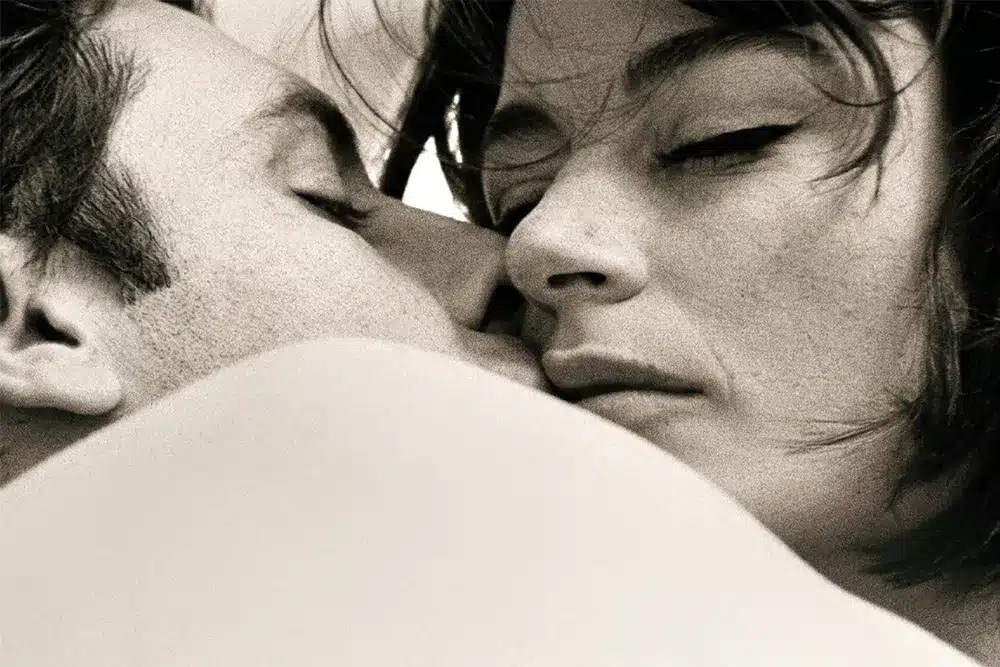
The climactic love scene illustrates this beautifully. This sequence was part of what made A Man and a Woman so famous and popular, as it still wasn’t quite standard to show couples in bed, obviously unclothed and getting busy. That remained more European than American. Visually, the approach is all close-ups on their faces, especially as Jean-Louis caresses Anne. The scene belongs to her, not only because she gets the most closeups but because in reverie she begins flashing back to her late husband, a movie stuntman who got killed on a job where she was the scriptgirl.
As these flashbacks intrude into the rather lengthy scene, the viewer realizes that, of course, Anne is making this comparison, and that she probably hasn’t made love since being widowed. These are piercing insights conveyed without words, and we understand why the moment becomes sad and sobering for Anne. Her flashbacks are in color while her present is monochrome, and the two strands dovetail in the startling moment when the man caressing her in monochrome is her late husband, resurrected and crossed over from the world of color.
Anne has realized that her husband isn’t yet dead for her, and for a while, Jean-Louis even imagines he must still be alive. This surprising culmination of the sequence sets us up for the ecstatic visual punchline, in which Lelouch either coins or perfects the cliché of the camera’s 360-degree spin around the couple as the musical theme revs into bliss.
Anne and Jean-Louis are very mid-1960s French modern. They meet because each has a small child attending a boarding school in Deauville. Anne works in the movies, and Jean-Louis is a race car driver who competes at Monte Carlo; the film crew entered the competition so they could shoot it. This need for speed was also very much of its time; John Frankenheimer released Grand Prix in the same year.
Thankfully, A Man and a Woman avoids the cliché of killing anyone in a car accident, and that was very much a thing in French films and French reality at the time. An accident figures in a flashback to explain why Jean-Louis is a widower, and there’s a fabulous montage of cars crashing and burning to illustrate the stuntwork of Anne’s late husband, so these elements help plant the foreboding possibility in our heads.
The husband is played by singer-songwriter Pierre Barouh, and he gets a song number in an early flashback. He sings a samba that, in music video fashion, jump-cuts in space and time without dropping the beat. This sequence signals that A Man and a Woman isn’t committed to realism, and then 90 percent of the film consists of what’s essentially improvised moments in which the kids invent their dialogue, and we look at misty beaches, race tracks, streets, and myriad ordinary locales.
It’s documentary impressionism. Anne and Jean-Louis have a brief dialogue about films and acting, and he wonders why people don’t take cinema seriously.
All this is very French New Wave and of its moment, although the maddeningly prolific Lelouch isn’t strongly associated with that movement. In other words, he’s not a name that critics list in their top five when discussing it, even though Lelouch is very much a personal filmmaker. He’s probably too unapologetically commercial, accessible, and bourgeois to stimulate much respect. His concerns aren’t political and social so much as romantic and aesthetic, and this too is part of his radicalism.
The planets were aligned when he caught Zeitgeist in a bottle with A Man and a Woman, a film whose success allowed him to continue for decades. His later films include a 1986 sequel, A Man and a Woman: 20 Years Later (Un homme et une femme: Vingt ans déjà), and the trilogy was completed in 2019 with The Best Years of a Life (Les plus belles années d’une vie). Unsurprisingly, Lelouch calls himself a happy man.
Criterion’s Blu-ray of A Man and a Woman is a 2K scan from the 35mm negative. It looks and sounds excellent, complete with minor bits of debris from the filming itself. Fans with the 2004 DVD might hang on to it for the curiosity of having the English dub available, since it’s not on Criterion’s disc. The excellent making-of is present along with footage from Cannes.
The most extraordinary bonus is C’était un rendez-vous (1976), a nine-minute short shot by Lelouch in a single take as he speeds recklessly across Paris, running red lights. The camera was strapped to the front of his car.