
Latin American cinema has long tried to turn political trauma into dramatic form; most recently, in A Yard of Jackals (Patio de Chacales). One of the deepest scars left across the Southern Cone in the late 20th century was the rise of military dictatorships, from Brazil in the early 1960s to Chile under Augusto Pinochet, who came to power in 1973 after the overthrow of democratically elected president Salvador Allende. What followed in Chile was one of the most violent and repressive regimes in Latin America, marked by torture and violence against political and ideological dissent.
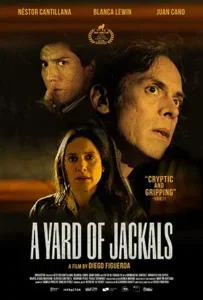
That still-open wound forms the backdrop of A Yard of Jackals, a debut feature directed, written, and edited by award-winning Chilean director Diego Figueroa. At its center is Raúl (Néstor Cantillana), a quiet Chilean man who makes miniatures while caring for his bedridden mother, Carmen (Grimanesa Jiménez). Over 108 minutes, the film lets the splinters of state violence work their way into his ordinary life.
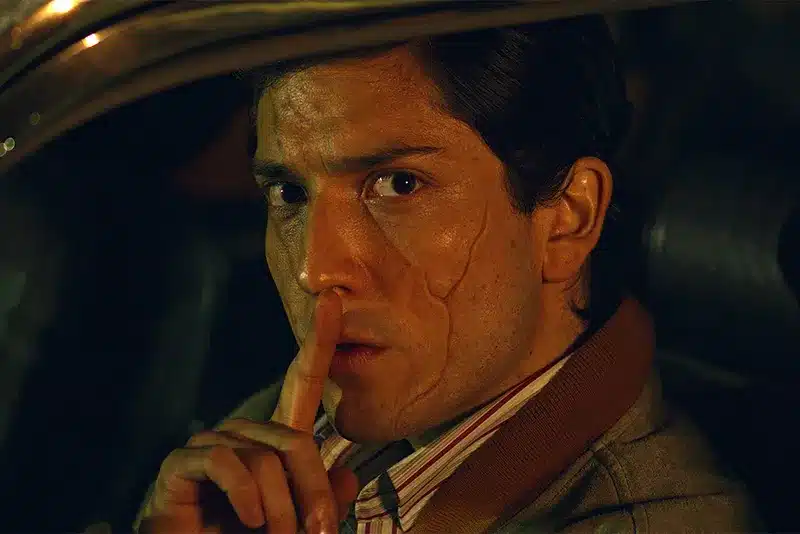
A noisy and conspicuous car arrives in the neighborhood in the middle of the night, bringing men in suits and ties. Raúl watches what is really happening from behind his curtains. The anonymous driver (Juan Cano), marked by a long, intimidating facial scar, stares at him and, with a finger over his lips, demands complete silence. A cold and confusing relationship begins there between the two men.
A Yard of Jackals tries to embrace the shape of a psychological thriller inside a film of stagnation. Its rhythm is slow, in no hurry to push the plot forward. We are drawn into Raúl’s solitude, and Cantillana gives a very strong performance inside it. The anxiety comes through restraint and precision.
Indeed, the character remains silent for much of the first act, whether caring for his mother, working at home, or listening to the radio. His often worried, wandering look communicates what the dialogue does not reveal. However well-intentioned it may be, the editing turns patience into sluggishness, and at least for the first hour, the rhythm is painfully dragged out. That pattern quickly loses its charge and begins to call for new developments, which arrive only in dribs and drabs until the film’s final act.
The sound editing keeps telling us what we are supposed to feel. If the shots remain long and empty, framed around the frugal setting of a simple house with bare walls, the sound effects belong to the world of a lurid reality show. Abrupt cuts of screeching violins to create tension and fear. Long stretches of dissonant sound to create discomfort out of absolutely nothing. It is as if we were being taken by the hand and coerced into sharing the protagonist’s miseries, without the slightest construction of a larger whole.
When strange noises begin coming from the neighboring house, Figueroa finally builds a real atmosphere. Raúl suspects that the place may be tied to covert operations by the government’s intelligence department, and, in panic, begins asking for help. Once he understands that help will not come from the police, he connects more deeply with Laura (Blanca Lewin), his platonic romantic interest, and reluctantly drags her into an investigative process that yields A Yard of Jackals‘ best scenes.
It would be difficult to find a depiction of torture scenes more visceral and, at the same time, less visually graphic than the ones offered here. Raúl and Laura begin recording the noises with a microphone capable of isolating them from the loud music that conceals torture sessions inflicted on political dissidents inside the neighboring house.
At the film’s harshest point, we are forced to hear hushed voices as the camera focuses on Raúl’s perplexed face. We see nothing, yet we can imagine in rich detail everything that is taking place. Beatings, abuse, drowning, and the use of dogs biting violently at bleeding bodies. This shock breaks A Yard of Jackals‘ sluggish rhythm and finally justifies the discomfort it had been building toward.
The photography now shifts fully into darker tones, with low lighting and a bluish palette. Sunlight is restricted to small exterior scenes, especially in the yard of the house, where, over the wall, we glimpse some of the government’s jackals next door. A Yard of Jackals never becomes truly claustrophobic because the tension only deepens once the enemy is clearly declared evil, which really happens only after more than half of the film has passed. From there, the director doubles down: less light, more gloom, more sound effects, small jump scares built out of cuts and figures watching from behind doors.
Raúl’s limp in his left leg is another detail the film insists on. Whenever danger presses in and the military threat becomes more immediate, his pain seems to worsen. In very tight close-ups, Figueroa returns to an old bullet wound on the inside of Raúl’s thigh, and the wound moves against the logic of ordinary healing. As the evidence of violence accumulates, the scar opens and starts bleeding again, turning into an unhealed wound. The parallel is not subtle: dictatorship remains a wound in the body just as it remains a wound in a people’s history.
Unfortunately, from there, everything proceeds as A Yard of Jackals has already dictated. The lack of subtlety ends up hurting an otherwise interesting experience, one that reminds us of the brutality of Chile’s years of tyranny and of the insignificance of a single ordinary man against the heavy hand of an oppressive state.