

Taking a critically acclaimed, historic composition and reconfiguring it for a seemingly anachronistic style can be tough to pull off, even, to some ears, heretical. However, for composer and pianist Aaron Wyanski, retooling the works of the prolific, groundbreaking 20th-century composer Arnold Schoenberg (1874-1951) has become something of an ongoing project, with results nothing short of stunning and deeply imaginative. Taking these unorthodox, atonal works and dropping them into the mid-century world of lounge jazz works a lot better than you would think, and the most ambitious example of this ongoing fascination may be his best work yet.
Pierrot Lunaire is Schoenberg’s 1912 interpretation of 21 poems by Albert Giraud, set in what is known as Sprechstimme, a form of speech-song in which the vowels in each word momentarily touch the indicated pitch before falling away from it. Like much 20th-century atonal compositions, Pierrot Lunaire can be a challenging listen. Composer Charles Wuorinen once compared the experience of listening to it as “befriending a porcupine”.
Another composer, George Perle, admitted that it is “not a work that one ever gets used to”. Music critic Tim Page, in his brilliant, comprehensive 1996 essay “Radical Music That Will Remain That Way”, noted that “this bizarre, arty, expressionist song cycle may not be Schoenberg’s most appealing piece, but it is certainly his most radical”.
Aaron Wyanski not only accepts the challenging approach he takes to the famous song cycle. He successfully transforms it into something decidedly different—dubbing it “Schoenberg in Hi-Fi”—while retaining the original arrangement’s odd nature and bold spirit. While Wyanski plays every note using a combination of the software platforms Logic and Pro Tools, soprano Anna Elder contributes the often difficult vocalizing. While the virtual ensembles range from small combos to big band, every single note is Schoenberg’s, except the rhythm track, which helps to put the piece in a proper mid-century sonic setting.
That rhythm track makes its first appearance right away, as the opening piece, “Mondestrunken”, starts with a roll of bongos leading into a hip-shaking Latin jazz arrangement. Elder hits all of those unusual notes perfectly, as blasts of horns egg her on. Meanwhile, “Colombine” is noisier and thicker than the usually sparser arrangements, amping up the radical atonality with clusters of organ notes and clattering percussion. The mallet percussion and sounds of water splashing on a tropical beach give “Eine Blasse Wascherin”, normally a relatively sedate chapter in earlier iterations, a bit of a tiki-lounge feel.
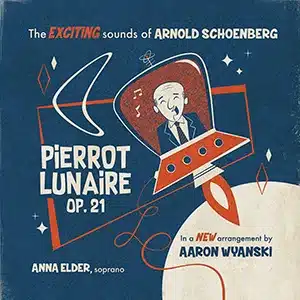
Composer Robert Carl wrote the extensive liner notes for the record (which also includes beautiful, period-appropriate artwork from Cyn Barrera, which shows Schoenberg being shot into outer space). He explains that Wyanski “decided to create an alternative history working from a few salient facts”, calling the project something of a “re-composition” of Pierrot Lunaire.
Wyanski, on the other hand, refers to himself as a “speculative musicologist”. Elder is given the daunting task of singing these pieces, which are already challenging in their original form, and transforming them into another time and place. Other highlights include “Der Kranke Mond”, originally executed as a duet between vocal and flute, and is given a lively jazz feel that combines Elder’s voice with percussion and acoustic bass. “Enthauptung” is also heavily influenced by jazz big bands before it settles into a lo-fi instrumental epilogue.
Aaron Wyanski and Anna Elder have given fans of Pierrot Lunaire an opportunity to sample this iconic composition in a completely different form, which may annoy unshakable purists. Still, it will more than likely please open-minded fans of 20th-century classical music who are aching to hear a new interpretation of a song cycle written more than a century ago. Those who are new to the piece will likely rush to find recordings of older, more traditional arrangements. Either way, this new recording of Pierrot Lunaire is a fresh, bold execution of one of classical music’s most revered and accomplished compositions.