
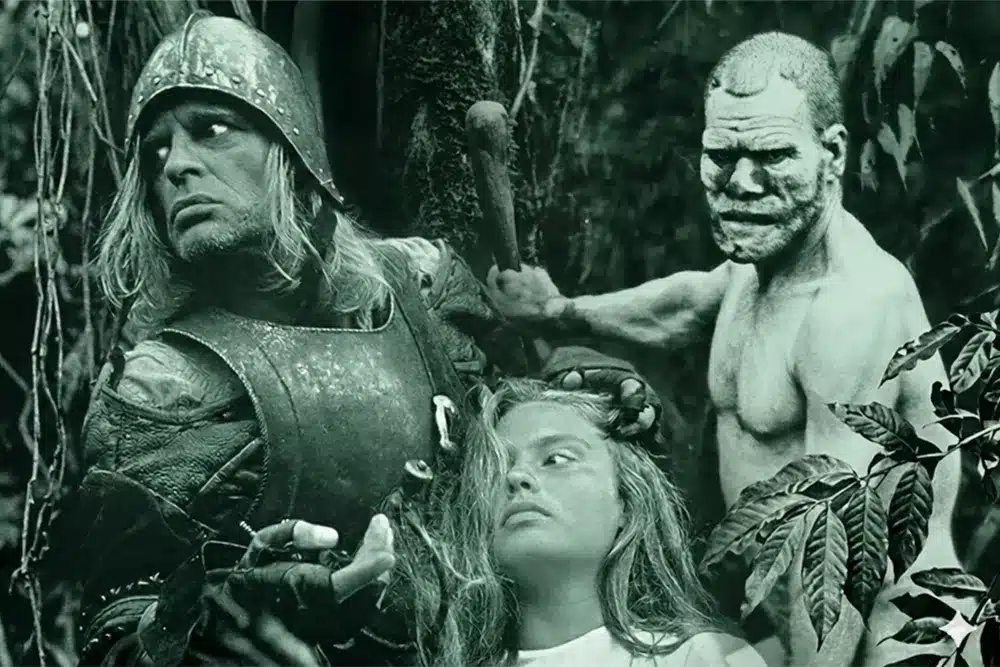
Both Aguirre, the Wrath of God (1972) and Cannibal Holocaust (1980) plunge audiences deep into the Amazon rainforest, but what we see there is viewed through radically different lenses. Though Werner Herzog and Ruggero Deodato approach the jungle with contrasting styles and intentions, both films interrogate human obsession, cultural intrusion, and the ethical limits of survival and storytelling.
Werner Herzog’s Aguirre, the Wrath of God follows Spanish conquistadors led by the fanatical Don Lope de Aguirre, vividly portrayed by Klaus Kinski. Kinski’s performance alternates between chilling calm and unhinged intensity, capturing Aguirre’s descent into madness and his obsession with El Dorado. The film’s haunting atmosphere emerges through long, lingering shots of the Amazon’s oppressive vastness, accompanied by a hypnotic, minimalist score that underscores the expedition’s fatalistic journey.
In contrast, Ruggero Deodato’s Cannibal Holocaust depicts a group of Western documentary filmmakers who disappear in the Amazon while filming indigenous tribes. When a rescue team discovers their lost footage, it reveals shocking acts of violence, both staged and real, alongside the crew’s exploitation of local people. The found-footage style blurs reality and fiction, critiquing cultural imperialism, voyeurism, and the ethical boundaries of media and human curiosity.
Both films center on encounters with indigenous peoples, though in radically different ways. In Aguirre, the Wrath of God, the natives are largely unseen yet deadly: the conquistadors are killed in offscreen attacks as they’re defending their land against intrusion. This offscreen menace emphasizes the fragility of the conquistadors’ control and the consequences of imperial overreach.
Cannibal Holocaust, by contrast, places these encounters front and center, making indigenous retaliation explicit and visceral. While Herzog heightens tension through suggestion, Deodato shocks viewers with the physical and moral consequences of intrusion.
Both productions faced grueling conditions in the jungle—unbearable heat, disease, and logistical challenges tested cast and crew. Herzog’s team endured the wilderness with minimal resources, which translated into immersive performances and breathtaking imagery that capture the jungle’s overwhelming presence.
Similarly, Deodato’s shoot pushed ethical and physical boundaries, with actors and crew frequently in dangerous situations to achieve realism. These hardships bleed into the films, lending an uneasy, lived-in authenticity to their portrayals of survival in hostile environments.
Violence toward animals underscores contrasting thematic approaches. In Aguirre, the Wrath of God, one iconic scene shows Aguirre calmly tossing a terrified monkey into the river. This quiet cruelty highlights his detachment from morality and nature, symbolizing both his descent into madness and the human cost of imperial ambition.
In Cannibal Holocaust, the killing of a pig is graphic and immediate, emphasizing human dominion and exploitation. In Herzog, the act is meditative and symbolic; in Deodato, it is confrontational, reinforcing ethical and emotional stakes.
In Aguirre, the Wrath of God, the Amazon River functions as a force of danger and uncertainty. The expedition faces wild rapids that threaten to destroy their rafts, forcing constant rebuilding and testing their resolve. The river mirrors the men’s unraveling ambition, carrying them deeper into chaos and emphasizing nature’s dominance over human plans.
In Cannibal Holocaust, the river primarily serves as a backdrop, framing travel, encounters, and violence along its banks. In both films, waterways remind viewers that humans are subject to nature’s currents—unpredictable, unforgiving, and ever-present.
Both films, in their own ways, center the perspective of indigenous peoples confronting outsiders. In Aguirre, the Wrath of God, the natives are largely unseen but deadly, defending their land against 16th-century conquistadors, a representation of centuries of imperial intrusion. Their presence, felt through offscreen attacks, underscores the consequences of colonial ambition and the fragility of foreign control.
Cannibal Holocaust, set in the 20th century, foregrounds indigenous retaliation more explicitly. The tribes assert agency against modern Western intruders, punishing exploitation and cruelty. Together, the films suggest a continuity: whether in historical conquest or contemporary intrusion, the Amazon’s inhabitants resist domination, asserting the ethical and moral power of local communities in the face of foreign greed.
Popol Vuh’s score for Aguirre, the Wrath of God is haunting and minimalist, enhancing the film’s dreamlike, fatalistic tone, evoking the slow decay of sanity during the expedition. In contrast, Cannibal Holocaust opens with a surprisingly gentle and melodic theme by Riz Ortolani, a haunting counterpoint to the savage violence that follows. This ironic contrast highlights the film’s critique of sensationalism, juxtaposing beauty and horror to unsettle viewers.
Imagining a switch of the films’ soundtracks illuminates how music shapes perception. If Aguirre, the Wrath of God were scored with Riz Ortolani’s gentle, melodic theme from Cannibal Holocaust, the expedition’s descent into madness might feel eerily calm or surreal, heightening the absurdity of Aguirre’s obsession through contrast. Conversely, if Cannibal Holocaust were accompanied by Herzog’s minimalist, hypnotic score, the violence could read as colder, more ritualistic, and meditative, emphasizing the inevitability of exploitation rather than mere shock.
A deeper parallel emerges when considering the filmmakers themselves. Herzog, both a narrative filmmaker and documentarian, seeks what he calls “ecstatic truth”—a reality beyond literal fact, reached through careful staging and confrontation with human and natural extremes. His work blurs observation and interpretation to illuminate obsession and madness.
Deodato, by contrast, presents Cannibal Holocaust as a documentary to heighten shock and authenticity. Its handheld camerawork and “real” reactions prompted legal scrutiny upon release, as audiences believed the violence was genuine. Both approaches raise ethical questions: who has the right to record, interpret, and display suffering in the jungle?
Aguirre’s hypnotic power relies on Klaus Kinski’s performance. His portrayal is a coiled, simmering presence, moving with unnatural rigidity, eyes burning, voice low and venomous. Herzog’s volatile relationship with Kinski only deepens the film’s mythos. The character’s obsession transcends the search for El Dorado; he embodies authoritarian madness and a destructive hubris that culminates in his final, surreal declaration as “the wrath of God”, surrounded by monkeys on a drifting raft.
While Aguirre, the Wrath of God meditates on madness, colonial hubris, and the fragile hold of civilization with poetic restraint, Cannibal Holocaust confronts viewers with relentless horror and social critique. Both films present the Amazon as a space of destruction, survival, and moral reckoning.
The monkey in Aguirre, the Wrath of God symbolizes innocence lost and nature’s vulnerability, while Cannibal Holocaust foregrounds indigenous agency and violent resistance. Kinski embodies obsession and unraveling in Herzog’s vision, while Deodato’s documentary style magnifies exploitation and ethical confrontation. Together, these films offer an unsettling examination of human ambition and the fragile boundary between civilization and wilderness.