

The Future
On the sound system at my gym’s indoor pool, childrens’ swimming instructor Sam treats us to his soft-rock playlist. We hear Elton John‘s “Your Song”, the Beatles‘ “And I Love Her”, George Harrison‘s “My Sweet Lord”, Simon & Garfunkel’s “America”, Fleetwood Mac‘s “Dreams”, and other songs full of acoustic or at least analogue warmth and declared, seemingly undisguised sentiments.
I’ve been a “Dreams” devotee since 1977, but it was while swimming in that pool in the past year or so that I realized one line in the lyrics is wrong. Thunder sometimes happens when it’s not raining. Does that mean players might love you when they’re not playing? When your mind drifts along with physical and musical waves, you have the opportunity to contemplate such things. Pieces of music don’t necessarily become more significant for you, but you might hear them in new ways.
Sam came to love these pieces of music and others decades ago, by osmosis, when his older brother returned to their New York City home from college and played records he’d been introduced to there. Sam’s affection for his soft-rock favorites seems endless, and in terms of soft rock—as opposed to, say, contemporary R&B—he doesn’t stray from this list. To my surprise, his soft-rock playlist doesn’t include two Al Stewart songs that it repeatedly puts in my head: “Year of the Cat” and “Time Passages”.
Like “Dreams”, “Year of the Cat” and “Time Passages” encapsulate certain sounds that signal the late 1970s. For example, all of these songs feature blanketed, pattering drum beats. That percussion announces the songs’ intentions to explore consciousness, not rock anybody’s boat.
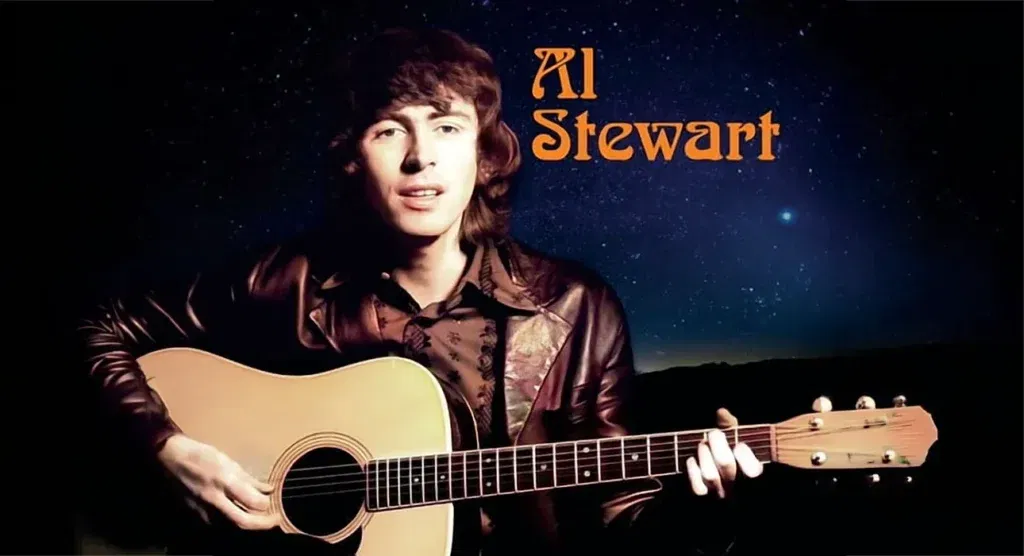
After hearing Sam’s soft-rock playlist for many months, I asked Sam if he’d ever checked out Al Stewart, and he hadn’t. Somehow, he’d lived these past five decades without knowing even Stewart‘s two big hits, soft-rock classics that were inescapable in their day, still get played over retail-store speakers, and no doubt are streaming somewhere right now. Sam wrote down Stewart’s name and said he’d look him up.
“‘Year of the Cat’, ‘Time Passages,’ I told him, knowing they’d be the first titles, the first bits of information, he’d discover if he plugged Al Stewart’s name into a search engine. Finally, one snowy Saturday morning, while I was swimming, Sam played “Time Passages” at the pool. I stopped at the end of the lane, near him. “Thank you, Sam”. He nodded, smiling. “Have you ever heard this?” I asked. “No”. He hated to admit it, the way New Yorkers constitutionally hate admitting they haven’t heard of something.
“It’s nice, right?” He nodded, holding out his arms and swaying to the gentle rhythm. “It makes me feel peaceful”.
“Yes”. That wouldn’t have been my word for it, but I saw Sam’s point. When “Time Passages” plays, it’s a Saturday morning in 1978 for me. I’m 13 but not yet trapped in the full-on turmoil of puberty or the existential tumult of junior high. “Nothing’s gonna change my world”, as John Lennon put it in the Beatles’ soft-rock masterpiece “Across the Universe”.
Girls will like me and recognize my worth, and this new school will become a second home like my elementary school was. Right?
The future feels formlessly full of possibility.
The Year of the Cat
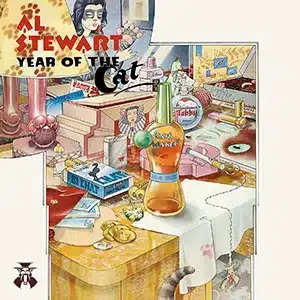
Al Stewart had been releasing folk-rock since 1967. His early albums had their charms (see his 1977 compilation, The Early Years), but he hit his stride with 1976’s Year of the Cat (hence that compilation, for the curious in his new audience). He scored a big hit with the title song of Year of the Cat, which he co-wrote with keyboardist Peter Wood. “Co-wrote” may be a euphemism, because Stewart reportedly based the music on a catchy piano pattern he heard Wood playing, even though Wood told him not to use it.
Bad, perhaps, on Stewart for appropriating that keyboard hook, though Wood played on the recording. Kudos to Stewart for giving that co-writing credit to Wood, who was pleased enough by the recording to stick around for Stewart’s next album, Time Passages.
Meanwhile, further “Year of the Cat” kudos to Stewart for lyrically drawing in his target audience, yet not talking down to outsiders, with the song’s opening reference to the classic Hollywood actor Humphrey Bogart. The song begins on “a morning from a Bogart movie / In a country where they turn back time”, as though this were a screenplay, one written by a purveyor of so-called magical realism.
Intrigued? That verbal establishing shot seems to ask. If so, listen on!
The lyrics are in second person, speaking to “you”, as “you” come “strolling through the crowd”. However, sorry, you’re not like Bogie. You’re “like Peter Lorre”. When’s the last time that Bogart’s contemporary, Peter Lorre, was mentioned in a song? Even if you don’t recognize the name, you might know who Lorre was. Think of the odd, bug-eyed character in Casablanca, who, as the police are dragging him off, shrieks at Bogie’s character, Rick: “Help me!… Hide me! Do something! You must help me!”
So if you’re “like Peter Lorre”, you may be “contemplating a crime”, as the next line specifies, but you’re just a petty crook, a sweating struggler, a cranky outlier, not the cool, collected romantic hero. Your fate will be somewhat out of your control, not as adroitly handled as Bogie’s would be.
Why is that? “It’s the year of the cat”. That phrase explains everything that happens in this song. “Don’t bother asking for explanations”. In a place where a “bus” would have brought “tourists”—one of whom might have been “you”, though the singer doesn’t say that—you encounter a mysterious woman (a manic pixie dream girl?), “in incense and patchouli”, “in a silk dress / Running like a watercolor in the rain”, who “locks up your arm in hers” and leads you to “a hidden door”. You both pass through that door, then spend the night together. As a result of this (small?) journey (within a journey?), “you’ve thrown away your choice and lost your ticket / So you have to stay on.”
In conclusion, “You know sometime you’re bound to leave her / But for now, you’re gonna stay / In the year of the cat.” The album cover, which depicts a woman in a cat costume, suggests that at least one meaning of “the cat” is the lyrics’ unnamed woman, a character who has adopted a persona.
The above summary moves much more quickly than the song, which takes its time–after all, it happens “in a country that takes back time”. The music of “Year of the Cat” has that blanketed, pattering drum sound, plus thumping bass and strummed acoustic guitar. Acoustic piano delivers that evocative arpeggiated riff. An acoustic guitar solo feeds into an electric guitar solo, which feeds into a saxophone solo. Over top is an ambitious but not overly busy string arrangement, the aural equivalent of artful cinematography. (The musical team is too extensive to name here; please see the album’s credits, which are included on its Wikipedia page.)
The rest of the record offers variations on that musical approach, with electric piano here, violin there. Al Stewart’s historically or faux-historically informed narratives benefit from catchy enough melodies and Stewart’s perfectly clear vocals. If he didn’t enunciate his lyrics so carefully, the light-folk-rock backing would labor to no purpose. Still, the title track comes last because most of Year of the Cat doesn’t catch the ear quite so beguilingly. “Broadway Hotel” and “One Stage Before”, the two songs that precede it, come close, as Side Two builds momentum. You don’t struggle to enjoy any of Stewart’s songs, but you anticipate that final movie of the mind.
What, ultimately, does “Year of the Cat” add up to? It’s a romantic adventure with mystical overtones. You sink into its atmosphere, and that not only suffices but provides deep pleasure. The music and lyrics work hard to induce something like synaesthesia, where nonaural sensations arise in response to sounds. The Eagles’ soft-rock masterpiece “Hotel California” (1976) works like this, where even when you know what narrative turns and combinations of syllables, notes, and textures to anticipate, you still thrill when your favorite bits arrive. Like the person being addressed in “Year of the Cat” you know you’ll have to leave this scenario when the song ends, but in the meantime you’re perfectly happy. After all, it’s the year of the cat.
Fair enough, but that narrative’s underlying threat comes from time. Perfect happiness will yield to time’s passage. In that sense, Al Stewart’s next hit, “Time Passages”, represents a thematic sequel to “Year of the Cat”. All things—years, relationships, experiences—must pass, and at best we’re left looking back, whether in memory or chronicle.
The Past
For 1978’s Time Passages and its title song, Al Stewart clearly tried to duplicate the success of his commercial breakthrough. With just a little less tweaking, “Time Passages” might have been seen as just a rewrite of “Year of the Cat”. However, Stewart and the producer and engineer of both albums, Alan Parsons, retained most of the musical team from Year of the Cat but changed the formula just enough that the follow-up stands on its own.
As satisfyingly atmospheric as “Year of the Cat” is, “Time Passages” has the edge. Like The Godfather Part II (1974) or Before Sunset (2004), it’s that rare sequel that betters the original. How so? Partly it’s that “Time Passages” aims its multiple hooks so committedly at the charts. Stewart even more shamelessly panders on Time Passages‘ “Song on the Radio” (“You’re on my mind / Like a song on the radio,” he sings), but there the tacit shout-out to DJs and programmers distances the listener, whereas “Time Passages” provides a direct line into the brain and especially into the memory.
As on the Time Passages album (where, incidentally, every song’s a winner—it’s a perfect album), Al Stewart and Parsons shift the sonics from the suggestions of folk music, with its inherent warmth, to an icier sheen. One of Parsons’ major achievements was engineering a little-known masterpiece of pristine proto-sheen, Pink Floyd‘s Dark Side of the Moon (1973). So-called yacht rockers of the late 1970s were loving icy sheen, which might have reached its apotheosis on Boz Scaggs’ fascinatingly frigid Down Two Then Left (1977).
In any case, the 1980s were near, and, as in Game of Thrones, winter was coming. Al Stewart actually started the 1980s by eschewing sheen and rocking out, comparatively speaking, on his 24 Carrots album, but meanwhile, back in 1978…
In “Time Passages”, instead of an arpeggiated acoustic piano or strummed acoustic guitar, an unmistakably electric keyboard ushers in a good-timey groove with just a bit more bounce than “Year of the Cat” has. This groove might not make you feel like dancing, but you might lift your arms and sway the way Sam did at the gym the first time he heard it.
Brief electric-guitar licks and saxophone accents foreshadow a Spanish-guitar-inflected acoustic-guitar solo, which leads to a sax solo that, like the soaring strings, might be exploring the wide-open sky shown on the album cover or might be reflecting the singer’s untroubled state. We know now that this sax part, like the one in “Year of the Cat”, the one in Gerry Rafferty’s “Baker Street” (1978), the one in Bruce Springsteen‘s “Badlands” (1978), and so on, ushers in so many such excursions in 1980s pop and pop-rock, to the point that the “’80s sax solo” is a cliche, but in 1978 the solo in “Time Passages” still sounded fresh and inventive. (Again, please see the album or Wikipedia for the musicians’ credits.)
“Time Passages” would more obviously follow up on “Year of the Cat” if it were in second person as well. Instead, it’s the first-person recounting of an unidentified person who could be the “you” addressed in “Year of the Cat”. Time has gone by, and he feels wistful. After all, “It was late in December, the sky turned to snow”, and those conditions naturally lead one to reflection. “I felt the beat of my mind go / Drifting into time passages”. At the risk of overinflating the observation, I’ll venture to say that Al Stewart’s reaching to deliver the notes on the title phrase gives the song a winning weakness. The melody must go to that place, but the singer can’t quite, and the disparity coincides with the slight struggles in the lyrics, like the visual ripples in the album’s otherwise crystalline cover photo.
At this point, our first-person narrator doesn’t refer back to the events of “Year of the Cat”. However, in the singer’s consciousness, “Years go falling in the fading light”. Perhaps they’re falling like the pages of a calendar in an old Hollywood movie. In any case, years have passed. We don’t know when in time the singer is situated—December of what year, the year of what—but if this song is a sequel to “Year of the Cat”, then it’s presumably not that year. It could be the very end of that year, but the degree of pastness on the singer’s mind suggests he’s looking further back. Suddenly, in talking to himself, the singer shifts into second person: “There’s something back here that you left behind…”
“…In the year of the cat”. No, he doesn’t sing that phrase. That reference would be too obvious for Al Stewart’s purposes, cheapening his vision. Instead, he, the narrator, sings, “Oh time passages / Buy me a ticket on the last train home tonight”.
Just as the phrase “year of the cat” remains undefined and therefore can serve as a period of time, a kind of place, a state of mind, what have you—its Asian astrological significance having no real weight here—so “time passages” can be transitions, tunnels, or even sections of writing. Are “time passages” symbolically buying that ticket, or is he speaking to himself? In either case, recall that the “you” in “Year of the Cat” has lost “your ticket” and so temporarily had to stay put. Here, that “last train home” the singer envisions is so open-ended, concrete yet free-floatingly metaphorical, it solidifies the song’s resonance.
The song remains in second person until near the end. In the next few lines, “you hear the echoes” of the past and “feel yourself starting to turn”. The singer’s changing, but we don’t know from what to what. We might connect it with the lines in “Year of the Cat” about staying “for now”, though “you’re bound to leave her”. When the turn comes, in other words, the singer—let’s say the singer in both songs—has a different perspective and makes a move or is inspired to move. “Don’t know why you should feel,” he tells himself in “Time Passages”, “That there’s something to learn.”
“Ah, yes, I need to move on for the sake of my growth,” we might imagine him thinking. “I have something to learn.”
The singer undercuts his hint of self-importance with the self-critique of the next line: “It’s just a game that you play.” He’s not calling himself a total loser, nor is he flippantly congratulating himself for winning some mental/psychological game. Stewart sophisticatedly acknowledges a reality without offering an unnecessary condemnation. Call his train of thought navel-gazing, but it might be summoning wisdom.
Now back to concrete details, because “the picture is changing”. Just as at the start of “Year of the Cat”, the person was “strolling through the crowd”, the person in “Time Passages” is now “part of a crowd”. When “A girl comes towards you / You once used to know”, it’s easy to see her as “in incense and patchouli”, “in a silk dress / Running like a watercolor in the rain”, just as the woman in “Year of the Cat” first appeared.
This time, though, “You reach out your hand” instead of having her “[lock] up your arm in hers”, as she did in that feline year. Forget the happy ending, however qualified. “You’re all alone, in those / Time passages”.
Remember her? You stayed with her for a while, but then you left. If you see her now, it’s only in memory or imagination.
The lyrics shift back to first person: “I know you’re in there / You’re just out of sight.” What is? This “you” could be some version of himself, or of her, or of yet another person. It could be anyone or anything. These lines might acknowledge that bits of the past remain in us even if we think they’re lost or don’t recognize their current forms. Alternatively, these lines could be wishful, not just wistful, thinking. The final beauty of “Time Passages” is that it doesn’t declare definitively, even when the singer seems to be stating his truths. Maybe he’s just thinking. Maybe all he really has or can know is the “last train home”.
If on “Time Passages”, Al Stewart went over ground he went over in “Year of the Cat”, he did so because he wasn’t finished with that territory. “Year of the Cat” needed its sequel to feel complete.
Going from “Year of the Cat” to “Time Passages”—continuing the saga, sort of—means journeying from innocence to experience, adolescence to maturity, the exotic to the philosophical. The “last train home” wraps up the journey. Presumably it’s the final passage. There’s still time for Al Stewart to deliver “Year of the Cat Part III: Time Passages in the Afterlife”.