
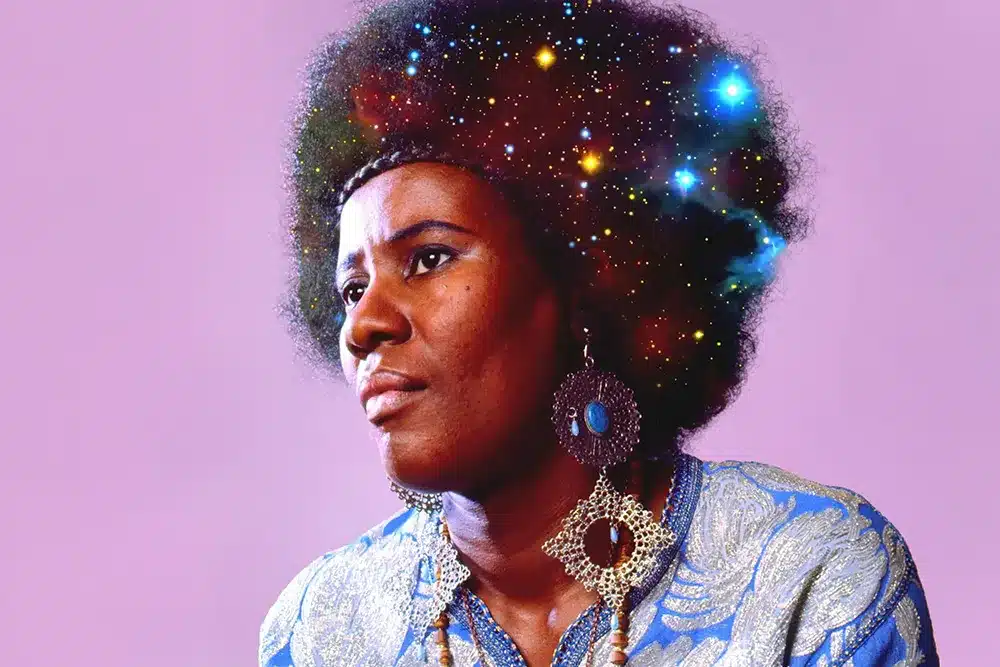

Alice Coltrane was far more than the critically underrated pianist in the fiercely free, later-day quartet of her legendary saxophonist husband, John Coltrane. She was a true musical visionary. She mastered not only the piano in styles ranging from classical to bebop to free jazz but also the harp and organ.
Later in her career, she demonstrated a singular talent as an arranger, conjuring majestic, otherworldly sounds from an orchestra. These became the centerpieces of many of her celestial solo recordings, including 1971’s Journey to Satchidananda, which foreshadowed New Age and Ambient music and continues to influence contemporary artists such as Björk and Radiohead.
Alice Coltrane was a feminist icon who raised four young sons alone after her husband’s early death, and an astute businesswoman who oversaw his vast catalog and musical legacy. Most important to her, however, may have been her status as a spiritualist. Coltrane was an unrelenting seeker whose fierce immersion in Eastern religions led her to become a spiritual teacher herself, Swamini Turiyasangitananda (Turiya, for short), a truly inspirational figure who guided many others to the light at the ashram she founded in California.
Now, veteran music journalist Andy Beta profiles the many sides of this woman in Cosmic Music: The Life, Art, and Transcendence of Alice Coltrane. Beta’s latest is the first full-length biography of this forever-forward-thinking and often misunderstood musician. It has two distinct yet unified missions: to uncover lesser-known facts about her early life and multifaceted musical career after her time with her jazz-giant husband, and to provide an in-depth view of her equally profound spiritual journey.
Alice McLeod was born in 1937 in Detroit, one of America’s most musically rich communities. She followed her mother’s lead, becoming a keyboardist and choir leader at the local Baptist church, where she developed a love of Gospel music that would infuse her work throughout her life.
Coltrane came of age alongside neighbors such as Motown’s Berry Gordy and Aretha Franklin and found her footing in jazz alongside other Detroiters, including Barry Harris (who dated her sister), Yusef Lateef, Kenny Burrell, Benny Maupin, Elvin and Thad Jones, her bassist half-brother Ernie Farrow, and her NYC roommate and collaborator-to-be, Joe Henderson.
Terry Pollard may have been Alice Coltrane’s greatest influence. This pioneering female bebop pianist gifted her first home piano and secured her first major professional gig, replacing Pollard in the band of acclaimed vibraphonist Terry Gibbs.
Beta’s discussion of her youth in Detroit details not only these influences but also other forces that shaped her. These included the vibrant club scene in the legendary, now-lost Black Bottom neighborhood and the houses (not tiny apartments) of Detroit’s black middle class, where Coltrane and her fellow jazzers apprenticed until all hours. There was also the emotional impact of so-called “urban renewal”, when communities like hers were bulldozed to make way for freeways, and the riots this social calamity generated.
Beta also discusses Alice’s first out-of-body experiences and astral projection at age nine. These experiences would persist throughout her life: mystical moments and communications that would shape her music and life decisions, continuing through her death in 2007.
Naturally, Alice’s time with John is an important part of the story, but it is far from the bulk of what Beta imparts. After a brief period (and marriage) in Paris with vocalist Kenneth Hagood, she meets John, whom she had admired since his album Africa Brass at Birdland in New York in 1963, where he serenades her with the song “Always”. The two would marry in 1965, and Alice would be happy just being a wife and young mother until she was asked to replace pianist McCoy Tyner in his group in late 1966.
Alice Coltrane’s “wonderfully idiosyncratic” yet rarely praised piano work would feature prominently in many of his final, very free recordings, including the 1973 album Live in Japan. Importantly, Beta surmises that John’s legendary “A Love Supreme”, written in September 1964, was not only a “hymn to God” but also a hymn to his new love, Alice.
John’s death in July 1967 would have a profound impact, creating initial depression, hallucinations, and drastic weight loss that almost broke her. Alice was left with four children to raise – the youngest only four months old – and his vast archive of past and future recordings to manage. “Though they had known each other only four years, Alice believed they were two spirits united over eons,” writes Beta.
Alice’s solo career was fostered by two things from John. The first was his gift of a Lyon & Healy harp, which arrived mere days after his death. “John was nowhere in the world but appeared to manifest in the form of the magnificent harp,” said Alice. It became a key element in “carrying on his quest for cosmic music.”
Coltrane’s home in suburban Dix Hills, Long Island, had a recording studio in the basement, which Alice completed shortly after John’s death. On late nights, after her kids were put to bed, she would compose, study the harp and the art of production, and craft five of her early albums, including her 1968 debut, A Monastic Trio, and 1971’s Journey to Satchidananda, one of her very best. For Alice, “the piano is the sunrise, the harp is the sunset.”
Alice’s musical and spiritual journey was shaped by tapasya – a Sanskrit word for the intense spiritual discipline designed to purify the mind and body. She would fast, meditate for 20 hours a day, and experience hallucinations and astral visits from John, who would guide not only her music but also the release of his posthumous works.
Months after his death, she would also receive a visitation from Igor Stravinsky, which led her to record his “Firebird Suite”. Like Laura Nyro and the Rascals’ Felix Cavaliere, she would be a fervent disciple of Swami Satchidananda and begin frequent pilgrimages to India.
The final chapters of Alice Coltrane’s musical life are, in many ways, inseparable from her deepening spiritual quest. With later albums like 1972’s World Galaxy and 1977’s Transcendence, her music became more orchestral, Eastern-flavored, and infused with the Gospel music of her youth, and it was better received by critics. These albums were also made more searing by her deployment of a Wurlitzer Organ, which she believed carried the spirit and tonality of her late husband’s sax improvisations.
Illuminations, her 1974 collaboration with Carlos Santana, came about, in part, when the guitarist saw “John holding two ice cream cones while in deep meditation.” Some consider the harp and percussion solo, “Vrindavana Sanchara”, from Transcendence another important precursor to New Age sounds.
In the late 1970s, music would take a back seat to spiritualism when she founded the Vedantic Center for the study of Eastern philosophy after relocating to California. In 1982, she purchased 82 acres in the Santa Monica Mountains and founded the Sai Anantam Ashram.
The author provides an in-depth exploration of Alice Coltrane’s journey into Eastern religions, especially in the book’s later sections, making it an essential read for devotees of both music and spirituality. Beta tells how her travels to India led to her discovery of bhajans, Hindu devotional songs that elevate and calm the mind and soul. These would become her musical passion, captured in the wonderful solo organ-and-vocal album Turiya Sings (2021) and in recordings made with groups during her weekend devotions at her ashram.
They were first released on cassette tapes in bookshops and are now available in two collections: World Spirituality Classics: The Ecstatic Music of Alice Coltrane (2017). Coltrane even brought her devotional music and readings to television via a 20+ episode public television show in the mid-1980s, Eternity’s Pillow. Four of these episodes are available today on the Criterion Channel.
Andy Beta has done a tremendous job of capturing the life and impact of this remarkable woman. Alice Coltrane is a musician who, in some ways, is a true equal to her legendary husband. She is also an important spiritual figure whose messages continue to resonate with new generations of open-hearted seekers and music lovers.