
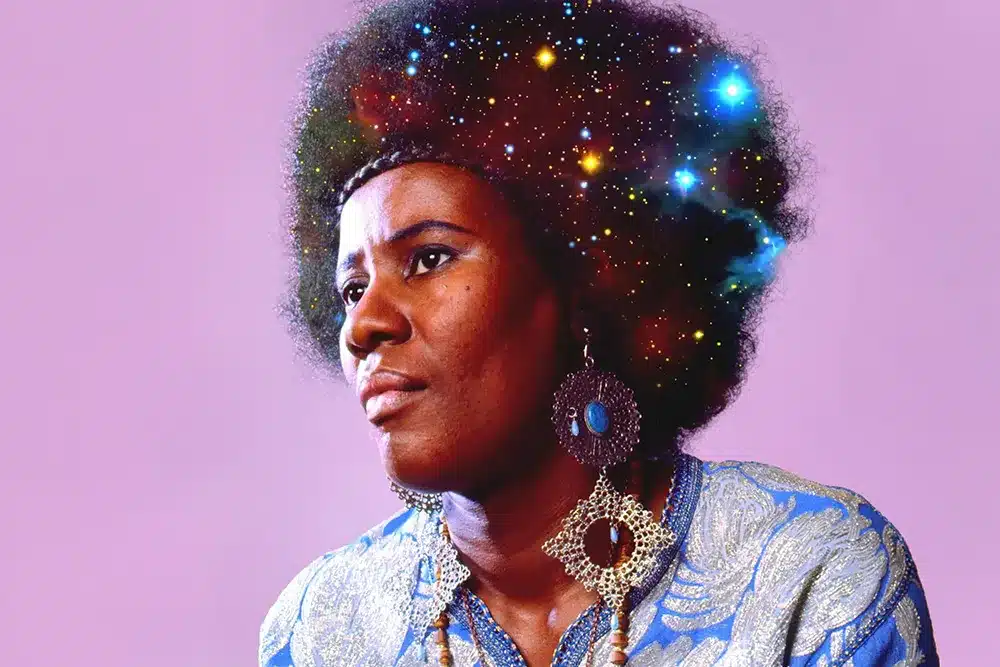

Alice Coltrane’s 1971 album Journey in Satchidananda is among the most acclaimed free jazz albums. Upon its release, the influential jazz journal Down Beat proclaimed it to be “sacred jazz of the highest order.” Coltrane pushed even beyond what many of the most adventurous performers of the fusion era imagined, inspired by her studies of Hinduism with Swami Satchidananda.
When I first heard Journey in Satchidananda, it struck me as a remarkably accessible musical experiment. Alice Coltrane’s piano playing draws deeply from her formative musical education playing gospel music in church. Her swirling piano flows serenely next to the celestial flourishes of Coltrane’s second instrument, the harp. Cecil McBee’s sonorous, cyclical upright bass lines anchor the music in the familiar, while the drifting, droning tanpura played by Tulsi Sen Gupta opens new possibilities.
More typically, the jazz press was less enamoured of the avant-garde, with one critic lamenting much of Coltrane’s music as “overblown, simplistically exotic and stagnant”. Pitchfork journalist Andy Beta’s new biography of Coltrane, Cosmic Music, therefore sets out to right the historical record, drawing heavily from more recent interviews with Coltrane’s surviving children, bandmates, and spiritual followers. My reading is that an appreciation of the resilience and calm that powered Coltrane’s music is key to appreciating her life story.
Alice Coltrane was born Alice McLeod in Detroit in 1937, into a family that was both musical and devout. She was 20 years old when, in 1957, a family friend, Berry Gordy Jr., co-wrote the song “Reet Petite” with Jackie Wilson. In 1959, Gordy would establish Motown Records, arguably Detroit’s most famous musical brand. At its peak, Detroit’s jazz scene was as vibrant as its pop music and its automobile industry. Great jazz musicians such as Donald Byrd and Kenny Burrell were educated at the city’s Cass Technical High School.
Miles Davis frequently performed in the city, and first poached Paul Chambers, then Ron Carter, to anchor his two great quintets. As a recording artist, Alice Coltrane never crossed paths with Miles Davis. Yet, as he was arguably the singularly most famous jazz musician and an acerbic cultural commentator, the early chapters of Cosmic Music call frequently upon Davis’ thoughts to illustrate everything from the quality of Detroit’s musicians to the quality of its dope.
While Detroit’s musical community was the envy of America, the city at large was not entirely at peace. Beta’s account of Coltrane’s early years is bookended firstly by the 1943 Detroit race riot, and secondly by the demolition of the Black Bottom neighbourhood where her family lived, which was cleared to make way for the construction of the I-375 highway. These destructive incidents and others colour the biography, culminating in the 2008 Universal Studios fire, which occurred one year after Alice Coltrane’s death and destroyed many recordings in the Universal Music Group catalogue, including those from Impulse! Records.
Cosmic Music evokes these powerful events to support its theme of how Alice Coltrane drew resilience and calm through her spiritual growth, rising above the conflicts and upheavals she witnessed and endured. From an early age, she experienced astral projections as out-of-body experiences. Yet reading the first such account in Cosmic Music, that she would wake up “in an unfamiliar room or landscape, far from home,” comes as quite a violent shock amidst the details of urban unrest happening around her.
After living as a working musician in Europe during the 1950s and after a brief first marriage, she met John Coltrane in 1962, who became her second husband in 1965. A key motive of Cosmic Music is to shed light on Alice Coltrane’s life and art that have been obscured by John Coltrane’s gigantic legacy. As perhaps the second most famous jazz musician after Miles Davis, it is understandable that the book’s second section expends a great amount of energy detailing John’s musical activities in the period between 1962 and his death in 1967.
As a counterbalance to this potential pitfall, Beta argues that Alice Coltrane was a dedicated domestic partner and mother to their three children, and a crucial influence on John Coltrane’s musical and spiritual growth. This argument is substantiated by the recollections of musicians who collaborated with both Coltranes, such as saxophonist Pharoah Sanders. In 1966 and 1967, Alice replaced McCoy Tyner as the pianist in John’s band, recording two albums released before his death, and more besides.
After an intensive period of mourning and meditation, from 1968 to 1978, Alice Coltrane was at her most active as a recording musician. At this time, she led several spiritual jazz groups. She collaborated with Carlos Santana on his own spiritual quest, which exposed her to a rock audience, not for the final time in her life. Additionally, she released several of John Coltrane’s posthumous recordings, which were embellished with unorthodox instrumentation at the Coltrane family’s home studio.
I was surprised by the description of the Coltrane family’s wealth earned from John Coltrane’s success with Impulse! Records, which became known as “the house that ‘Trane built”. Wealth and jazz music do not go together in the public imagination. Alice Coltrane, however, was sharp at business and adept at managing John Coltrane’s archive, which she carefully stewarded and channelled into furthering her musical and spiritual causes. Yet also, the Coltrane family owned stables and several horses, and the rhythm of their gait was an additional inspiration for her performance.
Within online communities such as Rate Your Music, Alice Coltrane’s spiritual jazz albums continue to hold near-canonical status, suggesting that her achievements have not been wholly obscured by her decades-long withdrawal from the music industry or by the immense gravitational pull of John Coltrane’s reputation. Rather than rescuing a forgotten figure, Cosmic Music enlarges the frame through which she is seen.
In Detroit’s musical heritage, in her spiritual visions, in her partnership with John Coltrane, and in her careful stewardship of his legacy, Alice Coltrane appears not as a marginal figure eclipsed by history, but as an artist whose life and music were animated by a consistent pursuit of spiritual equilibrium. If the book occasionally risks reproducing the shadow it seeks to dispel, it nonetheless succeeds in clarifying the depth of her authorship, not only of recordings, but of a spiritual and familial legacy. In that sense, Cosmic Music does not restore Alice Coltrane to history; it reveals that she was shaping it all along.