
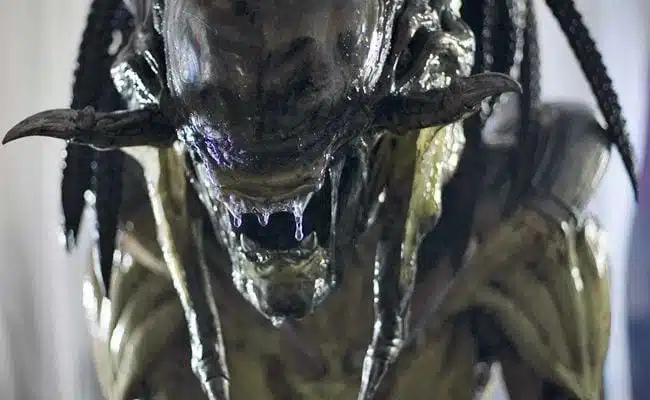
In the pages of The Next Reel we take an informative (if oft irreverent) look at film history, focusing on the linkages between movies (that go far beyond sequels and remakes) and the evolution of film and filmed stories.
Case in point, our November 2012 column, “Building the Perfect Star Beast: The Antecedents of ‘Alien‘“, discussed the amazing filmic lineage that led to Ridley Scott’s Alien (1979), one of the best films of all time, whether you call it Science Fiction, Horror, Art Film, the best Haunted House movie of all time, or if you side with the many that claim that Alien transcends genre. This diversity has a lot to do with the many mixed parents that eventually gave birth to Alien. As co-author Dan O’Bannon put it, “I didn’t steal Alien from anybody. I stole it from everybody!”
Alien’s legacy was further secured when a Canadian former truck driver broke into B-movies and did the impossible. James Cameron wrote and directed the 1986 sequel Aliens, which carried the franchise forward (without repeating the first film) and earned comparable critical praise and incredible box office success. Aliens is one of the few films in the Action, Horror, or Science Fiction genre to earn its lead an Oscar Nomination.
Sigourney Weaver was nominated for Best Actress (one of her three Oscar nominations) at the 1987 Academy Awards for playing Ellen Ripley, a character also credited with redefining gender roles and breaking the glass ceiling in believable action-heroine roles.
Backed by Weaver’s excellent acting, Ripley becomes a feminist role model. Her character is undeniably feminine, motherly to the young girl Newt (Carrie Henn), and, like all the characters, she is terrified and vulnerable when surrounded by the threat of the title star beasts. However, it’s also Ripley, who takes charge, saves lives, comes up with the best plans, and believably evolves into the heroine the story requires to move forward.
Aliens became a milestone in storytelling, sequel-making, gender roles, recognition… and so much more. With Aliens in place, the legacy of Alien seemed to be impossible to tarnish.
And for the next six years, that was absolutely true.
Behind the scenes 20th Century Fox could barely hold its xenomorphic horses before getting another sequel out. Brandywine Productions (the company behind the first two films) was commissioned to create a third iconic film for the franchise. Producers David Giler, Walter Hill and Gordon Carroll had a tall order on their hands. They wanted to replicate the critical and commercial successes of Aliens by doing what Aliens had done. However, what Aliens did was to further the saga without becoming a repeat of Alien. Thus the producers found themselves having to replicate without repetition.
The initial ideas for Alien 3 (1992) were cerebral and introspective and seemed to prove that they were going swiftly in the right direction. The plan was to formulate a two-part story to span the third and fourth films (to be shot back-to-back). The villains would, again, be less the title Aliens and more the duplicitous and money hungry Weyland-Yutani company, whose next high-profit goal is to use the Xenomorphs as biological weapons.
Aliens’ Corporal Hicks (Michael Biehn) would be the lead of the third film, with Weaver’s Ripley appearing in a cameo. Weaver would then take the lead in the fourth film. Ultimately, the Company would face off against a group of expatriated and militaristic Earth people who would mass-produce the dangerous Aliens for their epic battle against the greedy Company. Weaver agreed to the cameo because she liked the Cold War parallels and soon Fox was negotiating for her return as well as that of Ridley Scott.
Anyone who has actually watched Alien 3 knows well that this is not the movie we ultimately got and the fourth film in the saga doesn’t resemble this planned fourth story in any way.
Then again, anyone familiar with Ridley Scott’s career knows that the director was not exactly “available”, with films like Black Rain (1989) and most notably Thelma and Louise (1991) already in the works during the aftermath of Cameron’s Aliens.
William Gibson, the famed Cyberpunk author, was available and quickly expanded Giler and Hill’s treatment into a “Marxist Space Empire” story, deeply aware that a Writers Guild strike was looming. Gibson’s screenplay picked up right where Aliens left off, with Newt, Hicks, Ripley, and the remnants of the android Bishop (Lance Henriksen) still floating unconscious in their sleep chambers. Once the Union of Progressive Peoples (or U.P.P., the aforementioned militant exiles) removes the hitchhiking Facehugger and Bishop, the Sulaco drifts its way to… the mall.
No, I’m not kidding. Soon, the sleeping Ripley and Hicks reach Anchorpoint, a Weyland-Yutani space-station shopping center. With Ripley in an induced coma, Hicks investigates Anchorpoint to see if the rumors of Alien production are true. Soon Hicks and the stirring Ripley must team up with the U.P.P. to battle the Company and the monsters that have found new, challenging places to incubate… such as inside what’s left of Bishop.
Gibson delivered the script on time (in December 1987) and would later jokingly describe his screenplay as “Space commies hijack alien eggs – big trouble in Mallworld”. Giler and Hill were surprisingly less kind. Although the story was fast-paced and featured the thrilling battle the treatment called for, the producers called the script “the opposite of what we expected.” Giler and Hill expected a messy screenplay with all kinds of great ideas they could use in the final product. What they got was, as Giler put it, “a competently written screenplay but not as inventive as we wanted it to be.”
The irony is that Gibson’s well-done script was too close to what Giler and Hill had described. “(I)t was our story,” Giler explained. “We had hoped he’d open up the story, but it didn’t happen.” Giler further indicated that the fault probably lay with Hill and himself, rather than Gibson
Still, they didn’t give up on the author and (as he waited patiently through the writer’s strike for word) the duo came up with their own story and production ideas. This included director Renny Harlin, who had just made a name for himself in the USA with A Nightmare on Elm Street 4: The Dream Master (1988). At the time, this wasn’t quite the strange choice it may seem today, as the sister franchise Predator would later pick up Stephen Hopkins for Predator 2 (1990) based on his work on A Nightmare on Elm Street 5: The Dream Child (1989).
After the strike ended, Giler and Hill asked Gibson to approach a rewrite with Harlin’s more divergent ideas (such as Aliens invading Earth and humans visiting the Alien homeworld). Gibson balked and walked, believing the producers had taken too long to respond and hadn’t returned any constructive feedback.
If there was any true point that the film and the future of the franchise began to break down, this was arguably it. With Gibson gone and the strike no longer an issue, Giler and Hill began to micromanage the process with story conferences and lines in the sand. Gibson’s successor Eric Red worked five weeks with a production team that (as Red described them) “didn’t know what they really wanted”.
To make matters worse, with the storyline’s change in direction, Weaver also had misgivings. So, despite Giler and Hill’s story and the Gibson screenplay as his basis, Red was forced to start completely over with new characters, new subplots, new breeds of Aliens, and absolutely no Ripley whatsoever. All the while, Harlin, Hill, and Giller were “interfering” and demanding rewrites. Flashing back to the production on Aliens, when James Cameron (who was a Hollywood newbie at the time) was ordered to turn in a screenplay without Ripley, Cameron had threatened to quit. With Hill and Giler’s support, Cameron won out, and Weaver was paid a record salary (thirty times what she was paid for Alien). Red received no such support, and Weaver remained lukewarm on the prospect.
However, Red turned in his screenplay on time, despite the micromanagement. The new, more open storyline features Space Marines discovering that Newt, Hicks, and Ripley were all killed by Aliens. Instead of the Sulaco reaching a space mall, the action moves to a small American town (actually a bio-dome space station) where the townsfolk have to do battle with the title monsters. This time, despite Hill and Giller’s close involvement, Red’s script was rejected for deviating too much from the original story (whereas Gibson’s had been rejected for hewing too close to it). Red’s accusations that Brandywine wasn’t sure what they really wanted seemed to be true. Red left, and the production company decided to abandon the idea of filming two sequels back-to-back. For his part, Red disowned the script as not his own and moved on to other projects.
In early 1989, the film industry wasn’t the only thing facing big changes. The Berlin Wall was only months away from falling, and the Tiananmen Square protests were already making international headlines. The fall of Communism and the Cold War analogies in the Alien 3 script became outdated, and new writer David Twohy (instructed to expand on Gibson’s script and ignore Red’s) removed the obvious Capitalism vs. Totalitarianism plot and turned the space station into a prison planet. The twist was that the prisoners were being used for biological experiments with the Aliens to give Weyland-Yutani their biological weapon. Brandywine may have loved the idea, but Harlin didn’t, feeling that it was too similar to the previous films. He left the project to make the Andrew Dice Clay vehicle The Adventures of Ford Fairlane (1990) instead.
The kibosh on the Twohy screenplay came from none other than 20th Century Fox’s Chairman, Joe Roth, who declared, “Sigourney Weaver is the centerpiece of the series.” Roth knew what he was talking about, having recently greenlit the planned Peter Jackson Planet of the Apes revival starring the franchise’s core, Roddy McDowall. While Roth was around long enough to insist on Weaver’s inclusion (with a salary bump to $5 million), Roth left the company in 1993, and his successor on the Planet of the Apes project, Head of Production Tom Jacobson, canceled Jackson’s film, in part, because he was unaware that McDowall was the centerpiece of that saga. (For more on that fiasco, check out ‘The Planet of the Apes’ Films They Almost Made).
Weaver’s return came not just with a pay bump, but also a percentage of the box office and demands that the story not depend on guns and be impressive in scope. She also insisted that Ripley die at the end and that Ripley have a sex scene with an Alien (an idea she’d had since preproduction on Aliens). After that, who wouldn’t want to die? Twohy kept his job (for the time being) and plugged away at a newly Ripley-centric screenplay. Luckily, while Weaver had most of her demands met, the sex scene idea was nixed.
The star was back, and the writer seemed to be staying, but Alien 3 had no director. That was until Hill saw a 1988 fantasy film called The Navigator: A Medieval Journey. Hill began to dog that film’s director, Vincent Ward, with offers to helm Alien 3, and while he eventually accepted, the project’s luck continued to suck. Ward hated Twohy’s screenplay.
Ward’s idea re-envisioned the omnipresent space station as neither a mall, nor a bio-domed town, nor a prison planet, but a wooden monastery satellite. One of these monks sees “a star in the East” and believes it to be a good omen. Instead, it’s actually Ripley’s escape pod that crash-lands on the planet, bringing forth a woman into the populace (inviting sexual temptation) and one of our favorite acid-bleeding Aliens (which the monks interpret to be a devil assigned to punish them).
Everyone from Giler and Hill to Weaver and Roth loved the wooden-planet idea, and they planned epic sequences. Twohy, however, didn’t have a chance to love or hate it. A friend told him Fox was now working with Ward and writer John Fasano, so he left the project in frustration. As Twohy put it, “Hollywood pays its writers well but treats them like shit to make up for it.”
Brandywine wasn’t quite on board, finding the wooden planet idea unrealistic. Fox executive Jon Landau agreed and thought that these ideas would turn the film into much more of an art film than a commercial project. Thus, a list of changes was drafted, all of which were refused by Ward, and Ward was fired on the spot.
Please note that by this time, four years had already passed since Aliens necessitated a sequel. No one on this project worked for free, whether or not their ideas were used. The embittered Twohy himself described his work as well paid. For a similar example, as discussed in the aforementioned Planet of the Apes article, Fox gave Oliver Stone $1 million for a script idea for a Planet of the Apes film… that never came close to production. Both Fox and Brandywine had, by this time, already spent millions on an Alien project with no director, no agreeable script and a star who could leave at any time.
So Giler and Hill (already paid as Producers) took the pen and tried to finalize the script by Ward and Fasano. The wooden planet idea was still under consideration, but Giler and Hill found it daunting to keep the concept while keeping the film realistic and not ludicrous. Creatively drained (and who wouldn’t be after this long?) Giler and Hill petitioned Roth to allocate another $500k to hire another writer to doctor their script. You can guess how lucky new writer Larry Ferguson was. He overstepped his mandate and rewrote Ripley as what Weaver described as “a pissed-off gym teacher”. Like his predecessors, Ferguson was paid and walked.
Another little tidbit Weaver worked into her contract was the mandate that Giler and Hill write the final shooting script (believing only they and Cameron had ever written Ripley correctly). Thus Fox (who had just paid $500,000 for Ferguson’s unusable rewrite) agreed to give Hill and Giler an additional $600,000 for an emergency rewrite.
Emergency was the operative word. By this time, Brandywine and Fox were only weeks away from the January 1991 start of production, and they had already spent $7 million… with just about nothing to show for it.
Already hemorrhaging red ink, Fox hired a TV commercial and music video director to helm Alien 3 as his directorial debut. This may have seemed like a bargain for the studio and something of a blasphemy for Alien fans, except that the director’s name happened to be David Fincher.
Fincher still lists the original Alien as one of his favorite films, and he had a vested interest in getting this film right not only for himself and his career but for the franchise in general. Fincher did further work on the screenplay with Rex Pickett (who was also fired) and revised much of Giler and Hill’s “final” version of the script, to boot.
So finally everything was coming up roses for Alien 3, right?
A Whippet and a Puppet
Well, this was the young, unproven director David Fincher, perhaps best known for the Jermaine Stewart video “We Don’t Have To Take Our Clothes Off”, not yet the influential director of Fight Club (1999), Se7en (1995), Gone Girl (2014) and The Social Network (2010). Thus, Giler, Hill, and seemingly everyone else at Fox and Brandywine again micromanaged Fincher much as they had Red. Fincher soon clashed with the studio over script and budget and found that they didn’t trust his vision at virtually every turn.
In addition, the cinematographer had to drop out because of complications from Parkinson’s disease, and the special effects creator of the previous film’s Alien Queen, Stan Winston, was unavailable. Original creature creator H.R. Giger was then hired to create new sketches for the Alien, which Fincher envisioned as more of a “puma” than the better-known bipedal monster from the previous films. Fincher dismissed almost all of Giger’s ideas.
Fincher’s idea for the Alien’s portrayal was to dress a whippet (a dog similar to a greyhound) in Alien prosthetics and let it run around the set. The result had the crew laughing at the unintentional comedy. Ultimately, Tom Woodruff, Jr., the special effects replacement for Winston, played the creature, along with a rod puppet and an animatronic head for close-ups.
The newly redesigned Alien was one of the few successes of the film, and while the cast was impressive (with appearances by such actors as Charles Dance, Charles S. Dutton and a returning Lance Henriksen in a cameo), the final script, which combined so many of the prior attempts, made for a disjointed and underwhelming motion picture. The wooden planet idea was abandoned in favor of a refinery. The inhabitants were an amalgamation of monks and prisoners, with imprisoned factory workers who embraced religion to control themselves. Ripley arrives (with the fellow survivors dead), “pregnant” with an Alien Queen, while a warrior alien who gestated within a dog runs around at super speed and wreaks havoc amid an otherwise boring plot.
Michael Biehn was insulted that the film killed off his character, Hicks, and Henn’s Newt, both of whom had been planned to appear in earlier drafts. Biehn demanded (and received) almost as much money for using his likeness in one scene as he had for his acting in Aliens. Cameron similarly found the unceremonious deaths of Newt and Hicks to be a slap in the face to both himself and to fans.
This would have worked for the bleak, desolate film had it been a success. Fans agreed with Cameron and Biehn concerning the deaths of two favorite characters. Negative word of mouth also dogged the already expensive film, and when it finally debuted in May 1992, Alien 3 opened at #2 behind Lethal Weapon 3 and quickly faded. With a domestic gross of $55 million, Alien 3 just barely made back its budget. Worldwide, the film fared better, and the global box office of just over $104 million brought the final haul in to just under $160 million.
Critically, the film fared poorly, and the once-invincible series had its first critical and commercial flop. In the final analysis, Rotten Tomatoes lists Alien 3 as “Rotten” (44 percent approval). One of the film’s biggest detractors is Fincher himself, who is quoted as saying, “No one hated it more than me; to this day, no one hates it more than me.” Although many deleted ideas were re-inserted into the 2003 “Assembly Cut” (from the Alien Quadrilogy boxed set, which also featured expanded versions of the other films in the original series), Fincher refused to be involved; thus, there is no “Director’s Cut” of Alien 3.
Many sagas have missteps, and both Brandywine and Fox (as well as fans worldwide) believed the saga could be resurrected and even end on a positive note.
Ridley Scott and James Cameron were both eyeing the series again. Cameron became disheartened by the idea of an Alien vs. Predator (2004) film. Sigourney Weaver similarly thought the concept “sounded awful” and listed it as one reason she insisted Ellen Ripley die during Alien 3. Similarly, Giger and Hill, probably still weary from the previous film’s failure, opposed Alien 4 because they believed it would ruin the franchise. To their credit, however, they stuck with just one writer this time.
Screenwriter Joss Whedon was tasked with figuring out how to construct a Ripley-free sequel. Originally, Whedon framed his screenplay around Newt from Aliens, since Ripley was dead, and died in a way that left no question of resurrection. Whedon then surrounded Newt with a crew of ne’er-do-well mercenaries, including an intellectual, a uniquely and impossibly talented young lady, a renegade tough guy, and a badass man with a woman’s name. Whedon reused these archetypes for his characters in both Titan A.E. (2000) and the later TV show Firefly (2002) and its 2005 theatrical spinoff, Serenity.
Fox, however, was wary of repeating last time’s mistakes and wanted to secure Weaver’s involvement. The actress didn’t like the idea and hated the concept of Ripley waking up every few years to face new monsters (especially if one of them was a Predator). That was until she read Whedon’s revised script. The character she was to play was not the same “Ellen Ripley” but the eighth and most successful clone of that character whose DNA was accidentally mixed with that of the queen she was carrying when the original Ripley died. Unfortunately, the geniuses behind the cloning process also wanted to recreate the Xenomorphs.
Weaver liked the idea of expanding her character this way and liked the idea of an $11 million paycheck just as much. Note: she had been paid just over $30k for Alien, which jumped to $1 million for Aliens, a full $5 million for Alien 3, and Fox more than doubled that for the fourth film.
Fox and Brandywine were determined to keep Alien 4 out of development hell and quickly scouted directors since the producers, star, and writer were already contracted. After his success with Trainspotting (1996), they approached Danny Boyle to direct, but after meeting with effects supervisors, he dropped out of the project.
Finding his Planet of the Apes concept blocked a second time by Fox (this time in the late ’90s during which, ironically, he passed on the chance to work with James Cameron on his own Apes vision), Peter Jackson was approached to direct the fourth Alien film, but declined due to lack of excitement. After the success of The Usual Suspects (1995), Bryan Singer was hired to direct the Alien sequel, but Fox soon saw his potential to launch their burgeoning superhero franchise (which Cameron had also once been attached to), and so Singer was reassigned (successfully) to X-Men (2000).
Finally, French director Jean-Pierre Jeunet was offered the folding chair due to his unique visual style. The director agreed and brought his own special effects and cinematography crew, resulting in a largely French crew (who spoke little to no English) and an all-English-speaking cast. They had to hire interpreters to avoid chaos.
Further, Jeunet was not in sync with the tone of Whedon’s screenplay, and while virtually everything the writer had included (save the third act that was set to take place on Earth) made it to the screen, the tongue-in-cheek comedy that Whedon has always been a master of was almost completely missing from Jeunet’s final product (in spite of a blackly comical mood).
To be sure, Alien Resurrection (1997), as it was eventually titled, was far from the mess that was Alien 3, but despite some challenging new Alien and Hybrid Creature effects, the fourth film failed to fully re-right the series. Critics agreed the fourth film improved on the third, and Weaver’s role as this new, super-powered Ripley (with acidic blood of her own) was worth seeing; however, the film received mixed reviews. Some blamed Whedon’s script, some Jeunet’s direction, but most critics simply found the series had gotten a bit long in the retractable teeth.
Whedon continued his derision, saying Jeunet and the crew didn’t change his vision but executed it horribly. “They did everything wrong that they could possibly do,” he claimed. On the flip side, creator H.R. Giger called Alien Resurrection excellent, but expressed confusion and disappointment over his lack of screen credit for the creature design.
Whedon scripted the final act to take place on Earth, but the studio cut it before it could be filmed. Undaunted, Whedon drafted his own sequel for Alien 5, which followed the fourth film directly and also took place on Earth. Weaver passed on the idea, preferring to return the action to the original planetoid of the first film. Without Weaver, Fox was uncertain of proceeding.
However, Scott and Cameron were both interested in creating their own franchise entries, and they also had something else they believed could survive without Weaver’s involvement.
Fox has no dearth of Sci-Fi franchises to choose from. Planet of the Apes, Star Wars, The X-Files, Alien, the list goes on and on (although Lucasfilm is now at Disney, Fox did release every prior live-action Star Wars film). Fox is also the studio (and rights holder) behind the Predator franchise. When Dark Horse Comics gained the rights to the Fox sci-fi property of Aliens they soon pitted those monsters against the Predators and created a successful multimedia double-franchise.
Fox actually approached Cameron with the screenplay (for production, direction, or both), but Cameron scoffed at the idea, preferring to work on his own sequel (potentially in a partnership with Scott). When Fox greenlit Alien vs. Predator anyway, Cameron quit his own Alien sequel project, believing a crossover film would “kill the validity of the franchise,” and went so far as to compare it to past Universal Studios Classic Horror monster matchups. As late as 2006, Cameron still refused to return to the franchise, unwilling to accept the studio’s meddling with a potential sequel. This, of course, didn’t stop Cameron from working on his own science fiction feature with Fox, Avatar (2009), currently the biggest-selling movie of all time.
Alien vs. Predator’s production plans stretched on longer than Alien 3’s. In fact, the studio had been in some form of pre-production on Alien vs. Predator since before Alien 3’s release.
Screenwriter Peter Briggs secured Fox’s agreement to adapt Alien vs. Predator in 1991 (though they didn’t truly move on the film until around 2002). Brandywine was teamed with Davis Entertainment, adding founder John Davis to the list of producers that still included Carroll, Giler, and Hill. At first, despite its combined nature, the film seemed like a great step in the right direction. Although it was a sequel to Predator and a prequel to Alien, new writer/director Paul W. S. Anderson was careful to follow the continuity of both sagas and not ruin the future of the series by making Xenomorph aliens common knowledge.
While Arnold Schwarzenegger (star of the original 1987 Predator) expressed interest in a cameo (though his win of the California Gubernatorial election prevented it), Weaver remained adamant about not taking part. Woodruff returned (as he had for Alien Resurrection and concepts from the original drafts of Alien, written by Dan O’Bannon and Ronald Shusett, were used. In fact, Anderson worked directly with Shusett and O’Bannon on the story before finalizing the screenplay with Shane Salerno.
While critics were denied pre-screenings (usually a sign the studio knows bad reviews are coming), many reviews for Alien vs. Predator (2004) were actually very positive. Critics praised the film’s design, look, and effects. On the other hand, most reviews were negative, and the film received the worst Tomatometer rating of any film in either franchise (to date) with a 21 percent approval rating (below Predator 2’s 25 percent). The biggest criticisms centered on underdeveloped stock characters, MTV-style editing, and dark lighting, not to mention the toning down for a PG-13 rating.
On the other hand, Alien vs. Predator also made more money than any other film in either franchise (to date), pulling in over $172 million against a $60 million budget. Further, one voice of praise for the film came from an unlikely source: James Cameron himself. “I actually liked it. I actually liked it a lot.”, Cameron insisted after seeing the film and ranked it as the third best film in the Alien series. Ridley Scott, on the other hand, has still refused to see the film to this day.
Therefore, depending on who you ask, the Franchise may or may not have done something right in the years since Aliens. But then came time for a sequel and… that’s when things went very wrong for the crossover franchise.
Fox listened to critics about the toned-down gore for the PG-13 rating… and seemingly nothing else. After accepting a pitch from Colin and Greg Strause (“The Brothers Strause”) to direct a sequel based on a screenplay by Salerno, Fox also brought back Davis, Giler, and Hill (and their respective companies), though Giler and Hill’s fingerprints are hard to detect anywhere in this movie.
Picking up where the last one left off, we are finally given that Small Town American theme that Alien 3 (rightly) threw out. Aliens Vs. Predator: Requiem (2007) doesn’t take place in a bio dome but in an actual US town… and again, since nobody knew about Aliens or Predators during the events of Alien (far in the future), you can pretty much predict the ending. Not much of the rest of this film is actually “predictable”, to its credit. Instead, the filmmakers seem determined to exploit their R rating with a gore quotient that embraces bad taste to keep it going.
Alien vs. Predator may have been the worst-reviewed up to that point, but its one and only sequel makes it look like a critical darling by comparison. A few critics gave it positive reviews as a fun B movie, but overall, AVP: R, as it’s abbreviated, was widely derided as one of the worst films of 2007.
While the film earned almost $130 million against a $40 million budget, the negative reception kept sequels from being made. Rotten Tomatoes lists this film as carrying a 12 percent approval rating. There was no requiem for this film, unless you count Predators (2010), which featured nothing from the Alien franchise.
So what went wrong with the series? Alien and Aliens proved to be two of the most acclaimed and successful films of their kind(s) and transcended gender barriers and awards expectations to truly shine as incredible films. Was further success too much to ask?
Perhaps Aliens was a fluke, born of a young filmmaker in one of his most creatively fertile eras. It’s rare to find a sequel in any genre that can both push the franchise forward and avoid repeating the original film, but that is exactly what Cameron did with Aliens.
After Aliens, where could one go? The bar was arguably set too high, and disappointment was inevitable. Perhaps it was this fear of disappointment that led to Brandywine’s desperation and repeated attempts to “perfect” a screenplay for Alien 3 that should probably have more organically grown from the prior entries.
Regardless of why, the saga’s true downfall is easily attributed to Alien 3. Perhaps everyone got a bit too close to the project and had too much on their plates to handle it. Weaver was lured back with large sums of money and demands for the script. Writers came and went, and directors gained and lost interest. By the time Fincher was hired (almost as a puppet emperor) to helm the film, they had already spent a full $7 million with nothing to show for it (the original 1979 film had a budget of only $9 million). Fox and Brandywine wanted a return on their investment, which led to fast-paced decisions and cutting corners to meet the production deadline or lose even more money.
The Realism Is the Thing
Virtually the same story happened with the 2001 Planet of the Apes reimagining. After two decades and millions of dollars spent with nothing to show for it, the many Ape cooks were still spoiling the proverbial stew. So Fox, desperate to recoup their investment, jumped on the next completed script they received, and while that film was a financial success, the critical and audience reaction was similar to Alien 3.
Once a blight like Alien 3 stains a saga, it becomes the benchmark by which all future films are judged. Audiences and critics would look at any entry after Alien 3 and say something like “Well, I doubt it’ll be as good as Aliens, but let’s hope it’s a damn sight better than Alien 3.” Fox and Brandywine knew this and fought to overcome that stigma while still trying something new (as each Alien sequel has attempted).
Alien Resurrection‘s distancing from its predecessor(s), while well-intentioned, was part of the problem. Similarly, Twohy’s own Sci-Fi series (featuring Vin Diesel’s Richard B. Riddick character) would later face a similar obstacle. Audiences reacted poorly to the expensive, overly expansive 2004 The Chronicles of Riddick; so for the third film, Twohy both distanced the story from The Chronicles of Riddick and went back to basics. Therefore, 2013’s Riddick plays like a virtual remake of the first film in the saga, 2000’s Pitch Black.
While the adage of “You’re damned if you do and you’re damned if you don’t!” springs to mind like a chestburster, there must be a happy medium. With each new director (after Cameron set the bar so high), Fox and Brandywine went for a decidedly different approach and thematic feel. This, of course, led the studio to hire the director of the French Romantic Comedy Amélie (2001) to helm Alien Resurrection… before he could speak the same language as most of his cast and crew.
True, Jeunet also directed Delicatessen (1991) and The City of Lost Children (1995), both of which are much closer thematically to the Alien franchise, but the point is that the combination failed to gel and the film did not save the franchise. In short, while Alien Resurrection was certainly a departure from Alien 3, it also strayed too far away from the core of the saga and never recaptured the magic that Alien and Aliens enjoyed.
As with Planet of the Apes, Fox felt there was no way to continue on the laid course. In the case of Planet of the Apes, they rebooted the series again (successfully) with Rise of the Planet of the Apes (2011). With its star gone and its reputation tarnished, the Alien series was matched with Predator to go their own way (until that, too, went horribly wrong). Both of those films similarly missed the magic of the first two films.
But what was that magic? The answer is surprisingly simple. While it’s true that both films share a Science Fiction backdrop, Alien is an artistic Horror film and Aliens is a brilliant Action film. However, these films are not as different as they seem.
The key here is the realism.
Alien worked so well because it felt so real. Yes, the special effects were creative and convincing, but so was the dialogue, the horrified reactions, the simple camaraderie. When those “Space Truckers” wake up for coffee and cigarettes, they chum up, talk over each other, laugh and feel like any group of workplace buddies. When one of them gets a facehugger through the helmet, it’s hard not to feel for the guy (especially once he wakes up and a tiny monster bursts out of his chest). When another finds himself trapped by the now-grown creature, it’s truly terrifying because, well, we know this guy. When Ripley’s life is threatened by an evil android she thought was a trusted human co-worker, we are genuinely disturbed. We barely see the black-on-black monster and to this day it’s difficult to truly understand how every effect was achieved. This makes the threat all the more dire and realistic. All the while, the camera, sound and lighting all click as if we are watching a documentary and therefore every surprise is that much more gripping.
Let’s not forget that Alien started its life as a B-Movie called Star Beast that no one expected to become such an icon. Re-read the above paragraph. Evil androids, monsters exploding out of torsos of truckers from space. On paper, that’s a B-Movie. Yet in execution it’s anything but. Scott took that script and made a near perfect movie that felt (and feels) real at every moment.
While it’s true that James Cameron employed a genre shift to make Aliens, he actually did not change the tone as much as many viewers might think. Look again at the lighting, the camera work, the sound, the realistic dialogue. We are introduced to these Marines as real people, joking and having fun, even in their overconfidence. Ripley is logically strengthened by her ordeal, but equally logically terrified. Newt is no simple carbon-copy kid, but a full, three-dimensional character portrayed by a serious actress. When monsters attack the Marines, we share their shock. When Newt laments the loss of her parents, we feel her pain. When Ripley is forced to take over the situation and mount an escape, we sense the desperation.
In short, both Alien and Aliens execute their (oft fantastical) stories realistically and convince the viewer that we are watching real people on real space ships and on other worlds facing extraordinary creatures. With Alien 3 and Alien Resurrection we feel as if we are watching a movie with actors on sets playing characters fighting puppets and CGI monsters. In the case of Alien vs. Predator and Aliens vs. Predator: Requiem no suspension of disbelief is requested, nor given. In the case of Alien and Aliens virtually none is required. We, quite simply, believe.
Nor is this simply the choice of a director who always focuses on such realism. Look at 1984’s Terminator, the last film Cameron made before Aliens and 2009’s Avatar (which also featured Weaver in a key role). Both films have great special effects for their eras and both tell their stories well. However, both movies still feel like movies. Arguably very good movies, sure, but these are shot as entertainment, not for realism. Both Alien and Aliens take the realistic approach and even at their most outlandish the audience buys into every moment. It isn’t that Cameron made a completely differently themed movie after Alien. It is that Cameron only imitated the right things when he told his very different story. That is what has made the first two films so great. Subsequent filmmakers have completely missed that mark.
Reports of the saga’s demise, however, have been greatly exaggerated. To be sure, the misstep of Alien 3 might have been avoided by either pursuing or waiting for Cameron or Scott to take the chair. Certainly the saga might have been saved after Alien Resurrection with the return of one of these artists instead of throwing out the larva with the bath water by making Alien vs. Predator (Cameron praise or not).
After all, Scott’s idea, which he felt free to discuss in 2002 after Alien vs. Predator went into production, was to return to “where the alien creatures were first found and explain how they were created”. Scott also promised to explore the true nature of the “Space Jockey” who mysteriously appeared (as a gigantic skeleton) in the first film. This idea seemed to jibe well with Weaver’s desire to return to the planetoid of the first film.
However, in the ensuing decade, the film landscape had changed with Avatar on the high side and AVP:R on the low. Once Fox finally agreed to greenlight Scott’s project (on the condition that he direct the film and not simply appear as producer in name only) the project had become a prequel set well after (and naturally ignoring the events of) the Alien vs. Predator films (as Scott refused to see them). In spite of Weaver’s previous hints that the fifth film would focus on Ripley more than the title creatures themselves, Weaver would not be involved.
After Fox found Damon Lindelof to finalize Jon Spaihts’s script (based on Scott’s concepts and the original Alien) the prequel came to be known as Prometheus (2012) (after a suggestion from Fox CEO Thomas Rothman).
Released in 2012, Prometheus was a rousing critical and commercial success for Scott Free Productions, Brandywine Productions, Dune Entertainment and, of course, 20th Century Fox. Critics largely praised the film (resulting in a 73 percent Tomatometer rating) and audiences turned out in droves to see this film which appealed to new audiences and fit well into the Alien mythos. While not emulating the “fly on the wall” approach of the first film, Scott has stated clearly that while Prometheus takes place in the same universe as Alien and provides deeper history for that film, he had no intention of simply replicating the earlier movie. Where other directors have failed, Scott succeeded. Prometheus went on to pull on over $403 million against a $130 million budget making it the most financially successful of any film in the Alien or Predator franchises.
Still, the prequel did not answer all the questions (and, in fact, was set on a different planet from the original Alien). The finale was left open ended intentionally with the hopes that Scott would return. Would this finally close the distance between Prometheus and Alien?
Lindelof suggested that the sequel, should it happen, will be even farther away from Alien, and while existing in the same continuity, would be the story of continuing Prometheus, not Alien 0. Luckily the film, tentatively (but surely not permanently) known as Prometheus 2 now has a script by Jack Paglen and is being rewritten by Michael Green (with Lindelof committing to other projects to allow a “fresh voice” for Prometheus). Ridley Scott is directing and stars Michael Fassbender and Noomi Rapace are contracted to return. Scott has indicated that the second film (due for a 2016 release) is required to “bridge the gap”. But will it, or will the script deviate onto its own tangent as Lindelof has suggested?
Either way would work for the franchise, as (knock on wood), the old Nostromo appears to have been righted on its course. While not involved with Prometheus (the events of which took place before Ellen Ripley was born), Sigourney Weaver has voiced interest in returning to the saga because Alien Resurrection’s ending felt incomplete for her as well as for the franchise.
Weaver recently appeared in Chappie (2015) from writer/ director Neill Blomkamp. Blomkamp’s sci-fi chops have been further proven with Elysium (2013) and District 9 (2009), the latter of which was nominated for four Academy Awards, including Best Picture. In February 2015 Blomkamp posted concept art to his Instagram feed featuring Weaver as Ripley, Biehn as Hicks and further concept art for set pieces and, of course, a Xenomorph.
While at first this seemed to be “wishful thinking” on the director’s part, Weaver soon confirmed her involvement in the film and Fox was soon to follow with the greenlight for the project. At the time of this writing, Blomkamp is preparing two sequels that will not ignore any film in the saga, but will favor the first two, yet still tie in with the third and fourth film in the series. In addition to Weaver, Biehn has also confirmed his involvement as Corporal Hicks.
Blomkamp’s most famous movie to date, District 9 featured alien creatures in a mockumentary format. If the director truly grasps that the greatness of the first two films were their realism, he will also know what tools to employ to make that realism work.
Thus the saga that went so horribly wrong with severe missteps and repeated attempts to bandage the wound in the series (causing more desperation and mistakes) may finally be righted with not just one creative team, but two. Is there room for both a fifth Alien film to continue the saga and a second Prometheus film to continue the prequel series within the same continuity (both tentatively set for a 2016 release)? Look at the Marvel Cinematic Universe, which has done that very thing. There is more than enough room to expand this incredible saga and, if you will, resurrect Alien into the powerhouse it once was.
Time will tell whether the saga has been completely repaired and the acid-holes in its hull patched completely. But with the return of Weaver, Biehn, Rapace, Fassbender and Scott, not to mention the inventive mind of Blomkamp we might just see Xenomorph Gold once again.
Whether or not both branches of the saga go into development hell before rotting and finally falling off, you can read about the aftermath thereof here in the Next Reel. See you then.