
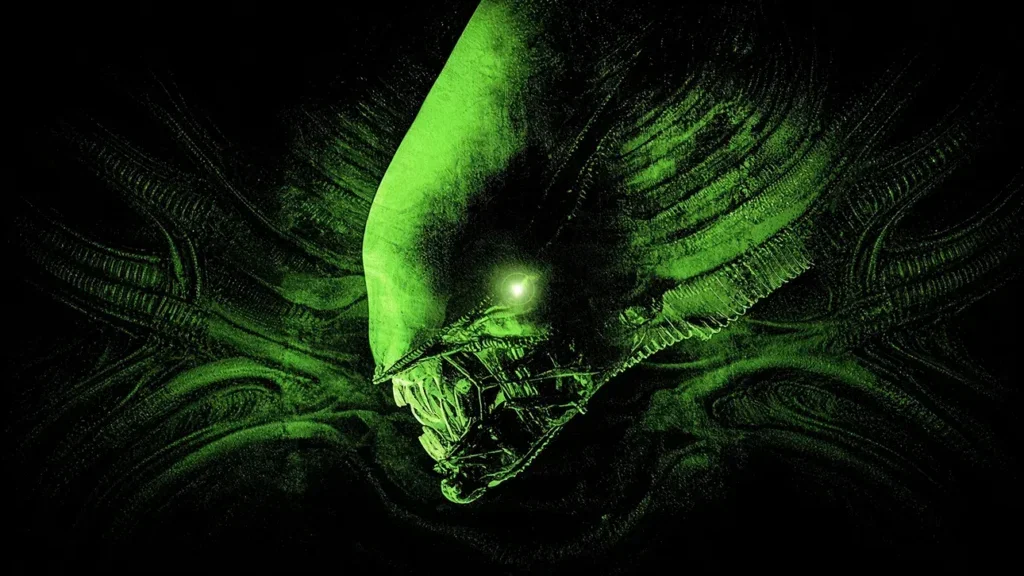
“I had never been so sure of anything in my life.” — Ridley Scott, recalling his reaction to H. R. Giger’s creation for Alien.
The most terrifying thing about the Alien in Ridley Scott’s film was never its teeth, its speed, or even the obscene efficiency of the creature’s life cycle: it was the impression that the thing had existed long before anyone entered the room. When Alien appeared in 1979, cinema had already accumulated decades of monsters, extraterrestrials, mutated bodies, hostile machines and speculative futures. Most of them remained legible inside the categories that produced them. A creature belonged to biology. A spacecraft belonged to engineering. A corridor was architecture. A weapon was an object.
H. R. Giger introduced a visual environment in which these distinctions had already collapsed. Bone could become structural support; tubes suggested intestines and industrial conduits simultaneously; skin stretched across the mechanical forms without revealing where the organism ended and construction began. The creature emerged from that world with the same internal logic as the walls surrounding it. This was the decisive move.
Giger did not design a monster and then decorate a universe around it. He brought an already mature visual language into cinema, capable of producing bodies, machines, interiors, furniture, weapons, and entire environments without changing its grammar. The xenomorph was simply the form through which a mass audience first encountered it.
The language had a name: biomechanics. The term sounds almost technical, yet its power lies in refusing the clean technical separation on which modern design depends. Industrial objects are normally constructed to conceal their relationship with the human body. A machine may extend strength, speed, memory, or perception, but its casing reassures us that it remains an external instrument. The boundary is obvious. Giger’s images dissolve that convenience. Mechanical components grow inside anatomical structures; vertebrae become pistons; cables acquire the tension of tendons; reproductive forms reappear inside devices whose purpose cannot be determined.
Even when individual elements are recognizable, their relationship becomes unstable. The viewer understands the parts and loses the whole. This is why a weak imitation of Giger is so easy to recognize. It gathers ribs, skulls, tubes, black surfaces, and sexual suggestion as if they were ingredients. His strongest work operates at a deeper level. Everything appears governed by a single biological order. The object does not look decorated with anatomy. It looks as though anatomy has become its engineering principle. A chair may possess a spine because the spine is structurally necessary. A wall can resemble a thorax because the architecture appears to have grown according to the same rules as the body standing in front of it. Nothing needs to announce itself as grotesque. The logic is already wrong enough.
That wrongness becomes concentrated in the xenomorph’s head. Its elongated cranium is memorable because it refuses to stabilize as a single form. It can suggest a weapon, an armored shell, a phallus, a machine casing, or an animal skull without resolving into any of them. The absence of visible eyes removes the most familiar instrument through which human beings read another living presence. Eyes locate attention, aggression, fear, hesitation. They tell us where a creature is looking and allow us to imagine what it might be thinking. The Alien clearly perceives its surroundings, yet the face returns almost nothing.
Then the mouth opens, revealing another mouth hidden inside. The second jaw operates with the abrupt precision of a mechanical piston, turning anatomy into apparatus at the moment of attack. There is no expressive transformation, no visible rage, no psychological escalation. A biological structure simply performs its function. The effect is colder than ordinary aggression because aggression still belongs to emotion. Giger created a predator whose body appears to have already eliminated the distinction between instinct and machine logic. The creature does not need to hate its victim. Hatred would almost make it easier to understand.
Its reproductive cycle pushes the same visual logic beyond appearance and directly into the organization of the human body. The facehugger is disturbing before any explicit violence occurs because the design has already rearranged intimacy into predation. Limbs wrap around a human head; the alien’s body seals itself against the human face; its tail tightens around the throat. The encounter is physically close in a way that conventional attack is not. Penetration follows. Incubation takes place inside the host. Birth destroys the body that made it possible.
Giger and Alien’s broader design system takes processes culturally associated with sex, pregnancy, continuity, and reproduction and converts them into stages of invasion. The chestburster scene remains shocking because the blood is only the visible end of something that has already happened in private. The real violation began earlier, when the body lost control over what could enter it, what could grow inside it, and what could use its organs as temporary infrastructure. The victim does not merely die. His biological sovereignty has already been cancelled.
The body becomes an environment.

That reversal reaches far beyond a single memorable sequence. Much of H.R. Giger’s visual vocabulary is saturated with reproductive anatomy, penetration, genital structures, skeletal systems and mechanisms whose shapes repeatedly cross the boundary between erotic and threatening. Sexuality is neither a decorative provocation nor an isolated layer placed over science-fiction imagery. It is built into the machinery. Curves attract the eye and then refuse the expected reward of beauty; openings suggest both anatomical invitation and physical injury; smooth surfaces can feel sensual until a neighboring structure changes their meaning. The viewer is repeatedly pulled toward forms that become hostile only after attention has already committed.
Conventional horror often establishes danger through visible corruption: wounds, decay, asymmetry, rot. Giger’s work is frequently immaculate. Surfaces are polished. Structures repeat with almost architectural discipline. Mechanical precision gives the images a strange elegance that works against the subject matter. Attraction survives inside disgust. The conflict does not resolve, and the unresolved state is more disturbing than simple ugliness because ugliness provides instructions. It tells us to turn away. Giger’s images keep the eye moving inward, toward the creature.
This same instability governs Alien‘s architecture. The xenomorph’s derelict spacecraft does not feel like a futuristic machine designed around recognizable engineering. It resembles something discovered rather than manufactured, a structure whose technical sophistication is obvious even though its principles remain unreadable. The Space Jockey intensifies that effect because pilot, body, seat, and mechanism appear to have become one continuous construction. The eye searches for the border between corpse and equipment and finds only another transition. Was the body inserted into the machine, or was the machine built as part of the body? Is the chair an external device, a skeleton, an organ, a vehicle, a fossilized extension of the organism that once operated it?
Human categories begin to fail. That failure produces a particular kind of scale. The scene does not need exposition explaining that humanity is insignificant in an ancient universe. The visual language establishes it immediately. We have entered an environment that does not recognize our divisions between life and technology, interior and exterior, object and anatomy. It has been functioning according to another order long before human beings arrived to classify it. We arrive late.
Much of science fiction gains its futuristic quality by exaggerating recognizable contemporary technology. Screens become larger, engines more powerful, cities more vertical, weapons more efficient. H.R. Giger moved in another direction. His future appears ancient because nothing is cleanly new. Bone, machinery, fossil, flesh and architecture have already spent enough time together to lose their separate identities. The result feels less invented than excavated.
This is one reason the images from Ridley Scott’s 1979 film retain their force despite decades of imitation. Contemporary technology has become smoother, quieter, and more visually hygienic than the machines imagined in the late 20th century. Interfaces disappear behind glass. Devices hide their mechanisms. Sensors operate without announcing themselves. Cables vanish. Consumer technology presents itself as frictionless and almost immaterial.
Giger imagined technological intimacy without that reassuring cosmetic layer. His machines have cavities. Internal systems remain exposed. Structures seem capable of sweating, reproducing and decaying. Technology does not escape biology’s humiliations. It inherits them.
The cultural afterlife of biomechanics demonstrates why this distinction mattered. A successful horror movie creature can produce sequels, merchandise and copies. A visual grammar can produce unrelated descendants. During the decades after Alien, Giger-derived structures spread across science fiction, horror cinema, video games, album imagery, tattoo culture, fashion and industrial design.
H.R. Giger’s contribution to Alien extended far beyond his creation of this creature. The derelict spacecraft, the
Space Jockey and the environments surrounding them followed the same biomechanical grammar. Instead of placing a monster inside conventional science-fiction scenery, Giger helped construct an ecosystem in which creature, technology and architecture seemed to belong to the same evolutionary process. That changed the nature of the fear.
The horror came partly from losing familiar boundaries: organism and machine, interior and exterior, reproduction and destruction, attraction and disgust. The Alien did not merely threaten the human body. Its entire lifecycle violated the body’s sovereignty. Penetration, incubation and birth were transformed into mechanisms of predation. Giger made biological processes themselves hostile.
The achievement was recognized immediately. Alien won the Academy Award for Best Visual Effects in 1980, with Giger among the recipients. Yet the more consequential result cannot be measured by an award. His visual grammar escaped the film.
Biomechanical imagery subsequently appeared throughout science fiction, horror, video games, album artwork, tattoo culture, fashion and industrial design. Countless artists absorbed fragments of Giger’s art without directly reproducing it. Ribs became architecture. Machines became anatomical. Human bodies merged with technological structures. Darkness acquired a new vocabulary.
This is what separates an image from an architecture. An image can become famous and remain an image. An architecture generates further images, objects, stories and interpretations after its original context disappears. Its strongest elements become sufficiently coherent that other people can enter the system and continue building from
them.
Directors, production designers, writers, game developers and artists inherited a visual territory none of them had created alone. Prometheus, Alien: Covenant and Alien: Romulus expanded, revised and reinterpreted parts of it. Games such as Alien: Isolation let audiences physically navigate environments descended from the same visual grammar.
At that point authorship becomes something stranger than ownership. The creator establishes the initial rules, but a sufficiently powerful cultural architecture eventually exceeds both the work and the person who originated it. New participants misunderstand parts of it, extend others, introduce contradictions and discover possibilities the
original architect may never have intended. That does not necessarily weaken the system. It can be evidence that the system has become capable of evolution.
Nearly half a century after Alien‘s release, H.R. Giger’s creature remains instantly recognizable. More importantly, the world around it remains generative.
Giger died. The universe did not. It continues to live, mutate and expand without its original architect.