
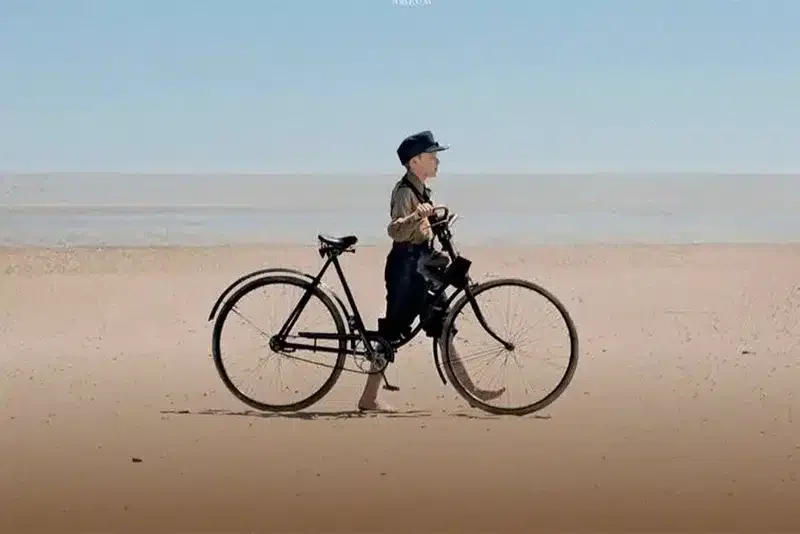

Coming-of-age drama Amrum, which premiered at Cannes in 2025 and later screened at the Sofia International Film Festival, is set on the German island of Amrum in the North Sea during the final weeks of World War II. It follows 12-year-old Nanning as he helps his family get by through work and hunger, as the world unravels around him. The late director Hark Bohm co-wrote the film with Fatih Akin, and the material draws from Bohm’s childhood. It is a wartime story, though memory is already sitting inside it.
Amrun stays close to the ground. Akin does not inflate it into a prestige-war picture. He stays close to Nanning’s days, to the errands, the labor, the practical pressures that pile up. Bohm had been working on this material for years, and the description of the project as “a Hark Bohm film by Fatih Akin” is about as accurate as these labels get. Akin is not only filming Bohm’s memories; he is carrying them the rest of the way. He has said he first tried to approach the film in Bohm’s style before realizing he had to direct it in his own way.
Akin shoots the island in bright light, often with wide shots that leave room for the coast, the wind, and the horizon. That beauty keeps rubbing against the life Nanning returns to at home, where everything feels tighter and more humiliating. Outside, the island seems open. Inside, space closes down. Amrum doesn’t let its visual grace become comfort.
Jasper Billerbeck, in his first screen role, gives the kind of performance Amrum needs. It is quiet, contained, and very sure of itself without seeming worked over. His character does not signal maturity in obvious beats. The change in Nanning happens more gradually than that. He seems to carry a little more each time the story turns back to him, until the weight begins to look normal on him, which is part of what makes it painful. Billerbeck’s acting doesn’t ask for attention, which is part of what makes it so impressive.
Nanning is helping provide for the family, taking on responsibilities that do not belong to him, and learning very quickly that softness is a luxury nobody around him will allow. Amrum is especially sharp in the moments when something more recognizably childish comes out of him and gets shut down almost at once. He is not exactly discovering adulthood. Without really knowing it, he is already being pushed into a life that is not his yet.
At one point, Nanning, visibly uneasy, asks his mother for permission to lend a book to a childhood friend who wants to read Moby-Dick for the first time. The scene unfolds in a dim, somber library, where the boys also pause over the father’s many books, all tied to Aryan and Nazi themes. Nanning does not seem to understand the full meaning of what surrounds him there.
What comes through more clearly is the admiration of a son who still takes his father’s work at face value, whatever it contains. From there, the film turns toward analogies in Moby-Dick, a book neither boy seems fully able to grasp, though they return to it in passing as the story goes on.
When they later suggest that Hitler might be Ahab, the comparison is simple but telling: a man lost in his own grandiose obsession, dragging everyone else along with him. Nanning, in that sense, is like Ishmael; caught inside a madness he did not choose and too young to understand, but not too young to suffer through it.
Nanning’s bond with his mother (Hille Hagener, played by Laura Tonke) carries the script. He loves her with the kind of totality only a child can manage, and that love changes the meaning of what he does. His labor is an expression of attachment. Amrum understands that, under these conditions, care often expresses itself through work rather than speech. The emotion lies in the boy continuing to do what is asked of him for the people he loves.
Amrum understands that routine can become dramatic very quickly when survival is at stake. A lot of what Nanning does sounds ordinary when described: he helps secure food and helps at home, and moves from one need to the next. You feel how much those tasks cost him, how much of him gets tied up in simply continuing. The writing does not decorate those actions or enlarge them into false drama.
The material comes from Bohm’s own youth, and the film maintains that proximity. Akin’s direction carries an awareness that the story belongs to someone else’s memory. It carries the weight of lived memory without turning inward or self-important. Amrum is made in the space between two filmmakers, one of them remembering, the other shaping what can be done with that memory.
Something has already started to come apart among the Germans on the island. The film catches a moment when Nazi conviction is clearly fraying inside the local community. Amrum does not stop to summarize its politics for the viewer. Even a family with some standing is not insulated from what is happening around them. Scarcity runs through the whole place, though not evenly, and the story is alert to that difference.
The world around Nanning keeps wearing down what he has been taught to accept. Throughout Amrum, he keeps crossing paths with war refugees from Poland, figures presented in raw, harsh terms: ragged, dirty, trying to carve out some place on the island through manual labor, petty crime, or whatever else might keep them alive.
Nanning first sees them arriving while he is working the fields, and one of the film’s more arresting early images is the look he exchanges with an older girl among them. Later, they confront him outside his school and question his claim to belonging there. He may be German, but his family is not from Amrum either. So who gets to say who belongs to that land?
The encounters between the island’s settled population and the outsiders grow harsher. At one point, as Nanning carries roasted fish home, he is beaten and robbed of the food. Later, after struggling terribly to obtain a little butter, he is chased again. This time, the pursuit spills out toward the water.
The tide begins to rise, and one of the men, unable to swim, begins to drown while the older girl looks on in panic. Nanning is left with a choice that Namum does not overplay: let the man who attacked him disappear into the water, or save him. He throws a rope. That moment does not turn Nanning into a moral hero. Instead, it shows him, through lived experience rather than argument, beginning to step outside the hard logic he has inherited.
The last scene is beautiful. Nanning looks up toward the sky and the horizon, and the low-angle framing gives him, for a moment, a kind of stature the rest of the film has denied him. Then the cut comes, replacing the boy with the older Bohm. It is a wonderful gesture, quietly returning it to the life that first gave it rise. The child we have been watching is no longer only a character inside a wartime story: he is now connected, plainly and movingly, to the man who carried this material for decades.
You think back through everything differently once Bohm appears in the film. Amrum‘s sadness looks different after that. So does its beauty. What lingers is a child being pushed toward usefulness too early, but also the sense of a memory finally finding a form, and of one filmmaker carrying another’s unfinished work the rest of the way.