
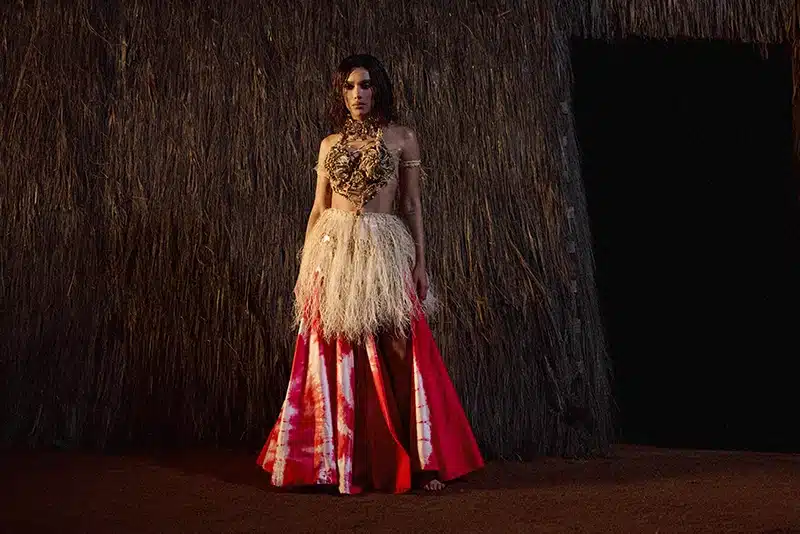

It often happens when a pop artist becomes so larger than life that they reach a point of no return: they either drown in darkness or hold on to light so tightly that the music has no other option but to channel it. That moment has arrived for Anitta, the superstar who redefined the limits of what a Brazilian pop act can be and how far it can go.
After bringing Brazilian funk to the global stage and building a career in the US and Latin American markets while remaining a hot name on everyone’s lips in Brazil, EQUILIBRIVM shows the singer on a journey of introspection in more ways than one: spiritual, but geographic too. Anitta’s inward turn takes shape in an embracement of lyrical and musical references to her religion, candomblé.
It also comes with a deeper, renewed engagement with her own country’s music, now extending beyond Brazilian funk to a broader spectrum of Afro-Brazilian sounds: batuque, samba, reggae, ijexá. Anitta christened this rhythmic fusion “macumbeats”. Other releases prior to EQUILIBRIVM (such as Mandinga Beat’s Mandinga Beat Novo) have explored a similar path that I, in another article, called “house mandinga”.
At a moment when Brazil’s popular and ancestral traditions are increasingly shaping Brazilian pop, and religions of African origin have entered the cultural vocabulary to the point where expressions like “living orixá” now describe pop stars with a certain aura, EQUILIBRIVM feels so in synch with its time that one could wonder how organic it is.
Especially after launching her international career, Anitta has consistently made efforts to stay attuned to the forces currently shaping Brazilian culture. That’s perhaps more visible in her Carnaval-aimed project Ensaios da Anitta, where she incorporates genres such as piseiro and others with which she has little organic connection, aligning herself with trends as they emerge. It’s both as a testament to her multitasking skills and as a strategic instinct, like Dorothy Gale following the yellow brick road, aware that no matter how far she ventures, there is still a home she cannot afford to lose.
The list of collaborators in the album reinforces this impression: 11 out of 15 tracks feature at least one guest artist. Since EQUILIBRIVM is a project based on faith and spirituality, a metaphor about collectivity and communal strength is certainly fitting. However, ultimately, shouldn’t an Anitta album be more about Anitta? In any case, the curation of collaborators speaks more than the number of them.
From Marina Sena to Liniker, from Os Garotin to Luedji Luna, from Ebony to Melly, the names present on EQUILIBRIVM could very well make up a “Meet X artists who are redefining Brazilian music” magazine article. EQUILIBRIVM almost feels like an Anitta festival for the new Brazilian pop and hip-hop/R&B of the 2020s. Except that Rachel Reis is missing, she would have been a perfect choice for EQUILIBRIVM, too.
Is EQUILIBRIVM just another instance of Anitta trying to prove how exceptional she is in reading Brazil’s cultural moment? Better put: is Anitta simply following a trend, or is she, in fact, canonizing one she helped create?
Brazilian pop arguably exists in a before-and-after Anitta, or, more specifically, a before-and-after “Show das Poderosas” (2013), one of the most ambitious funk MC projects ever released in Brazil. While she was not the first to merge local genres with a global pop aesthetic, she was perhaps the most decisive in establishing that identity.
She trained an audience once devoted exclusively to artists like Beyoncé, Rihanna, and Lady Gaga to recognize the same visual and sonic codes within a distinctly Brazilian context. Pabllo Vittar would later expand this by folding references from the Northern corners of Brazil, like forró and brega, into similarly polished pop structures. Together, these movements laid the groundwork for the hybrid Brazilian pop sound that has been crystallizing since the mid-2010s.
It’s wrong to say EQUILIBRIVM revolutionizes Brazilian pop and that it merely repeats what pop artists of lesser caliber than Anitta have been doing. EQUILIBRIVM rather consolidates what other sparse Brazilian releases of the last decade had already been sparsely signaling: the idea that Brazilian pop, to fully assert its identity, must inevitably draw from local genres and cultural roots.
The piseiro-infused pop of Duda Beat and the countryside-tinged sound of Marina Sena (an artist some now accuse Anitta of echoing on EQUILIBRIVM) would likely not exist in their current form without Anitta first reshaping the rules of the Brazilian market. In a country that long sidelined the potential of funk, brega, and forró emerging from peripheral scenes in places like Pará and Rio de Janeiro, it took Anitta to demonstrate that peripatetic pop could be widely palatable and fully capable of crossing into mainstream, middle-class spaces.
If EQUILIBRIVM now sounds timely, it’s because at some point in the past, Anitta was ahead of her time. From this perspective, EQUILIBRIVM works as Anitta turning this evolving language into canon. She does so in a way that aligns both with her personal identity, her religion, her connection to samba and Afro-Brazilian rhythms, and her trajectory as an artist who, after reaching unprecedented global heights, chooses to look inward rather than further outward.
Sonically, the album’s textures and aesthetic direction expand on a vision of Brazilian pop Anitta has been developing for years, not only through her engagement with local genres, but also through the incorporation of sonic elements linked to Candomblé (traces of which were present even in “Aceita” from Funk Generation, her most overtly commercial project). Her spirituality and devotion to Candomblé was first made visible to a national audience at a time when acceptance of Afro-Brazilian religions was far more contested than it is today. The elements that inform EQUILIBRIVM are not performative religiousness and Brazilianness.
The purpose is respectable, and the music delivers somewhat in line with it. The album opens on a strong note. “Desgraça” works as an effective introduction, weaving together multiple threads from different phases of Anitta’s career and persona: samba elements, percussive textures, echoes of funk melody, and a chorus that could easily sit within axé music traditions.
“Mandinga,” featuring Marina Sena, highlights one of the record’s recurring tensions. The track could just as easily belong to Sena’s own repertoire, almost making Anitta feel replaceable in her own track. Yet “Mandinga’s” multi-melodic structure justifies the collaboration, as both artists occupy distinct musical spaces within the same composition.
“Ternura” revisits a softer side of Anitta reminiscent of earlier tracks like “Zen” (2013) and “Cobertor” (2014), while “Nanã”’s first verse recalls the Anitta of Pedro Sampaio’s “Dançarina” collab in how it seems tailored to be a World Cup or Brazilian tourism ad: a stylized, almost sanitized vision of Brazil. The remix leans toward the kitsch, but sampling Os Tincoãs is far from insignificant. Her merit lies in introducing the group’s legacy to a new generation, while rappers Rincon Sapiência and King Saints help anchor the track.
Anitta manages to maintain the rhythm and hues even when translating Brazilian faith and flavor into tracks sung in Spanish and English: the samba “Pinterest”, the Spanish cover of “Várias Queixas” by the percussion group and Carnival bloco Olodum, and the forgettable songwriting but nice showcase of Anitta’s sweet timbre, “So Much Love”.
Comparisons with other Brazilian pop girls of her time become inevitable again with Anitta’s choice to close EQUILIBRIVM. “Ouro” has the same spoken-word poetry style (and almost the same title too) as “Ouro de Tolo”, the track that closes Marina Sena’s Coisas Naturais (2025); and the same crowd-settling closer vibe as “Deixa”, the last track in Gaby Amarantos’s Rock Doido (2025).
The album falters when it becomes too literal, as in “Deus Existe”, or when it forces a conventional “party moment”, as with the weak “Choka Choka”, her collaboration with Shakira, which ends up wasting the metatextual potential of putting together two of Latin music’s most powerful figures.
The most effective pop moment comes in “Meia-Noite”, a Los Brasileiros collaboration that embodies EQUILIBRIVM’s intentions with clarity and immediacy. The chanting chorus “Depois da meia noite eu vou sair / porque a rua é logo ali / o meu lugar é lá / deixa ela passar” is perfect. It sounds like a spell, a command, a cry for freedom, a refrain from a Carnival trio’s parade, all at the same time. It’s a perfect balance between the euphoric pull of a jump-along pop hit and the cyclical, almost ritualistic quality of a mantra. Now this is a version of Anitta that hadn’t fully and officially blossomed in her discography, and that makes perfect sense beautifully and enjoyably.
In many ways, EQUILIBRIVM (2026) is Anitta’s Ray of Light: introspective, yet built for movement; shaped by a woman who has seen the world and found its limits; and who now channels that clarity into something at once spiritual, rhythmic, and fully attuned to the pulse of contemporary pop. Much like George Harrison’s incorporation of Indian music into the sonic vocabulary of the Beatles, or Madonna’s engagement with Kabbalah during her late 1990s reinvention, EQUILIBRIVM places Anitta in the lineage of pop artists who occupy such a cerebral position in shaping the popular culture of their scenes that their spiritual shifts cannot help but represent something greater about pop music as well. “As inside, as outside.”
If not for that, then EQUILIBRIVM shall at least distinguish itself as a prolific creative breakthrough in Anitta’s trajectory. While Funk Generation remains the album where concept and execution are better aligned, EQUILIBRIVM might be the project that finally solidifies Anitta in the public imagination as an artist, not just a performer, a sex symbol and a businesswoman, but a deliberate and evolving creative force.