
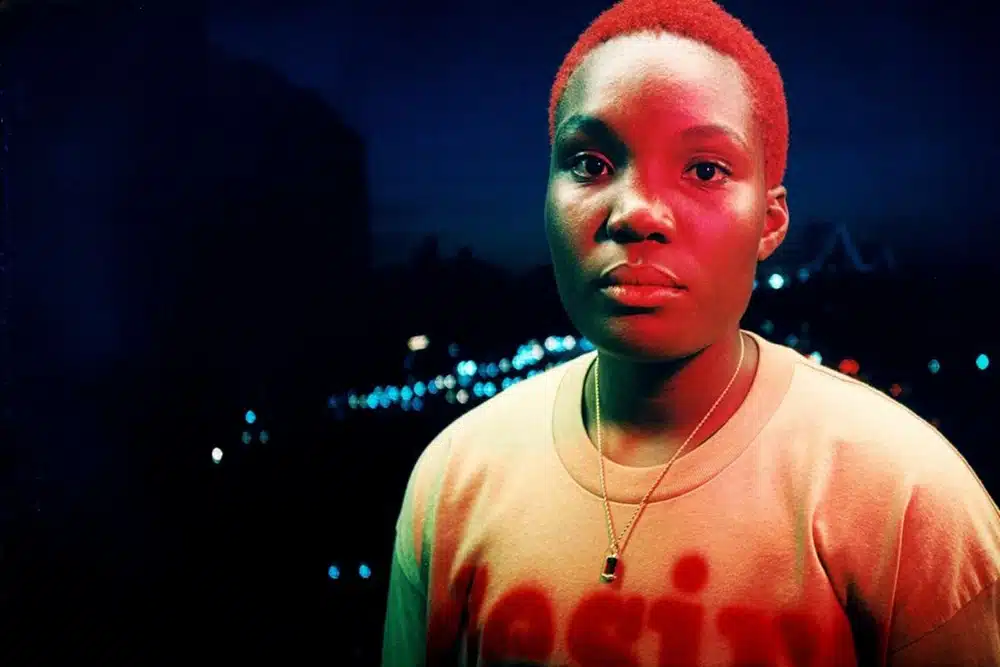
Arlo Parks’ third album, Ambiguous Desire, bears little resemblance to her previous record, My Soft Machine. My Soft Machine, though, only felt tangentially connected to Parks’ Mercury Prize-winning and Grammy-nominated debut, Collapsed in Sunbeams. Sunbeams, for its part, felt like a sad, confessional R&B album with folk elements, while Machine brought in more downtempo rock influences. Ambiguous Desire is a dance-pop album, but since this is Arlo Parks, it’s a low-key, introspective one.
The early singles paint an accurate picture of what the album is about. “2SIDED” is driven by a simple drumbeat and synths that are grimy in the verses and sparkling in the chorus. Parks sings about a new relationship and the other person’s ambiguity. She pleads, repeatedly, “You know how I feel / Tell me it’s two-sided. “Heaven” is an unusually positive track for Parks. Over a clicking beat and active bass, she describes joyful summer nights in the city. Yet the song still feels more wistful than joyous, with lonely piano flourishes accenting the spaces between the vocals.
The most recent single, “Get Go”, has more of a classic Eurobeat flair, with drum and synth sounds that wouldn’t have seemed out of place in the late 1990s or early 2000s. Parks proclaims in the chorus, “I knew we had it from the get-go / But I don’t wanna let go.” It’s one where the music and lyrics work together, as if Parks is dancing her way through a night with a new partner.
The rest of Ambiguous Desire covers a little more ground lyrically and sonically. Opener “Blue Disco” is a relaxed, mid-tempo song driven by heavy synth bass and extended organ chords. Parks describes a club in great detail, as well as what’s happening with her friends. The lyrical perspective and some of the sounds of this track make the influence of LCD Soundsystem (cited among a half-dozen indie dance-oriented acts in the press notes) make a lot of sense here.
Many of these songs still cover Arlo Parks’ usual territory of relationships and insecurities. “Senses”, which features welcome change of pace backing vocals from Sampha, is sparsely arranged and airy. Parks declares in the chorus, “And now I’m here / Feeling super bad about it / Trying to find the courage” while reflecting on what seems like relatively minor issues.
“Beams” slides between funky drums and a piano-driven A section and a quieter B section with a simple but effective piano hook. Here, Parks unloads with phrases like, “I know I said I’d be okay, but it’s smashing me up”, and “I know it’s the right thing to do, but I don’t wanna.” Whatever catharsis Arlo Parks gained by spending time in New York City’s queer club scene, her neuroses still dominate her songwriting.
A couple of tracks function as outliers that hearken back to Parks’ earlier material. “What If I Say It?” still features a bit of a funky beat, but is much more of a slow pop-R&B ballad. By backing off on the beats, Parks’ vocals take center stage as she gets inside her own head and wonders, “What if I say it / Does that make it real?” The brief “South Seconds” goes further, featuring a pair of quiet guitars, bass, and piano, but no drums. It’s short, romantic, and hopeful, and it sounds like it takes place at sunrise, while the rest of the album seems to unfold around 1:00 AM.
Musically, the indie dance-pop feel of Ambiguous Desire is a successful sonic shift. Yet Parks, who is as much of a poet as a musician, benefits from having such a strong lyrical perspective. Even with a mostly different musical style, these songs are still recognizably Arlo Parks. Her aching, personal stories and insecurities are familiar by this point, but often still devastating. It’s nice, however, to get a handful of songs this time out where she’s feeling pretty good.