
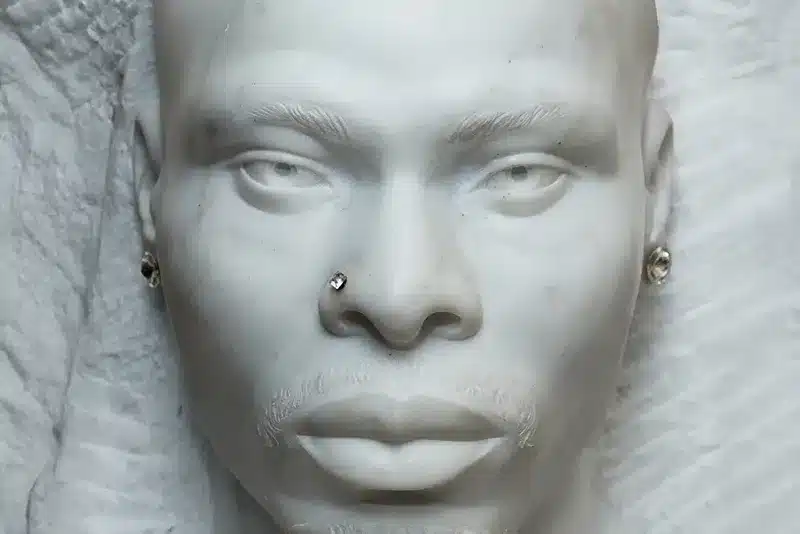

There is a moment, somewhere around the fourth or fifth listen of Asake’s fourth studio album, when the strings on “Gratitude” rise and the choir leans in, and you understand that the Lagos singer is no longer trying to convince anybody of anything. The hustle has ended. The argument is over. What remains, on M$NEY, is the long, slow exhale of a man who has spent four extraordinary years climbing and now wants a few minutes to look around. Whether you find that exhale beautiful or anticlimactic will depend, in part, on which Asake brought you here.
He arrived, four years ago this autumn, as a brawler. Mr. Money with the Vibe, released in September 2022 through Olamide’s YBNL Nation, was so densely packed with hooks, chants, and percussion that it played like a street carnival accidentally captured on tape. He followed it eight months later with Work of Art, then, in 2024, with the more anxious, internationally minded Lungu Boy, and, somewhere in the middle of all that, became the most-streamed artist in the history of Spotify Nigeria. He went from supporting Broda Shaggi’s comedy skits and dancing his way through Obafemi Awolowo University to selling out the O2 Arena in London. He was nominated for a Grammy. He was nominated for another. The runway was clear.
Then, in February of 2025, he left the label that had made him. The unfollowing came first—the cold, ritual purging of an Instagram following—then the announcement, and then the single “Why Love”, released through a new imprint of his own called GIRAN Republic, with longtime collaborator Magicsticks on the boards. The break with YBNL was not so much a violent break as a final one. Olamide, who had co-written and shepherded so many of those early records and whose presence had been a kind of insurance policy on Asake’s wilder instincts, was now somewhere else. A former associate named Tunde Perry launched what can only be called a smear campaign, alleging everything from misogyny to homophobia, and Asake answered, characteristically, with a song.
“Military” was its name. It’s a swaggering, lacerating piece of self-defense over glistening keys, and it is on this album in different clothes, restitched and retitled as “Oba”. That a song originally written in fury could be recast as a song about kingship tells you most of what you need to know about the year Asake has had. The wound has cooled. The crown is on.
M$NEY, released through GIRAN Republic and EMPIRE on the first of May, runs 13 tracks and clocks in at just over 35 minutes, leaner than anything he has done. Three guests, all carefully chosen: DJ Snake on “Worship”, the French-Congolese rapper Tiakola on “Badman Gangsta”, and the South African amapiano titan Kabza De Small on “Asambe”. Everything else is Asake alone, which is a kind of statement in itself. The mythology around his early records always involved Olamide standing somewhere just out of frame. Here, the frame has been cleared.
The first thing you notice is that the album opens not on a beat but on a choir: actual human voices, breathing together, somewhere between a Pentecostal worship session and a Yoruba dirge. Magicsticks, the producer who has been with Asake since the beginning, makes a banquet of the next half hour. A violin sweeps in on “Gratitude” and never quite lets go; a trumpet rises and breaks on the bridge of “Forgiveness”; “Rora” is built on supple live keys that sound like the closing reel of some Italian film about brothers and money.
There is amapiano here, certainly. “Asambe” with Kabza is the closest thing to a club track, and there is fuji underneath almost everything, the patois of percussion that has been Asake’s first language since he was a boy in Lagos. There is also a quietness on M$NEY, a willingness to let an instrument hold a note, that we have never quite heard from him before.
His collaborators generously help him. DJ Snake’s “Worship” might have curdled into festival kitsch in less careful hands; instead, the Frenchman builds his drops around Asake’s chant of “Alhamdulillah”, “praise be to God”, and the result is a piece of Eurodance with a prayer rug under it. Tiakola, on “Badman Gangsta,” does something stranger and more affecting. The track samples Amerie’s “1 Thing”, that nervous, kinetic 2005 single that any millennial will recognize within four bars, and Tiakola enters in French while Asake, suddenly more searching than he has ever been, picks at his own Nigerian identity in the slipstream of his global fame. Of all the songs on the record, it is the one most likely to grow on you, then quietly become your favorite.
The trouble with M$NEY, if you want to call it trouble, is that Asake has never been a writer of great lines, and on this album he leans less on language than he ever has. The lyrics on “Oba”, the descendant of “Military”, have lost the original’s bite. “Big yansh, it is my type / God dey by my side” stands in for what was once a vivid swipe at his enemies.
“Wa” cycles through a refrain (“searching for ya”) that owes too much of its melodic shape to CKay’s “Love Nwantiti.” The love songs on the record’s second half, bodies meeting bodies, lights being turned off, are not where his pen wants to be. The young Nigerian streamer Gilmore, watching the album drop in real time on a TikTok livestream, summed it up with a kind of dejected affection. He clasped his hands, shook his head, and said maybe it would grow on us.
It does grow on you. That is the strange thing. The Naija Way critic Ayomide Tayo, comparing the album to a pyramid Asake has built for himself, gave it a 6.5 and called it an architecture with structural faults but more hits than misses. The NATIVE’s Chibuzo Emmanuel, who heard the cracks in the songwriting more clearly than most, conceded that M$NEY was simultaneously one of Asake’s most sonically polished projects and one of his least lyrically substantial. Both of these things are true. The album is a hangar; the listening party was, in fact, held in a private airplane hangar, which is a detail almost too on-the-nose to use, and inside the hangar is something gleaming and slightly hollow and also genuinely beautiful.
Where it lands, it lands hard. “Rora”, which means “take it easy” in Yoruba, is the best song and arguably one of the best things Asake has ever recorded. Over Magicsticks’s spilling-light production, he eulogizes himself. He admonishes himself in the same breath, a man on a balcony watching his own life from a height he never expected to reach and feeling, almost against his will, humbled by it. “Forgiveness” works in a similar mode; the trumpet flutters in like something half-remembered from a wedding, and on “MCBH” the elastic, almost rubbery groove gives him room to do what he does best, which is ride a beat as if it were a horse he knew. The closer, “Skilful”, is a small thesis: the money came from the work. The work was the gift.
What M$NEY really is, though—and this is the thing the noisier critics have mostly missed—is an album built for a room. Not a bedroom, not a pair of earbuds; a room with people in it, and lights, and a stage. The live instrumentation is not incidental. The choirs are not decorative. Asake has been thinking about the O2, about Madison Square Garden, about the festival fields where his career now plays itself out, and he has built this album with those rooms in mind.
“Forgiveness” and “Rora” and “MCBH” are not going to be ringtones. They will be sung back to him by 30,000 people in cities where five years ago no one knew his name. That is a different kind of ambition than the one he came in with, and it is fair to wonder whether the trade, the lyrical compression, the smoothness, the prayerful sheen, is worth it. The honest answer, on a fourth or fifth listen, is yes. Mostly.
There is a phrase, used by the small American Substack Shatter the Standards, that gets closer to what Asake has done here than any of the trade-press copy: àdúrà pop. Prayer pop, in Yoruba. He did not name the genre, but he may have made it. When M$NEY works—and it works more often than its sharpest critics will concede—the credit alert and the blessing become, briefly, the same notification.
A man who came up dancing for a comedian, who studied theatre at Ile-Ife and ate the city of Lagos whole, has built a fourth album that is both a victory parade and a quiet prayer of thanks for surviving the parade. It is not his loudest record. It will not move the way “Sungba” moved, but it will outlast some of the louder ones, because what it is doing is harder and stranger and, in the end, more honest.
Four years in, Asake is no longer arguing. He is, against every odd, content, and content, on a record this carefully made, turns out to sound like something close to grace.