

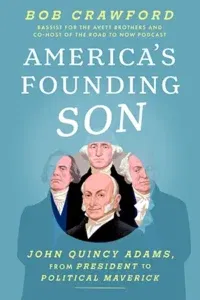
For most fans, Bob Crawford is known as the steady rhythmic force behind the Avett Brothers. With the release of his book, America’s Founding Son, Crawford steps into another role with confidence: historian. His subject is John Quincy Adams, a man Crawford argues is not defined by a single turbulent term in the White House, but by a lifetime—especially a post-presidency—of relentless public service and moral hardening.
Crawford’s fascination with Adams began on tour in the mid-2000s, when he picked up Sean Wilentz’s sweeping history of the early republic, The Rise of American Democracy: Jefferson to Lincoln. The book illuminated what Crawford calls America’s “tortured adolescence”, roughly 1820 to 1848—a volatile stretch wedged between the founding era and the Civil War. “We learn about the Revolution, maybe the Constitution, and then we jump to the Civil War,” Crawford said. “But this in-between period is where the country is figuring out who it is. That is a period that is so rich with characters.”
At the center of that reckoning stands John Quincy Adams (1767-1848).
Born Into Revolution
John Quincy Adams did not inherit public service as an abstraction; he grew up inside it. The son of John Adams and Abigail Adams, he watched the smoke of the Battle of Bunker Hill from Penn’s Hill as a child. Before he turned 14, he had crossed the Atlantic multiple times. In Europe, he absorbed diplomacy at close range as his father negotiated alliances and peace. As a teenager, he served as secretary and interpreter to American lawyer and diplomat Francis Dana in Russia, copying correspondence and translating French dispatches—an education few Americans of any age could claim.
His formal diplomatic career began early. George Washington appointed him minister to the Netherlands in 1794. President John Adams later sent him to Prussia. Under Thomas Jefferson, he served as a U.S. senator from Massachusetts before breaking with the Federalists over principle.
By the time he became Secretary of State under President James Monroe, Adams had negotiated on three continents, served in multiple European courts, and developed a reputation for meticulous preparation and emotional reserve.
War of 1812 and a Nation’s Standing
During the War of 1812, President James Madison appointed Adams minister to Russia. In 1814, he became one of five American commissioners negotiating peace with Britain at Ghent. Though not formally the head of the delegation, Adams was its most methodical voice, pressing for clarity and discipline as talks stalled and resumed.
The Treaty of Ghent restored prewar boundaries—status quo ante bellum—rather than dramatically redrawing the map. Border disputes with Britain lingered and would be resolved in later agreements, but the war itself confirmed that the United States would not collapse under pressure from a global empire. The burning of Washington in 1814 was a national humiliation. Yet the survival of the republic, followed by Andrew Jackson’s victory at New Orleans—fought after the treaty was signed but before word arrived—reshaped how Americans saw themselves.
“Andrew Jackson is a big character in this book,” says Crawford. “Days after the Treaty of Ghent is signed, he fights off the British in a remarkable fashion, takes on the British, and drives them out of New Orleans.”
Through the 1830s and 1840s, British influence still hovered over American foreign policy, especially in territorial disputes. The war had ended, but strategic caution remained.

Architect of Expansion—and Restraint
As Secretary of State, John Quincy Adams helped secure the Adams-Onís Treaty of 1819, in which Spain ceded Florida to the United States. The negotiations were hardly tidy. Andrew Jackson’s incursions into Spanish Florida nearly triggered a diplomatic rupture. Adams, alone in the Monroe administration, consistently defended Jackson’s actions, recognizing that Spain’s inability to control the territory strengthened America’s negotiating hand.
He also negotiated the Convention of 1818, establishing joint occupation of the Oregon Territory with Britain—an arrangement that postponed conflict while the young nation consolidated its strength.
Adams’ most enduring diplomatic achievement came in shaping what became known as the Monroe Doctrine. In a July 4, 1821, address, he declared that America “goes not abroad in search of monsters to destroy.” When President Monroe formally announced the doctrine in 1823, it reflected Adams’ insistence that the Western Hemisphere was no longer open to European retaking. The United States would avoid entangling alliances, but European powers were warned against interference in the Americas.
“In a European and political frame, the Monroe Doctrine was America saying, no, you’re not going to come messing around here anymore. There’s a new sheriff in town. We’re the United States. You’re not going to mess with South America. You’re not going to mess with Central America. You’re not going to mess with North America. This is our purview.”
The Election of 1824 and a Fractured Presidency
The 1824 presidential election fractured the political order. Andrew Jackson won a plurality of electoral votes but not a majority, sending the decision to the House of Representatives under the Twelfth Amendment. When Henry Clay’s support swung the contest to Adams—and Adams named Clay Secretary of State—Jackson’s allies charged a “corrupt bargain”.
Adams’ presidency (1825–1829) never recovered from that cloud. He proposed federal investment in roads, canals, scientific research, a national university, and even a national observatory—what he called “lighthouses of the sky”. In his first annual message to Congress, he argued that lawmakers should not allow narrow local interests to block national development. The language struck critics as detached from the electorate, and opponents seized on it.
Unlike Jackson, Adams did not aggressively purge political opponents from office. Though he made appointments and removals, he declined to treat patronage as a weapon. The restraint cost him. Backed by the organizational skill of Martin Van Buren, Jackson built a disciplined national Democratic Party and defeated Adams decisively in 1828.
“Adams and Van Buren both accomplished more things outside of their presidencies,” says Crawford. “I think that their post-presidencies better define them and better contribute to the grand American story.”
The Great Reinvention
What distinguishes John Quincy Adams—and anchors Bob Crawford’s book—is what came next.
In 1831, Adams returned to Washington as a member of the House of Representatives, the only former president ever to do so. Over 17 years in Congress, he shifted from a cautious statesman to a persistent antagonist of slavery’s political power.
During the Missouri debates of 1820, Adams recorded in his diary that the Union might one day dissolve—or endure a violent struggle that would tear it apart before it could be restored. The entries read less like speculation than calculation.
In the House, he confronted the “gag rule” adopted in 1836, which automatically tabled all anti-slavery petitions. Adams argued that silencing petitions endangered citizens’ constitutional right to be heard. For eight years, he introduced petitions, maneuvered procedurally, and endured attempts at censure until the rule was repealed in 1844.
The shift was gradual. As a diplomat and president, Adams had avoided directly challenging slavery. In Congress, he came to view it as inseparable from the nation’s political machinery—woven into tariffs, banking, and territorial expansion. When efforts were made to restrict speech on the subject, he drew a line.
Privately, Adams endured repeated grief. He lost two adult sons—one to suicide, another to alcoholism. In 1826, while serving as president, he learned that his father, John Adams, had died on July 4—the 50th anniversary of the Declaration of Independence—the same day as Thomas Jefferson. The symbolism was stark, almost theatrical, yet deeply personal.
“I do cover when his father passes away,” said Crawford. “His father was his hero. He looked up to his father, had great respect for both of his parents, and great admiration for his father.”
On February 21, 1848, Adams rose in the House to vote against a resolution honoring officers of the Mexican-American War, a conflict he believed would extend slavery into new territories. Shortly afterward, he collapsed at his desk. He died two days later in the Capitol building.
A Musician’s Historian
Bob Crawford, who holds a master’s degree in history and previously produced a podcast series on John Quincy Adams, approaches his subject with the patience of someone who has lived with the material. Years on the road with the Avett Brothers—long drives between cities, quiet hours before soundcheck—became research time.
In America’s Founding Son, Crawford makes the case that Adams’ significance rests less in his presidency than in his earlier actions and his refusal to withdraw from public life after it. In the nation’s uneasy middle years—after the founders had passed but before the Union fractured—Adams kept returning to the floor, returning to the argument, returning to the idea that the republic could demand more of itself.
“He’s the son of John Adams, who also ended up in the White House,” says Crawford. “He’s an eyewitness to the Battle of Bunker Hill. He was a diplomat, a Senator, a commissioner, an ambassador, and a negotiator. He’s the architect of the Monroe Doctrine. So all of that alone makes him historically relevant.”