
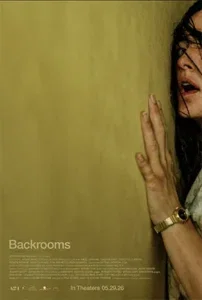
To begin, aside from the required warning that spoilers follow, let us stipulate that what happened in movie theaters in the early summer of 2026 was a good thing for the art and the industry. While jumped-up Disney streaming series and feature-length stuffed toy ad The Mandalorian and Grogu (Jon Favreau) strained to find an audience, filmgoers and industry-watchers were instead transfixed by a pair of new horror films from 20-something directors. Curry Barker’s haunted-girlfriend screamer, Obsession, looks to be the launchpad for an inventive genre director with plenty of tricks up his sleeve. Although Kane Parsons’ Backrooms is one of the freshest bits of guerrilla weirdness to have taken over the multiplex in a long time, the film’s looseness and sprawl may suggest a relatively shallow fictional universe that undercuts its groundbreaking potential.
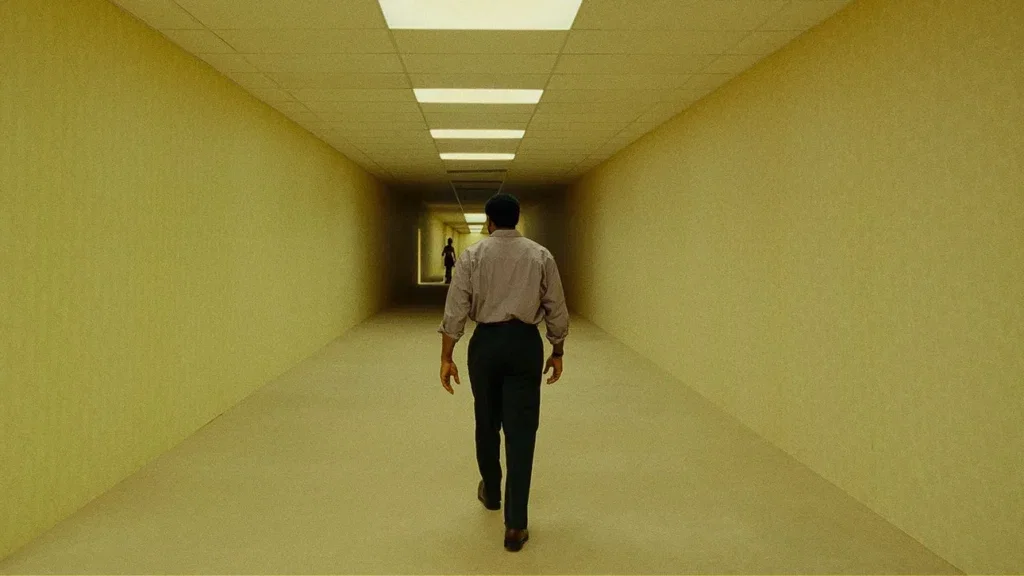
The YouTube series Parsons built his universe from does not have the same constraints as a feature film. Those shorts alternated between snippets of story—usually first-person shaky-cam footage narrated by doomed individuals navigating an endless maze of office building-like corridors interrupted by brain-snapping Escher-like breaks of perspective before they are chased by barely-glimpsed beasts—and mood-setting interstitials whose fuzzy graphics and muzzled narration suggest 1990s’ corporate videos put through the nightmare machine. These fragments glimpse, through a screen darkly, a world where a company’s research into magnetic resonance seems to have created an alternate universe, nestled alongside and occasionally breaking into the real world as it spreads with viral speed.
Backrooms, the film, sticks to that mythology but provides a clearer entry point by telling a linear story, with characters serving as audience stand-ins to explore these strange spaces. Clark (Chiwetel Ejiofor), the depressed and divorced manager of a down-at-heel discount furniture mart in the Valley, discovers he can step into the backrooms by walking through a wall in the store’s basement. Fascinated by the mystery, he explores the tangle of hallways, covered in a sickly yellow tint and filled with random, strangely constructed objects that look like the aftermath of a botched Star Trek transporter incident that split everything between two realities. Occasionally, he is threatened by a roaring creature of seemingly malevolent intent, but the world’s randomness and newness pull him back. Though terrifying, the backrooms hold more possibilities than his grey, no-future, drink-sozzled life back in the Valley.
Where Backrooms runs into trouble is when Clark convinces the few other people in his life to join his strange spelunking. Excepting a pair of characters whose doom is predictable from their first moments, the only other of note is Clark’s therapist, Mary (Renate Reinsve). Despite her hopeful messaging and attempts to break Clark out of his cycle of recrimination, Mary seems to share his bleakness and his desire for something new, no matter how dangerous it may be. To fill out her character, Will Soodik’s script eschews three-dimensionality in favor of a grim trauma narrative. Flashbacks to Mary’s horrific childhood help explain her glassy and disconnected manner, but really just serve as raw material for new elements that begin to sprout through the backrooms.
Backrooms is not so much a film about people as it is about spaces and mystery, evoking the sensation of waking from a deep dream and grasping the fragments of that world before they drift away. That presents rich opportunities to create an eerie, cinematic dark magic unlike almost anything else in theaters at the time. There is a virus-like ick to Parson’s infinitely replicating world and uncanny aesthetic, which is hard to shake afterward; dark corridors and blind corners are simply not the same.
That lack of characterization is not unusual for horror films. Many genre offerings, even ones with unusual promise, tend to offer up familiar types as cogs in the machine. Still, this also points to a surprising lack of imagination that limits Backrooms’ possibilities. Though hard to parse at first, what is seen of the underlying schema behind the phenomena that create the backrooms bears a strong resemblance to J.J. Abrams’ Lost. That series featured another corporate research project that warped the laws of physics and created a world of symbol-heavy mysteries that fascinated its explorers before trapping them in ultimately quite mundane dangers.
The aesthetic is slightly updated. Lost’s malevolent entity had a 1970s post-hippie analog feel, while Backrooms has a Blair Witch ‘90s handheld aesthetic. Still, the limitations are the same. No matter how diverting and bad-dream-inducing its eerie, long crawls and undeniably memorable fractured realities are, the film ultimately comes down to nothing more than hungry monsters chasing people. Having opened up new possibilities of how to construct a horror film by blending it with Borgesian science fiction, Parsons seems not to have known what to do with it.
We have seen this before. It was just a few years after Lost that Abrams was grinding out corporate product like Star Wars: The Force Awakens. Parsons has hinted there may be more Backrooms films in the future. Here’s hoping there is no Grogu.