

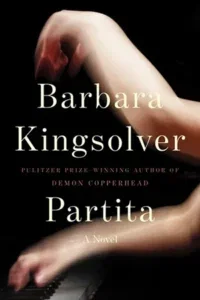
Every time an author sets out to write a book, they are in some ways wishing disaster on themselves. A thousand obstacles await, from a tardy Muse failing to spark inspiration to the many interruptions of the real world to the often dissatisfied or disinterested reading public. Then there are those writers who, after somehow coming out the other side of that vale of tears, not only whole but triumphant, have decided: Yes, I’ll do that again; willingly. This is the challenge that awaits Barbara Kingsolver with her new novel, Partita.
The reception to her 2022 masterpiece Demon Copperhead was everything a 21st-century American novelist could want but never dared to hope for: millions of copies sold, ecstatic reviews, and a Pulitzer Prize, not to mention inclusion in Oprah’s Book Club. A blustering Appalachian monster of a story about addiction, ravening despair, and the awful beauty of the ties that bind, Demon Copperhead was one of the few modern novels to actually earn its Dickens comparisons.
A hard act to follow. Partita does not try to replicate that book’s highwire act. This lessens the risk of letdown but also undercuts the story’s potential to be as transportive as we know Kingsolver can be at her best. More modest in scope and less raucous in tone than Demon Copperhead with its barnstorming melodramas, Partita is a soulful lament of lives interrupted, tricked out with romantic flourishes and op-ed asides before finishing with a surprising last beat of optimism.
Kingsolver’s narrator, Livia Cole, is introduced as a middle-aged woman living a quiet life on a Tennessee dairy farm with her solidly supportive husband, who seems to have no secrets. She is wrestling with the torments twitched up by the death of her domineering mother and the ghost of her younger brother, long dead by suicide, when she gets a call from a man named Sigurd who decades earlier turned her life around and maybe helped her ruin it.
With that, Livia takes us back to the late 1980s, when she was a small-town piano prodigy who, against her mother’s wishes, was attending the state university on scholarship. Spare and almost ascetic, with few possessions (a reaction to her mother’s hoarding) and almost no social life, Livia is drunk on music. A passage about her teenage competitions rings with the joy of creation but also competition:
Just wait until you hear me was what I always thought, trusting the rush of competence to flood into my hands along with the passions that blazed through my body, vibrating out through the piano strings, pinning my listeners to the backs of their seats … I have a satisfying memory of the pimple-faced Chattanooga boy, open-mouthed. Later that day, he asked me for my phone number, to what end, I couldn’t guess and didn’t oblige. I had a much bigger love on my hands than any fifteen-year-old boy could hope to breach.
Outside of music, though, Livia seems adrift. Sleepwalking through a run-of-the-mill relationship that barely registers in her memories, she sparks to life when she sees Sigurd. Older and worldly, he’s a typesetter and socialist organizer who passes out radical leaflets on campus. Beautiful, funny, and confident without being arrogant or making her feel ashamed of her provincialism, he is also the first thing to spark Livia to life, which did not involve turning marks on paper into transportive music.
Nevertheless, though Livia is anxious and angry as a scholarship farm girl among students who talked unselfconsciously about vacationing in France, she keeps his beliefs and dreams of a worker’s paradise at arm’s length. Kingsolver threads her politics carefully here, avoiding the temptation some readers might feel to make Livia thrill to the music of righteous revolution.
Livia’s unromantic upbringing in farmland, the up-at-dawn grind and daily tension of being just one bad harvest from devastation, has largely inoculated her against fantasies—of equality, utopia, or even love—outside of what she feels when roaring through Chopin’s “Raindrop” prelude (“I’d grown up understanding all the -isms as dangers on par with too-tight dresses”). She is not blind to class, describing Sigurd trying to “sell Marxism to Chicago bank managers’ kids who gave revolution a thumbs-up but wouldn’t quite look at him because he dressed like their parents’ gardener.”
Of course, Livia sets off on a torrid affair with Sigurd. Of course, it ends poorly. We learn this in the first pages when it’s teased that her bounded existence seems to have resulted from whatever transpired between them. Though it ends before Partita’s halfway point and is frequently interrupted by flash-forwards, this brief, electric coupling is both the book’s beating heart and Livia’s only grasp of a full life. It’s a deft piece of writing, with the affair’s breathless anticipation and sumptuous obsession easily taking a reader’s breath away, but it’s kept from the brink of being overwrought by Livia’s fundamentally grounded nature, which, though protecting her to some degree, also nearly dooms her.
The later parts of the novel track the indignities Livia suffers after things end with Sigurd and how she pulls her life back together. Kingsolver does her best with these sections, which range from gnarly to heartbreaking before achieving a kind of numbed acceptance once Livia understands all the things that will never happen to her and the family legacy she may not be able to escape. Some of the writing will remind readers of Demon Copperhead, with Kingsolver’s keen sense for the not-quite-buried animosities of the urban-rural divide and the stolid determination of her blue-collar characters to keep forces beyond their control from robbing them of their dignity.
In the same way that Partita sits somewhat unfortunately in Demon Copperhead’s shadow, this novel struggles to escape the gravitational pull of the relationship at its core. Too much of the material around it feels supplementary, drawn from other sources—one of Livia’s chattier friends seems placed here for expository purposes alone, as though Barbara Ehrenreich had dropped by uninvited and had thoughts to share—and somewhat colorless by comparison. Though Kingsolver crafts a good enough conclusion with Sigurd’s long-delayed return that unites all of her themes into one accelerating glissando, the sense of temporary uplift or peace it tries to convey feels forced.
Partita is a novel about loss and every dream deferred. Even a well-meaning attempt to paint that over only makes the ache worse.