
Saxophonist Ben Wendel has been experimenting with form and technology throughout most of his career. He is an ambitious composer and fluid improviser, so that makes him a “jazz” musician by default. Whether on his own or as a founding member of the band Kneebody, he has played with groove-oriented rhythms, electronics, and unusual instrumentation, as if jazz tradition were secondary to creativity. His new album, BaRcoDe, uniquely does exactly that.
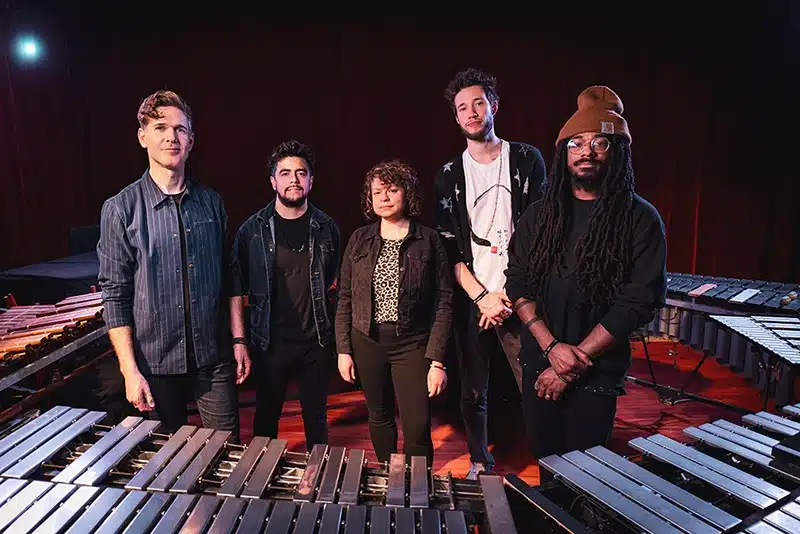
Recorded after this band had a pair of residencies at New York City’s Jazz Gallery, BaRcoDe brings Wendel together with four innovative vibraphonists/percussionists: Patricia Brennan, Simon Moullier, Joel Ross, and Juan Diego Villalobos. You heard me. That’s the band: tenor saxophone plus four mallet percussionists playing tightly arranged charts on vibes, marimba, balafon, and percussion, much of it enhanced with electronics.
The result is a set of five Ben Wendel originals and one arrangement of a song by Antonio Carlos Jobim, mostly patterned in careful orchestration. They tend to pulse, throb, and shimmer with a happy, positive momentum. Wendel is not the only improvising soloist — the vibephonists/marimbists are set loose as well. There isn’t any album I know that sounds like it.
“Mimo”, for example, starts with a single vibes player creating a simple, repeated, two-note pattern, adds a second set of mallets and a shade more complexity, brings in the ripping theme on saxophone, only then adds hand percussion and, eventually, dollops on deep bass notes from the balafon. The theme shifts to half-time, a blues pattern slides in, and rich polyrhythms appear, morph, and fuel improvisations. The solos use the full range of textures available to this group.
By contrast, the BaRcoDe band don’t always sound like a chattering group of chimers who lift Wendel’s usually bright, compelling horn. “Lonely One” is spare and slow, with one vibraphone playing a series of harmonies expressed in downward arpeggios and other percussionists joining sparingly. Someone whistles a blues melody (or are those electronic overtones?), and then Wendel’s horn plays a mournful theme, aided by some echo effects. Solos rapturously flow. On an out-chorus that gently turns major, Wendel’s horn sounds occasionally like a crying electric guitar.
Similarly, the Jobim tune “Olha Maria” evokes richer harmonies at a ballad tempo. Wendel asks one of the vibes players to take the first section of melody, then he joins in unison. Some of the harmonies are arpeggiated, which provides this performance with its flow — there is no hand percussion. In other spots, chords are played all at once, richly, and very low bass notes seem to creep in electronically.
A more typical track is “Birds Ascend”, with two mallet players in unison on a very fast and precise pattern, creating a feeling of precision merging with freedom. The saxophone becomes a third voice, then a harmonized pattern emerges from the vibes. Low notes anchor it all, and other notes wobble out of ideal pitch through electronic manipulation, creating tension as vibes improvise and Wendel uses his horn as accompaniment.
“Repeat After Me” features Villalobos’ hand percussion, establishing a mid-tempo groove that could be a modified tango. The highlight here is a set of traded fours between the saxophone and Joel Ross’s marimba. The groove gets deep and funky, despite the lack of a traditional rhythm section. It’s extra special when the tenor and one vibraphone play a lick in sharp unison against the funky percussion, given electronic depth. It grooves.
The programmatic shimmer at the start of “Clouds” is what opens BaRcoDe with almost baroque detail. The interplay of mallets makes the accompaniment shine, and Wendel has his typically bright tenor sound occasionally fuzzed with a bit of electronics, adding to the way this performance glitters in the sky.
Ben Wendel’s tenor saxophone playing shines on every track. He plays with fierce elegance. There is not a single dull note or unimpassioned moment in his solos. His sound, which leans toward the bright and clear, is still malleable and full of tonal variation, including his interest in subtly using effects on the horn. Comparisons are facile and, in Wendel’s case, truly hard to even dream up. He has the sharp excitement of Brecker, the shaded patterning of Mark Turner, and the melody-forward ease of Joshua Redman. But each of those connections is merely passing. Ben Wendel, to my ears, plays with his own voice.
I can imagine some listeners finding BaRcoDe to be slightly cold or programmed. While there is plenty of rhythmic momentum, it is choppy and, at times, mechanical, with the many percussion instruments lacking a legato gear to help the music swoop and slide. I remember listening to Pat Metheny’s Orchestrion project (2010), in which his guitar somehow triggered an elaborate mechanical contraption comprised primarily of percussive sounds, including hammers plucking strings. It was thrilling but a skosh inhuman.
Here, of course, the four-person percussion army is utterly human. I find the “swing” that it generates to be compelling precisely because it doesn’t sound like a drum kit and acoustic bass, that “jazz sound” that I adore but have almost come to assume on so many records. Wendel, along with Brennan, Ross, Moullier, and Villalobos, is finding rhythmic movement in the push-pull of hammers that are 99% precise but then shifted into tension by ingenious writing/arrangement, by electronics that color the sounds of the percussion in interesting ways, and by the small imperfections that jazz musicians naturally and artfully bring to their phrasing. I find the ensemble to be, utterly, a “jazz” group, with all its give-and-take.
However, there is no question that the choice of instruments and the amount of detailed arrangement push the music toward chamber music or “new music” to some degree. The album can be reminiscent of 2023’s All One, on which Wendel created dazzling arrangements for his own horns, overdubbing many parts in small concertos for a list of guest soloists. That album, which I profoundly enjoyed, was a “pandemic project” that grew out of isolation. BaRcoDe is different — a truly collaborative project, with each voice leaping out of the ensemble as appropriate. However, it remains true that Wendel’s brilliance at arranging the group with such precise action makes it sound less like a traditional “jazz”.
That is cool with me. It swings still, in its own way, and the thrill of hearing a truly new way of approaching an improvising ensemble can’t be beat. Ben Wendel’s BaRcoDe is unique and uniquely excellent.