
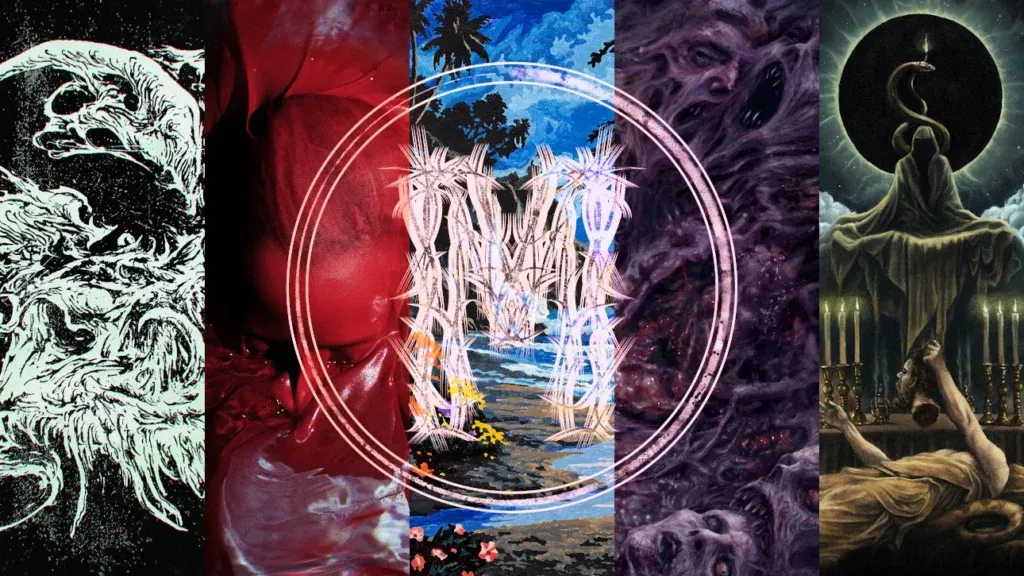
So, 2026. Let’s see if we get through this one as well! Regardless, there are already many excellent records to go through. The multiple interpretations of death metal still take centre stage, with Void Monuments going for a more traditional approach, while Voidhammer inject a crust quality into the genre’s form. On the heavier side, Exxûl unleash a tour de force of doom/power grandeur, with some off-kilter additions to spice things up, while the Ruins of Beverast continue to rest on the top of the hill with their brew of blackened death/doom.
On the more adventurous side, Zu cross the streams of their early days’ free jazz and post-hardcore fascinations with their recent ambient and post-rock ideas. At the same time, Ulver turn back the clock, leaving behind the electronica of their recent releases, and revisiting the days of Perdition City (and we are very happy about it!). That and much more, so dig in! – Spyros Stasis
Best Metal Albums of January 2026
Barbarian – Reek of God (Dying Victims)
Around since 2009, Italy’s Barbarian have carved out their own niche of the now-and-then wildly popular blend of black, speed, thrash, and trad metal, pushing it to its rawest, most primal extremes. Their latest LP, Reek Of God, continues down the same path, with riffs upon riffs tightly woven around filthy rhythmic cores, at once relentlessly propulsive and strangely anarchic. Tempos change often here, flowing from chugging grooves into stretches of what feels like an endless live stream of sped-up crucifixions—complete with a soundtrack of screams and hammered nails. Bonus points for referencing anarcho punk legends Crass—the lyrics to the extra gnarly “Shit He Forgives” were inspired by “Reality Asylum”—and covering the equally legendary grunge band L7 (“Freak Magnet”). – Antonio Poscic
Blackwater Holylight – Not Here Not Gone (Suicide Squeeze)
The pages of this column have been graced by many a heavy album that outwardly had very little in common with metal but whose spirit belonged to the idiomatic world of the genre (see Ulver below, for example). Blackwater Holylight deconstruct this archetype, turning it on its head. On the surface, the Portland, Oregon outfit play a mixture of doom and black metal, shoegaze, and variations thereof. Yet, the heart of the ten songs on Not Here Not Gone is filled with the softness of indie rock and pop, all of it embraced by the bittersweet warmth of lowercase mundane tragedies: broken relationships, missed chances, and existential anxieties.
It’s an ingenious subversion of both metal and singer-songwriter vernaculars. The density, sonic heft, and serrated edges of heavy music are used to breathe life into intimate songs, with the brighter disposition of opener “How Will You Feel” gradually transforming into the elevated blackgaze of “Poppyfields” and “Void to Be”, which even Alcest would be envious of. The result is music that can live simultaneously in the context of a KEXP set hosted by Cheryl Waters, side-by-side with Lucy Dacus or Julien Baker, and on stage in metal clubs, with tremolo-picked riffs and kick drums going scorched Earth. – Antonio Poscic
Bone Weapon – Chaos Marked By Death of Sun (Transylvanian Recordings)
Even in a film genre inundated with gore and brutality, S. Craig Zehler’s 2015 cannibalistic Western horror Bone Tomahawk stands out for its carefully constructed mise en scène and visceral storytelling that gnaw at something deeply hidden, lizard-brain-activated in our psyches. Chaos Marked By Death of Sun, the debut LP by Philadelphia’s death-doom metal trio Bone Weapon, doesn’t quite reach the same levels of affect, but it successfully strikes a similar nerve.
Where Zehler used subtle visual cues to unsettle his viewers’ subconscious, Bone Weapon unfurl a sinister imaginarium of death and doom metal elements—riffs that were probably made by dragging a guitar through mud, bass-drum rhythms that stagger and clobber as if in their dying moments—to draw listeners into an asphyxiating atmosphere, subverting expectations of brutality for haute tension and horror. – Antonio Poscic
Exxûl – Sealed Into None (Productions TSO/Nameless Grave)
The constellation of the Perpetual Planes has delivered many worthy acts. From the funeral doom of Atramentus and the technical death metal of Chthe’ilist, to the Hellenic-inspired black metal of Zeicrydeus, the group has cultivated a strong catalogue. The common thread is not stylistic unity, but a deep appreciation of lineage paired with a conscious effort to push tradition forward. Exxûl emerge from this ethos, their debut drawing heavily on established forms while reshaping them organically.
The core tradition for Exxûl’s debut lies at the intersection of doom/power. The big, determined riffs of “Blighted Entity” come crushing down, bringing with them in equal parts a Sabbathian weight and a traditionally heavy metal sense. It is a lineage that finds its origin in the great works of Candlemass and Solitude Aeternus, and has carried on through Memory Garden and Memento Mori. Exxûl immerse themselves in this mould, telling tales of dread and doom through their long-form compositions while creating a rich sonic backdrop of timpani and choirs. The picture is complete with sharp, heavy metal riffing, stepping away from the doom domain, and adding all the headbanging and galloping energy.
While the foundation is undeniable, Exxûl offer glimpses into parallel realms, some of which are quite surprising. Alongside the doom riffs and the echoing high-pitched vocals, there is a progressive inclination. The long-form nature of the tracks not only extends their epic storytelling but also gives Exxûl enough time to explore their complex ideas. Their songwriting is nuanced, similar to their tales. It does not follow a simple form; it offers delayed gratification through its maze-like structure. It gives birth to more discordant ideas, with “Walls of Endless Darkness” seeing the guitars descend to a dissonant setting that sounds eerily close to Snorre Ruch’s early visions.
On the surface, it might not be obvious what Exxûl are after. Listening to Sealed Into None without paying close attention can make the record appear dated, a record seemingly content to reassemble common doom and heavy metal tropes. Even then, it would still stand as a strong entry in the genre. A closer listen, however, reveals a more deliberate design. The progressive mindset cuts through the doom/power grandeur, while blackened, off-kilter disharmonies lend the material a darker, more unsettling undercurrent.
Thus, Exxûl succeed not by reinventing their chosen form, but by deepening it, crafting a record that rewards patience and attentive listening, and in the process, they succeed where the rest of the Perpetual Planes squad have succeeded. – Spyros Stasis
Furi Helium – No Altar Stands Eternal (Independent)
While Kreator’s new album, Krushers of the World, is at the very least good, it also once again highlights the dearly missed, more traditional thrash and speed elements the German stalwarts left behind in pursuit of a sound closer to melodic death metal. Today, Kreator are less Exodus and more At the Gates, so it’s up to bands like Barcelona’s quintet Furi Helium (“black sun” in Latin) to step in and fill their old shoes, nurturing a back-to-basics approach that’s big, tasty, and full of furi (sic).
At times, like on both the chainsawing, careening “Break the Chains” and the slower, groovier “Criminals”, they sound like a snapshot taken from Kreator’s past, blending angry fucking riffs with decidedly contemporary, death metal-adjacent visions of the genre. Although the music sounds simple and familiar, that doesn’t mean it won’t melt your face, mind, and spirit. – Antonio Poscic
Ligation – After Gods (Personal)
Marko Neuman is an explorer of all things weird and bizarre. In the past, with Dark Buddha Rising, he explored the psychedelic undercurrents of drone and doom. More recently, he has boarded the Sum of R spaceship, bending noise rock, post-rock, and dark ambient into an otherworldly mesh. Still, his newest Ligation alongside Profetus and ex-Katakombi member Mikko Saarikoski is the most deliberately antagonistic. Joined by bassist T. Isoviita, the trio descends into a pastiche of undecipherable extreme music.
On paper, Ligation present themselves a death/doom band with noise influences. In reality, they are all over the place. Their points of reference in their debut, After Gods, blur so much into one another that they become unrecognisable. They do not look to follow tradition, but rather unravel notions of genre. The first to fall is death metal, where the expected slow, guttural stench is replaced by something more reminiscent of technical death metal played by punks who have listened to too much Die Kruezen. This is just the tip of the iceberg, as Ligation also contort the progressive takes of Pan.Thy.Monium to a noisy stampede, to the point that it starts to resemble something of mid-era Neurosis.
Doom metal also does not escape their machinations. “Turmoil In Everest” performs a demented Black Sabbathian overture, with punk lineage again echoing through the bleakness. The weight here is further augmented by an industrial layer, its mechanized approach distorting the genre’s traditional form. The cherry on top arrives with the noise intersections. Here, bursts of white havoc aim to disrupt the proceedings, while the demonic saxophone solo destroys what remains in terms of logic and purpose.
In this manner, After Gods becomes a completely Dionysian experience. It lets aside any conscious notion of compositional rigour or solid structure. That is a difficult one to pull, as there is an ever-looming danger of just creating an absolute mess. This could easily result in an over-saturation, too many ideas colliding into incoherence. The noise could have taken over, or the death/thrash ideas could feel pointlessly inserted, but it never gets to that point. Instead, Ligation lose themselves in an ecstatic revelation, and it is exactly this feeling of losing control and surrendering to a creative process that elevates After Gods. – Spyros Stasis
Oraculum – Hybris Divina (Invictus)
The names of Nicolás R. Montoya and Eric Brisso are deeply ingrained in the Chilean extreme metal underground. Their most famous vehicle is Wrathprayer, a black/death steamroller that taps into the primal essence of Teitanblood and Pseudogod. What separates it from the crowd is the duo’s keen understanding of the mechanics of black/death, and not simply a desire to produce uncontrollable noise and havoc. It is the same discipline that they apply, but where Wrathprayer thrives on excess and saturation, Oraculum is defined by restrained and architectural pacing.
Joined most recently by Ricardo Tillería Ochoa on guitars, Oraculum’s debut, Hybris Divina, embeds itself in the primal death metal tradition, paying homage to its various forms. The start is quite telling, as grandeur radiates through the slow pacing of “A Monument to Fallen Virtues”. More than an intro, it acts as the connecting bridge to a more gruelling style of death metal, one that has been carried down the ages. The doom-laden playbook of Incantation shines through the ceremonial dread, while torturous progression is imbued with skeletal lead work piercing through the heavy riff layers.
From this starting point, Oraculum let their eldritch form slither through the cracks. Their groove transforms, from slow and torturous to defiant and polemic. It is full swing, taking them from the death/doom of “Dolos” to the black/death of “Mendacious Heroism” and “Carnage”. Brutal staccato pacing is as easy for them as the slow, abstracted doom form. Similarly, their guitar work can vary. On one hand, they are drawn to the gritty and grey style of Morgoth, but they are also fluent in the proto-death form. In this case, they unleash completely unhinged leads, mirroring the schizoid shapes of Possessed and early Slayer.
It all mirrors the core principle that defines Oraculum. This fine balance between chaos and order. A feeling of being in complete control, and yet at the very verge of losing it. On the surface, Hybris Divina might feel like a merely aggressive, old-school death metal record, but under the surface, there is something much more calculating. This ability, to keep one foot in the animalistic and the other in the cerebral, is what ultimately defines this record. Some of the greatest death metal bands excelled in being able to do exactly that, and Oraculum are firmly marching toward that pantheon. – Spyros Stasis
Qasu – A Bleak King Cometh (Phantom Limb/Apocalyptic Witchcraft)
Ancient future black metal. A contradictory statement, but one that fits Qasu, the project of instrumentalist/songwriter Aldous Daniken, vocalistic and electronics programmer Rahsaan Sagan, and prodigy drummer Nikhil Talwalkar (of Anal Stabwound and a myriad other projects). This contradiction is the key to understanding Qasu. Their goal is not, like many others, to drag black metal kicking and screaming into the future, forgetting its origins and in the process arriving at something diluted. No, they instead look to harness its ancient core and use its characteristics to guide them toward an unknown, unexplored future.
Their debut, A Bleak King Cometh, makes this clear from the start. An ominous droning sound introduces the proceedings, and is followed by a highly distorted (you can see the square waves) Thorns-ian riff, and not one from the 2001 record, but rather a lost track from the Grymyrk tape. The result is more nuanced, with Talwalkar laying down a frenetic drum performance while Sagan’s vocals, buried beneath the distortion, sound demented.
With the connection to the past achieved, Qasu now expand their scope. Like Thorns, they see the structure and coldness of industrial as a fitting accompaniment, turning “The Bitter Waters of the Abyssal Sea” into an abstracted, mechanical form that owes much to the early days of Swans, while “Faith in Violence” weaponizes the distortion to reach My Bloody Valentine levels of simultaneous rawness and grace.
Returning to the black metal foundation, Qasu also display a keen insight into its ambient leanings, cultivating a decadent, claustrophobic atmosphere aided by distortion and lo-fi production aesthetics. Here, they find further opportunities to increase depth, drawing on the electronica domain, where programmed beats appear within the vast sonic landscape. There are many flavours here, from the mystery and bleakness of “The Long Knives of the King” and the minimal, post-techno aesthetics of “Jewels Where the Eyes Once Were”. But, it is “Death Dreams” that steals the show, combining the same cavernous aesthetic with something akin to Burial’s deconstructed garage interpretations.
A Bleak King Cometh is successful due to its ability to find connections where none seem to exist. Black metal’s experimentation with industrial and electronic music can be traced back to the genre’s origins. Its latter-day exploration of shoegaze and noise rock has defined much of the last decade and forced many acts into the mainstream. Yet, it feels like Qasu understand how to use these connections in a novel way, finding pathways where before there were only dead ends. – Spyros Stasis
The Ruins of Beverast – Tempelschlaf (Ván)
With Tempelschlaf, the Ruins of Beverast’s Alexander von Meilenwald further codifies his unique dialect of blackened doom metal, balancing an avant-garde sense for songwriting and Thespian knack for drama with a profound understanding of the genre’s lingering shadows. The album functions as a liturgical descent, where furious blast-beats dissolve into subterranean ferocity and a fractured sort of radiance.
The title track opens the album by diving straight into the heart of darkness, intertwining doom elements with the gelid aloofness of gothic rock, as von Meilenwald’s velvety yet commanding, ever-so-slightly vibrato-tinged baritone guides us through a soundscape of hypnotic rhythms, glacial synths, and post-punk-evoking riffs. Elsewhere, this atmospheric sonic miasma solidifies into firmer avant-black metal tracks (“The Carrion Cocoon”), their loose structures and progressive flow bringing to mind the Memento Collider-era of Norwegian avant-metallers Virus—the highest praise an album in this niche of the metal world can receive. – Antonio Poscic
Sanctvs – De l’Âbime au Plérôme (Osmose)
Since the early 2010s, Xavier Berthiaume has been producing stunning works of black metal excellence. With Gevurah, he descends into a combination of orthodox black metal with subtle Mgla and Kriegsmaschine applications, while with Oriflamme he unleashes fiery, Quebecois fervour in the fantastic L’égide ardente. His solo vehicle, Sanctvs, is sonically closer to Gevurah, but even more committed to the genre’s orthodox manifestation.
Following in the footsteps of their debut, Mors Aeterna, Sanctvs do not look to deviate from the path. Their fierce outbreaks channel Aosoth, lending “Tabula Rasa” and “La Lumière de l’Infini” a polemic and graphic quality. However, they also travel further back in the orthodox lineage, conjuring a darker presence. The seminal works of Mayhem’s opus echo throughout De l’Abîme au Plérôme, and “Rex Hominum” has something of Funeral Mist’s epic extensions. In combining these lineages, Sanctvs escape the one-dimensional trap orthodox black metal often falls into. And they do not stop there.
Their ability to stand between dissonance and melody is one of their striking characteristics. The start of “Sacrifié sur l’autel de la rédemption” harnesses the exhilarating energy and piercing timbre to deliver an intricate hook. They also take the contorted arpeggios of Deathspell Omega and re-purpose them, moving them away from the malignant cacophony and into something more melancholic and sorrowful. It is the connecting tissue that turns “Tour d’Ivoire” into a more triumphant and ecstatic offering.
In the end, Sanctvs are not searching for novelty, nor are they interested in deviation for its own sake. What drives the project is discipline, devotion, and the refinement of orthodox black metal. De l’Abîme au Plérôme is thus not a revelation, but a deepening of the craft, another deliberate step toward its mastery. – Spyros Stasis
Stabbing – Eon of Obscenity (Century Media)
Formed in the early 2020s, Stabbing submerged themselves in the brutal death metal ethos, producing a work of intense slam weight in 2021’s Extirpated Mortal Process. Offering no respite, the band’s debut was a single gear behemoth nurtured by the NY style and Devourment’s grotesque groove. It was singular, its purpose complete annihilation through the barraging blastbeats and downtuned guitars.
Eon of Obscenity stands on the same firm ground, its compass still points toward the same brutal north. Stabbing songwriting, however, has become more nuanced, less indulging in simple slam methodology and more entangled with the pioneering forces of technical brutal death. The perspective on tempo shifts away from the monolithic approach of Extirpated Mortal Process toward unpredictability. Blastbeats, which interweave with downtempo breaks, sluggish groove, and heavy chugging, explode into bursts of piercing guitar bends.
This shift is also mirrored in Bridget Lynch’s vocal delivery, which steps away from the excellent, albeit one-dimensional approach of the debut and offers a broader expressive range. Deep guttural vocals shift into pained shrieks, while the bizarre, rapidly jabbering delivery in “Inhuman Torture Chamber” is particularly disturbing.
Despite the shift, the same question that surrounded Extirpated Mortal Process still looms over Eon of Obscenity. The weight of Stabbing’s influences remains prominent. Just as it was difficult to hear “Final Flesh Feast” without immediately thinking of Devourment, it is now hard not to feel the imposing presence of Suffocation in the title track, or the spectre of Defeated Sanity when “Nauseating Composition” takes shape. Yet this feels less like derivation than a necessary stage of evolution, where refinement comes before individuality fully takes form.
Without severing these times, Stabbing have deepened their sound while retaining its earlier impact, making a controlled yet confident step forward. – Spyros Stasis
Ulver – Neverland (House of Mythology)
Norwegian outfit Ulver have long since stopped being closely associated with black metal proper, yet their emblematic style of dark ambient and synthpop—heavily laced with electronics and post-metal elements throughout all phases—was a natural evolution and refinement of the genre’s most elusive atmospheric tropes. Even in this context, Neverland feels strange and unfamiliar, a new reconfiguration for the group rather than an evolution from where they were until 2021’s Scary Muzak. The new album is also the first without keyboardist Tore Ylwizaker (RIP 2024), whose contributions significantly influenced the band’s stylistic meanderings.
What we find on Neverland, then, is an ode to dark wave, gothic rock, and 2000s and 2010s downtempo electronica à la Xploding Plastix, with occasional turns into trip-hop (“Elephant Trunk”), dubstep (“Pandora’s Box”), and IDM (“Welcome to the Jungle”). This collection of styles is as confusing in practice as it appears in writing, yet the trio of Kristoffer Rygg and Ole Aleksander Halstensgård, with new keyboardist Jørn H. Sværen, somehow makes it work, constructing a disorienting but pleasantly heady voyage through an electronic soundscape. Dark things go bump in the night, conjuring a heavier detour here and there for good measure. Dancefloor-ready heavy music, imagine that. – Antonio Poscic
Void Monuments – Posthuman Imprecation (Blood Harvest)
Void Monuments want to relive the glory days of death metal. Not its later excesses or mutations, but death metal in its most traditional form. Neither its hyper-brutal manifestations nor its progressive or technical inclinations. Their debut record, Posthumous Imprecation, instead occupies a narrow middle route, shaped by the deliberate, suffocating pacing of Incantation and the blunt immediacy of Malevolent Creation. That exact sensibility oozes through the determined pacing of “Epitome of Fear”, its progression dragging toward an unavoidable demise, its guitar leads radiating with a grey, lightless hue.
While recent old-school death metal revivals have produced magnificent works, Void Monuments instead return to the original article with near-doctrinal rigidity. This ethos affects their energy, the tracks descending with strong momentum, a wrecking ball of blastbeats and sheer intensity erupting in “The Sign of Blasphemy”. It carries the same graphic violence that defined the late 1990s, coupled with the same skeletal riffology. The melodies are contorted, their nuance and colour deliberately drained away, leaving an empty husk behind in “Decapitate the Saints”.
In fully embracing this scene and sound, Void Monuments allow themselves to be consumed by it. The final nail comes through subtle theatrics, ideas that deepen the dark, damned essence of their death metal. “Devilish Prophecies” sees intricate synthesizers rise from the abyss, lending the record a genuinely horrific dimension. A similar effect emerges through the twisting guitar work of the closing track, “Father of Sin”, pulling the band closer to a world below.
Posthumous Imprecation excels through its dedication. Void Monuments have not merely ingested the style and sound of the 1990s death metal. They have internalized its ethos and produced a record that feels less like a revival than a continuation. – Spyros Stasis
Voidhämmer – Noxious Emissions (Caligari)
Noxious Emissions, the debut by California trio Voidhämmer, is barely 15 minutes long, but that’s plenty of time in the right hands to deliver some of the most vicious and disgusting death metal we’ve heard in recent years. The trio of Roger Herrera (vocals/guitars), Mike Royal (vocals/bass), and Shane Bogdan (drums) are all members of another excellent Californian death metal band, Karst. With Voidhämmer, they take that already pretty effective crusty style, tighten it up by adding just a bit of old school groove, and plunge everything into subterranean pits. It’s all crushing pressure and sensations of being buried alive down there, while a horde of demons screams, stomps, and roars just around the corner. – Antonio Poscic
Zu – Ferrum Sidereum (House of Mythology)
Zu’s story is one of experimentation and improvisation, but also one of evolution. Looking back at their 1999 debut, Bromio, it is easy to see an act guided by a Zorn-ian spirit, and its various manifestations, especially Painkiller. As the years passed, however, Zu began moving further outward toward the ambient realm. 2015’s Cortar Todo sowed these first seeds, but it was the follow-up, Jhator, that fully embraced them.
Zu’s trajectory shifted, with the record that followed continuing along this abstract orbit, but that motion is about to stall. Their new record, Ferrum Sidereum, is not so much a return to an earlier place as it is a consolidation of paths. The double album is an overarching work that maps the entire history of the Italian trio, diving back into its math rock origins, moving through free-jazz passageways and post-hardcore rhythms, and then soaring into post-rock grandeur and ambient bliss.
Ferrum Sidereum operates linearly. Its first half indulges in the volatile. “Charagma” and “Golgotha” tap into Zu’s abrasive edge, combining post-hardcore and alternative metal with free jazz. The drumming operates in the realm of precision; its meticulous counting forms a dizzying sense of repetition. It merges the industrial with the tribal, cold and calculating on one hand, expressive and otherworldly on the other. The saxophone roars in strained frenzy, while bass and guitars move from Faith No More-like bounce and riffing to low-key sound design. A sense of volatility dominates the opening stretch.
The second half, however, takes a different turn. Zu drop hints early on, as “La Donna Vestita Di Sole” opens up this grand sense, reminiscent of Jhator. Pads brilliantly adorn the background, while the erratic drumming suspends any stable sense of structure. What follows is a deeply meditative stretch, where progressive rock influences meet with post-rock and post-metallic concepts of pacing and scale. “Hymn of the Pearl” operates in that abstract domain, following a cycle of construction, peak, and deconstruction that defined post-metal’s heyday in the early 2000s.
Some may see this consolidation as contradictory, with Zu torn between their earlier volatility and their latter-day abstract illumination. While these two sides indeed exist and push against each other on Ferrum Sidereum, it is the band’s sense of placement and progression that alleviates this tension. Here, the incorporations feel natural, recurrent patterns, and complementary counterparts rather than competing impulses.
It is this sense of arrangement, coupled with the band’s long-standing history of excellent musicianship, fearless improvisation, and deep knowledge of sound design, that makes Ferrum Sidereum succeed and makes it stand proudly alongside not only Jhator but also Bromio. – Spyros Stasis
- MetalMatters: The Best Metal Albums of December 2025
- MetalMatters: The Best Metal Albums of November 2025
- MetalMatters: The Best Metal Albums of October 2025
- MetalMatters: The Best Metal Albums of September 2025
- MetalMatters: The Best Metal Albums of August 2025
- MetalMatters: The Best Metal Albums of July 2025
- MetalMatters: The Best Metal Albums of June 2025
- MetalMatters: The Best Metal Albums of May 2025
- MetalMatters: The Best Metal Albums of April 2025
- MetalMatters: The Best Metal Albums of March 2025