
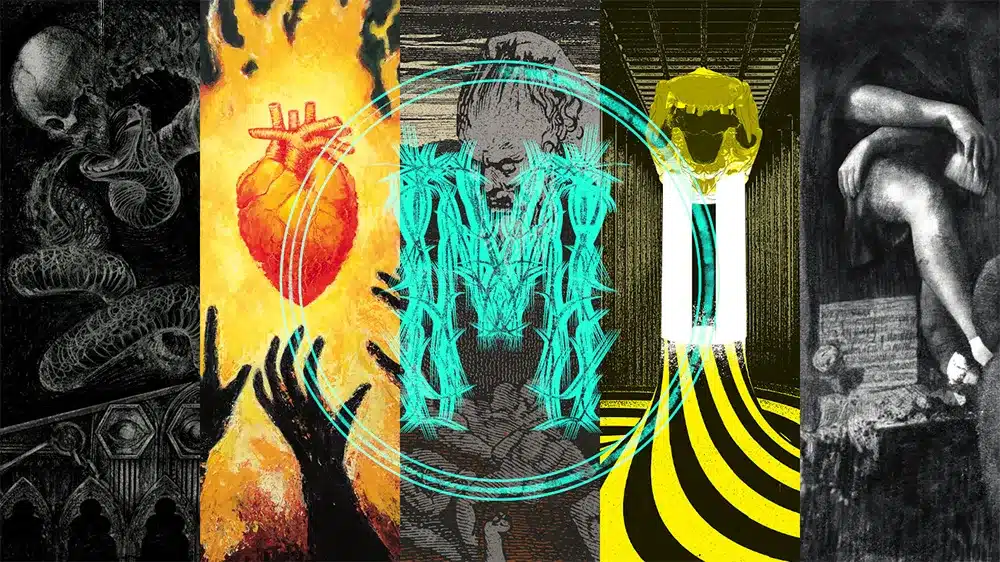
Even at the end of the year, December still packed a punch in best metal, with fascinating works of forward-thinking extreme metal, but also many plunged into the dark, traditionalist vein. From Rotten Sound’s thunderous EP, to Lychgate’s off-kilter organ fasciations, all the way to Dälek collaborating with the one and only Charles Hayward. There is something for everyone here, so dig in! – Spyros Stasis
Best Metal Albums
Dälek and Charles Hayward – HAYWARDxDÄLEK (Relapse)
From Faust to the Young Gods, Dälek’s collaborations are always on point. The experimental hip-hop act’s noise and ambient inclinations made a fitting pairing with krautrock and industrial acts. Their new collaboration sees them working with legendary artist Charles Hayward, of This Heat fame. The premise is intriguing, not just because of Hayward’s range, from experimental to free-jazz, but because his approach to rhythm and structure naturally complements Dälek’s sculptural ambient sensibility.
The foundation of this work lies in the ambient. “Increments” immediately reveals this focus, as droning noise creates an enveloping space. Attention to sound design is crucial, with minimal spaces coming alive through tiny intrusions or barely there gestures. “Between the World and The Drum” is the first major example, its micro-sounds, gentle cymbal flickers, and immersive synth wash setting the tone for the record’s patient world-building. Still, the most stunning moment arrives with “Sojourn”, where a lone harmonica tears through drones and momentarily reframes the album in stark, human terms.
The possibilities from there seem endless. Hayward’s drumming takes charge, pushing “Increments” and “Re-Evolution” toward a mind of motorik drift, a loose, cosmic momentum that feels both grounded and infinite. This effortless flow, honed through decades of improvisation, imbues “Antiphony” with deep meditative pull, a moment where the self seems to dissolve into motion. However, this abstractness has multiple faces, and moments like “Salvage” reveal Hayward’s quasi-jazz notions, a more abrasive sense brewing below the surface.
On the other hand, Will Brooks, aka MC Dälek, delivers a vocal performance that anchors the record. His lyrics echo through the vast spaces of “Between the World and the Drum”, the mantra-like repetition building an intoxicating dreamscape. Whether the moment is structured around minimalism (“As Children Chant”) or harsh beats (“Breathe Slow”), his performance remains assured, able to inhabit both narratives with ease and clarity.
It is another testament to Dälek’s instinct for collaboration, one that feels less like a fusion and more like a shared language emerging in real time. Their work with Hayward may well be their most complete and resonant collaboration yet. – Spyros Stasis
Darvaza – We Are Him (Terratur Possessions)
Darvaza is the collaboration of two heavyweights and extremely prolific artists in the black metal scene. Gionata Potenti, aka Omega, has worked with the likes of Blut Aus Nord and Macabre Omen, while Bjørn Erik Holmedahl is part of the Nidrosian scene, participating in Celestial Bloodshed and the subsequent acts that would sprout from their unfortunate demise. With Darvaza, the duo remain within the Nidrosian current, a tension between ritualistic chaos and biting melodicism, between blasphemous abandon and a strangely direct and memorable songwriting core.
For their sophomore record, We Are Him, Darvaza don’t look to alter their strategy. The frenetic energy is one of the driving forces, a constant pressure that does not let go. “Chaos.Fire.Devotion” radiates a feral intensity, a pressure that cuts straight through the shadowed atmosphere of “Darvaza”. Yet, the melodic backbone is just as crucial, forged through a distinctly blackened sensibility. It contorts the traditional riffs into something more immediately gripping, as in the opening of “A Last Prayer In Gethsemane”.
Both facets converge toward immediacy. Darvaza don’t overcomplicate their vision; their songs hit hard, stick around, and then vanish before they overstay their welcome. The echoing verses and choruses of “Holy Blood” display this ability, while the rocking spirit of “Blood of No-One” further drives the point across. This approach tightens the scope, compressing the longer tracks into something that feels shorter.
Despite the melodic directness, a deeper malignancy still governs the record. It thrives most clearly in the mid-tempo stretches. “Lazarus” coils with serpentine tension, while “Slaying Heaven” rises into something grander and more ominous. This is the heart of Darvaza’s power; everything else spirals outward from that dark, commanding centre. – Spyros Stasis
Fír – Het Sinistere Ogg (Amor Fati)
Fír’s 2024 debut full-length, De Stilte van God, is a marvellous specimen of second-wave, traditionalist black metal, with a deeper application of dark ambient techniques. Without delay, the prolific spectre stays on course with a new mini-album, Het Sinister Oog, a work that further embraces the Scandinavian black metal spirit.
While ambient components remain, they are now aligned with a stricter 1990s template, no longer diverging so freely in the dark-ambient realm or tapping into the dungeon-synth spirit. Fír instead rely on simpler applications, like the clean guitar start to “Poort achter het ontaarde woud”, casting a hallucinatory shimmer across the surrounding darkness.
In turn, this sharpened focus has made their black metal more polemic, a direct and pummelling approach that once more echoes with the spirit of early Bathory. “Eeuwige nacht op de horizon” takes a more rocking tone, a decadent swagger rising to the surface through the mid-tempo stampede parts. From there, Fír can recall various forms, at times relishing a punk-ish narrative through the ragged, awkward progression, while at other times hinting at the proto-epic impulses Quorthon would later refine.
The key remains the grimness. Fír’s riffology radiates coldness, the early Darkthrone spirit piercing through the darkness in “Wapen van elementaire duisternis”, while the mean demeanour of “Bloedroven” further digs its heels in this mold. This is what lies in the heart of Fír, a relish for the 1990s black metal sound in its original form. And few contemporary acts channel this tradition with such clarity. – Spyros Stasis
Kostnatēní – Přílišnost (Willowtip)
Following their early, dissonant days, Kostnatēní envisioned an off-kilter take on black metal. Úpal marked the moment when the band’s early dissonance gave way to something radiant and unstable, a black metal fuelled by a brilliant flame rather than by a cold grimness. And it did so naturally, merging Middle-Eastern melodies and Krallice-derived extravagant renditions with ease to their blackened core.
The same sense of ambition that led to Úpal is again applied in Přílišnost, but tenfold. The record wastes no time announcing its new identity. “Dokonalé křišťálové město” detonates with a Venetian Snares-like breakbeat, its fractured pulses setting a foundation where turntable scratches, ambient dropouts, and a Killing Joke-esque industrial pulse coexist with ease. Within this new architecture, Kostnatēní tap into a noise-rock disorientation with angular progressions that recall Swans, sheets of distortion that feel sculptural, and a punk-driven volatility that keeps “Čelist utlačovatele k obrubníku” perpetually off-balance.
Taking a step back to their black metal foundation, many of the same components are still there. Their unhinged exhilaration is anchored by a Dødheimsgard backbone, while the dissonant applications once again suggest Krallice and early Serpent Column. At the same time, their drifts into the atmosphere see them unearth the Ved Buens Ende spirit, and their Middle-Eastern applications, when coupled with a death metal perspective, move closer to Lykathea Aflame.
There is richness and depth within Přílišnost, but there are times when the flow of the record is held back by the range of qualities. It reminds me a bit of how Chaos Echoes’s sophomore, Transient, was biting a bit more than it could chew. Brilliant, but slightly unfocused. If this record functions as their Transient, a volatile experiment on the edge of collapse, it also suggests the possibility of a future Mouvement. Something more distilled, focused, and revelatory. Even in this unruly form, Přílišnost remains very compelling. – Spyros Stasis
Lychgate – Precipice (Debemur Morti)
Lychgate have always pursued an expansive and increasingly architectonic interpretation of black metal. Enamoured by its symphonic applications and avant-garde notions, they constantly chose to take the path less traveled. It has been a process of evolution and fine-tuning: the austere, less structurally ambitious perspective of their self-titled debut soon blossomed into something more complex and complete. An Antidote for the Glass Pill and The Contagion in Nine Steps were emboldened by a classical perspective, placing the organ as a fundamental component of their sound.
Their new record, Precipice, places the modernist classical framework at its core, the organ once again functioning as a structural device rather than ornament. In this way, they move quite close to early Arcturus, their bizarre renditions in “Renunciation” echoing with a masquerading effect as a sense of dramatic phrasing takes hold. It is a deeply atmospheric procession, one that shows intricate moments of restraint that parallel the feverish visions of Ved Buens Ende, especially with the melancholic tone of “The Meeting of Orion and Scorpio”. Much like the seminal Norwegian act, Lychgate use dissonance for mood rather than aggression, and the result is one of the more sublime moments of the record.
What complements this classical sense is their ability to tap into jazzy motifs. Here, they avoid the genre’s usual flamboyant displays, instead opting for the subtle road of modal wandering and rhythmic looseness. “Death’s Twilight Kingdom” is quite unnerving in that regard; its meditative quality transforms your surroundings to a space resembling the Red Room in Twin Peaks.
They still incorporate these classical and jazz-influenced elements within a more extreme metal form, here moving through the avant-garde aspirations of Dodheimsgard or late-era Abigor, but that is not Precipice‘s main pull. This is progressive inclination in its truest form, not repeating the gestures of late 1960s and early 1970s prog rock, but actively forging something novel. It’s invigorating to hear Lychgate still reaching for this, giving Precipice its distinct and forward-thinking identity. – Spyros Stasis
Martröd – Draumsýnir Eldsins (Debemur Morti)
Another project from frequent collaborators Alex Poole (Chaos Moon, Krieg) and H.V. Lyngdal (Wormlust), Martröd initially seemed like a one-off project. Their 2016 EP, Transmutation of Wounds, followed the Icelandic black metal path, honed in dissonance and rich in atmosphere, a sound that would then be championed by the likes of Mispyrming, Svartidaudi, and Wormlust. Their return with Draumsýnir Eldsins sees Martröd project a more complete vision, while still holding onto their heritage.
The dissonant pull is immediate, channeling Deathspell Omega’s principles from the start of “Sköpunin”, while also drawing from Aosoth’s latter days. In that way, they are stretching the listener’s sense of equilibrium, the cacophony and discordance always poised at a breaking point. But that never comes. As the track evolves, Martröd tap into an atmospheric stream, one that is informed by the Ved Buens Ende heritage. “Líkamin” sees this otherworldly essence rise as fumes, leading into a strange, ritualistic cadence that is informed by Wormlust. In these moments, they are at their most daring, easily moving through minimal ambiance, psychedelia, and even industrial and dark ambient motifs.
Yet, beyond mood and sonic vocabulary, what truly elevates the record is its structure. Every part feels meticulously thought out and tested, resulting in a heavily layered album where no element is without purpose. It mirrors a classical form, not in the sense of following superficial orchestral parts, but rather in embracing a compositional framework. This is the feature that propels the record to greater heights and gives an epic sense to their renditions, for instance, with the staggering start to “Tíminn”.
Ultimately, Draumsýnir Eldsins follows the path laid out by Poole and Lyngdal’s other works, especially Skáphe, yet pushes further, refining that dissonant, otherworldly language into something more purposeful and commanding. – Spyros Stasis
Rotten Sound – Mass Extinction (Season of Mist)
Comfortably sitting on the grindcore pantheon, Rotten Sound continue their pattern of dropping a shorter, brutal EP in the wake of each full-length. Mass Extinction channels the spirit of Apocalypse, coming out all guns blazing with “Recycle”, sharpening their Nasum-derived DNA to an even more focused burst of anger. Ultra-fast blastbeats, words spat out in cutthroat fashion, the madness elevates moments like “Empty Shells” and “Ride of the Future” to new heights.
In what feels like the blink of an eye, the EP clocks just under the ten-minute mark, Rotten Sound still evoke the usual suspects. Echoes of the old-school Swedish death metal are here, “Polarized” embracing Entombed’s heritage, while the title track decelerates to a doom-infused stomp. It might be slower, but it is no less punishing.
On the other side of the spectrum, the crust fascinations remain intact, the erratic progression of “Gone” drenched in the punk tradition, while the attitude of “Brave New World” encapsulates a dystopian vision, not so far from reality. Mass Extinction delivers exactly what it promises: 10 minutes of pure, undiluted Rotten Sound. – Spyros Stasis
Sodality – Benediction, Part 2 (NoEvDia)
Frequent collaborators Tomasz Dziubich (aka T. Kaos) of Lvcifyre and Marek Górecki (aka Mark of the Devil) of Cultes des Ghoules share a long-standing fascination with the occult pathways of the left-hand. Their partnership has already produced two formidable entities, Death Like Mass and Sodality, and after last year’s excellent The Lord of Flies, it is now Sodality’s turn to step once more into the light with Benediction, Part 2.
Sharing many traits with Death Like Mass, particularly the orthodox aesthetic, Sodality step into an earlier, more primitive black metal space. The sound is raw, decadent, and ritualistic, recalling the feverish atmosphere of early Necromantia demos. Here, everything rests on a familiar but potent triptych: dissonance, decadence, and ceremony.
The black metal foundations echo with cacophonous intent in “Heathen Angel Part II”, with Sodality employing the traditional riffing with its electrifying applications. It is a poignant form, one that becomes darker and more ominous with “Blood on a Mirror”.
The decadent element arises mainly through production, which maintains a lo-fi edge without completely surrendering definition. The inverted metallic haze of early black metal lingers, yet the extreme distortion breaks violently through it, and the ragged, contorted groove contributes to this sense of diseased momentum.
Still, the strongest quality for Benediction, Part 2 is its ceremonial aspect. The heavy drums that kick off “Confession” echo through the vast, dark cathedral spaces. Similarly, the simple progression to “Pure Light Shineth Through a Simple Servant” exposes the processional methodology through its slithering formulations, with the bizarre chants adding more weight to the background.
While Benediction, Part II is not a trailblazing work, Sodality wield their three-pronged weapon with conviction. They revel in this dark corridor, drenched in dissonance, driven by ragged frenetic force, and above all, unwavering in their ceremonial intent. It stands as a noteworthy continuation of their vision, and a reminder that the primordial pulse of the second wave’s early days remains very much alive. – Spyros Stasis
- MetalMatters: The Best Metal Albums of November 2025
- MetalMatters: The Best Metal Albums of October 2025
- MetalMatters: The Best Metal Albums of September 2025
- MetalMatters: The Best Metal Albums of August 2025
- MetalMatters: The Best Metal Albums of July 2025
- MetalMatters: The Best Metal Albums of June 2025
- MetalMatters: The Best Metal Albums of May 2025
- MetalMatters: The Best Metal Albums of April 2025
- MetalMatters: The Best Metal Albums of March 2025
- MetalMatters: The Best Metal Albums of February 2025
- MetalMatters: The Best Metal Albums of January 2025