
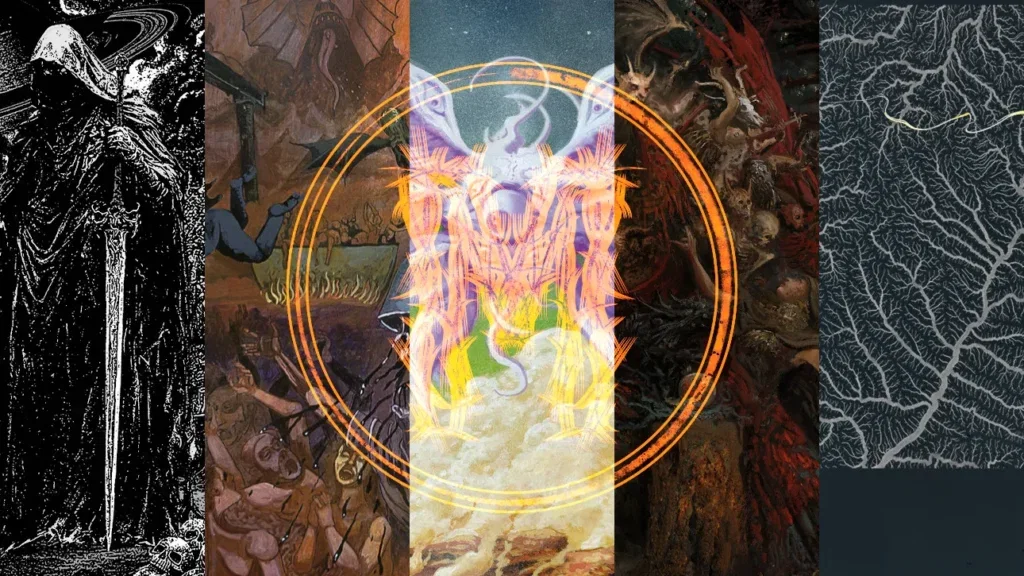
May is a month of long-awaited returns. In the month’s best metal, stalwarts of the old-school death metal ethos, Funebrarum, return after 17 years, still radiating the same cryptic and decadent stench. On the genre’s more primal side, Necroccultus also return two decades after their excellent debut, Encircling the Mysterious Necrorevalation, with a frenzied and rage-filled work. Outside of death metal, Lair of the Minotaur, one of the forerunners of the 2000s sludge revival, also unexpectedly return 16 years after Evil Power, employing the same high-octane energy to fuel their stampeding fascinations.
At the same time, newer bands appear to be hitting their stride. In the obscure drone space, My Heart an Inverted Flame continue to explore the atmospheric, quasi-doom space; Kaatayra open stepping outside of their black metal foundation; and Scimitar fulfil their high ambitions of progressive-minded blackened heavy collision. The month is rounded out by the mighty returns of Godthrymm, adding to their epic doom/death pedigree; Pharmacist, continuing to add to their forensically obsessed death/grind/thrash; and Spirit Adrift, who offer the final chapter to their heavy metal aspirations. There is something for everyone, so dig in!
The Best Metal Albums of May 2026
Funebrarum – Beckoning the Void of Eternal Silence (Pulverised)
Before the deluge of old school death metal revivalists, Funebrarum were already safeguarding the tradition. To that end, they did not fixate on a singular substrand but instead worked to coalesce its traditions. The sonic rivalry between the primal ferocity of the US scene and the groove-laden, more atmospheric expression in Europe presented an opportunity rather than a divergence. Their sparse output, only two, albeit excellent, records in 25 years, is steeped in this dichotomy, and their new record, Beckoning The Void of Eternal Silence, does not deviate from that path.
As the introduction fades and the title track kicks off, it is the ragged essence of early Autopsy and Incantation that prevails. The ragged, awkward progression unfolds at a slow, rumbling pace, as if an unwieldy force is dragging itself forward, colliding with everything in its path. It is a volatile affair, capable of reaching higher gears on “From Rotting Burial Shrouds”, where the drums take a harsher, more stampeding role. The groove can easily shift toward the European expression, where a less ragged and more direct quality emerges.
“Through the Barren Halls of Grieving Emptiness” takes a polemic form, mirroring the determined momentum of Bolt Thrower, while “Anhela Odor Mortuorum (The Adepts)” carries a rougher edge, its staggered riffs echoing with the HM-2 methodology of Grave. Together, these movements showcase how fluidly Funebrarum navigate between approaches rather than viewing them as disconnected identities.
Yet the real influence of the European scene lies in the atmosphere the record holds. That’s not new for Funebrarum, who have long explored the dark territories charted by the likes of Demigod, but in Beckoning the Void of Eternal Silence, it is pushed further. They are neither an afterthought nor a complementary part of the music, but a core component. In that way, they drench their death metal in a pervasive gloom, moving away from morbid fleshy fascinations and into a darker, otherworldly space. Again, their US pedigree grounds this approach, with their death/doom motifs echoing the deliberate practices of Winter. “The Whispering Cathedral” employs the same slow progression, the drums eternally rolling through the vast space, setting up a ritual of unknown purpose.
Even though Funebrarum step into existing traditions, looking to honour and carry them forward rather than reinvent them, what separates them is their versatility. Take Daryl Kahan’s vocal delivery, its low growls arriving with a repugnant quality. They can channel the full range of Funebrarum’s intent, from the violent stampedes to the more esoteric and gloomy moments. Similarly, the guitars morph depending on the role they need to fulfil. Here, Sam Osbourne and Phil Tougas can dive into the schizoid dissonance of the genre, their lead work spiralling out of control, but they can also deliver more pristine and melodically inclined parts when required.
In short, Funebrarum are back, and unsurprisingly, their death metal form is still operating at a high level. They continue to be among the standard bearers of the death metal creed, and they do so without sounding tired or annoyingly predictable. They remain vibrant and relevant, their death metal continuing to map out the divergent strands of the US and Europe, and bringing them together in (dis)harmony with Beckoning the Void of Eternal Silence.
Godthrymm – Projections (Profound Lore)
When Reflections, the debut record from Halifax’s Godthrymm, was released, it was an immediate stunner. Led by Hamish Glencross (ex-My Dying Bride/Solstice), Godthrymm found themselves between two parallel UK traditions, the sorrow-laden doom/death of the Peaceville Three, and the more weight-driven, epic doom of Solstice. Distortions, the second part of the Visions trilogy, followed by refining rather than reshaping that foundation. Projections ultimately struggles to sustain the consistency, resulting in a record whose peaks rival its predecessors, but whose structure ultimately falters.
The first 30 minutes of the record are excellent. The legacy of New Dark Age lives on in “Trenches Deep”, tapping into the epic doom vein. The rhythmic patterns unfold with deliberate weight, each step stretched to maximise tension. Vocally, the track leans into a more traditional heavy metal register, its range extended to accommodate both the sorrowful passages and the more devastating moments. The second half of the track further dives into this heavy mode, as the pace quickens and the delivery turns harsher, driven by the pummelling rhythmic changes.
From there on, it is the Peaceville Three spirit that takes over. The sorrowful lead work here is key, and it channels the best that the tail end of the doom/death scene had to offer. “Truth in My Own” settles on an ethereal quality, passing from initial melancholy to deep sorrow. The heavier rhythm section reinforces this shift with a sense of momentum that heightens the emotive weight.
The descent deepens with “The Sun Never Fell”, with the melodies tracing back to the darkwave origins of Fields of the Nephilim, its second half unleashing some unexpectedly groove-laden yet still depressive passages. The transformation is truly complete with the highlight of Projections in “Endure My Skin”, where Aaron Stainthorpe’s presence pulls the track toward the glory days of A Line of Deathless Kings, his delivery carrying a sense of perseverance amid deep struggle.
That’s where the record runs a bit out of steam. “Jewels” is an interesting track, more detached and elusive than the heavy hitters expected from Godthrymm. Instead, there is a strange 1970s prog tone that defines the progression, and Catherine Glencross’s vocal delivery is excellent. The main issue here is that the softer repetition of the main themes does not build toward a clear structural or emotional resolution. In turn, this disrupts the album’s momentum, as its softer sound struggles to follow the devastation of “Endure My Skin”.
“Hope Is Eternal” returns to the heavier sound but struggles to re-establish direction. Its evocation of the Peaceville Three is still excellent, the lead work and vocal delivery oozing with sentiment, but it ultimately falls short of the record’s first half.
Placed alongside Reflections and Distortions, Projections feels less consistent. Godthrymm’s willingness to expand their palette, particularly through the more ethereal and progressive leanings of “Jewels”, suggests new directions. Still, these ideas are not yet fully formed within the record’s structure. Even so, its opening stretch stands among the strongest material Godthrymm have produced, capturing a form of UK doom that few bands still articulate with such conviction. – Spyros Stasis
Kaatayra – Caminhos de Água (Independent)
Through his multiple projects, Caio Lemos has always explored various intersections of black metal with different experimental takes. And yet, even these projects evolve. In 2025, Caio Lemos released Vauruvã’s third record, Mar de Deriva, leaning further into a progressive rock inclination and leaving behind the looser, more extravagant aspects of the past. Now, Kaatayra is going through a similar transformation, but here the urge to change leaves behind much of the black metal component.
Kaatayra subscribed to the atmospheric, folk-inclined black metal sound, with their melancholic overtones paralleling those of Panopticon. In their new record, Caminhos de Água, they move away from oppressive black metal toward a more luminous and expansive sound, reorienting the music around post-black metal. To that end, they still use many of the genre’s core mechanics, employing traditional tremolo picking in cleaner passages to produce melody rather than the expected dissonance. There is a similar inversion of black metal texture here, reminiscent of the latter-day work of Botanist and the way they would use the hammered dulcimer to achieve a brighter result.
This shift gives more space for Kaatayra’s other interests. First, the electronic component can now retreat into its ambient foundations. That naturally aligns with their post-black metal direction, as the brighter soundscapes can pierce through and harmonise with the guitar melodies. More importantly, they can provide a foundation for Kaatayra’s folk aspirations.
The tribal instrumentation in “Rio Preto”, with its subtle drumming and acoustic guitar, channels a meditative quality. It also has space for more ambitious takes, like the start of “Águas Passadas”, where the beautiful piano lines interact with ambient soundscapes to craft a strangely calming and otherworldly experience. It is a different take on the Agalloch-ian tradition, but rather than infusing the music with neofolk, Lemos brings the mystical traditions of Brazilian folk to the fold.
What remains unchanged, and is a trademark of all of Lemos’ works, is the flow of the record. There is a certain fluidity to the album, each track melting into the next to offer an unbroken experience. Lemos’ refusal to rely on recurring themes or progressions to maintain the listener’s attention remains admirable. However, by reducing black metal’s presence so drastically, the album loses some of the tension and contrast that previously defined Kaatayra’s sense of movement.
While individual moments rarely repeat, the emotional and timbral palette operates on a narrower spectrum. The journey is still beautiful and intricate, but it misses the peaks of their previous works, especially Toda História pela Frente. However, Lemos has shown an uncanny ability to reinvent his projects, evolving their sound further and touching on different themes. So, this is just another chapter in Lemos’ growing story, even if this transformation does not yet reach the heights of Kaatayra’s past.
Lair of the Minotaur – I Hail I (The Grind-House)
In the 2000s heyday of sludge and heavy rock, one of the bands that flew just below the radar was Lair of the Minotaur. The Chicago band traversed the same space as early High on Fire, but there were some distinct differences. Firstly, Lair of the Minotaur possessed a higher gear, something that allowed them to deliver more extravagant and aggressive compositions. Most importantly, they had a broader scope of extreme music. While operating within the same sludge intersection of doom and heavy rock, they leaned more heavily into thrash, death, and hardcore.
Their first three records, as they worked their way to the astounding War Metal Battle Master, seamlessly combined these divergent forces. Their 2010 follow-up, Evil Power, however, found them taking a step back in their aggression and extravagance—still a solid work, but one that felt more tame. Returning after 16 years, they pick up the thread of Evil Power.
The hardcore foundation shines immediately on “Emperor of Dis”, and its poignant, beatdown-derived rhythm defines most of the record. From there, Lair of the Minotaur tap into two different metallic lineages that are associated with hardcore. The first is thrash, which imbues the songwriting with volatility, a constant sense that they are just on the verge of being derailed. For the most part, they return to a more determined sense of pacing and edge, akin to Celtic Frost’s To Megatherion, especially with the staccato riffing of “Enthroned in Violence”.
On the flip side, they can move into the doom space, where they appear as a faster, more momentum-driven take on Crowbar. In these moments, they temper their hardcore inclinations, maximising their brutality. “Saturnus Reign” is a prime example of this approach, its gruelling stomps carrying its punk origin, but the metallic tinge adds a heavier sense of impact.
While this combination already sees Lair of the Minotaur stretch their sound significantly, there are still surprises to be found in I Hail I. On the rhythmic side, they push their rhythmic approach to both extremes. “Tartarus Apocalypse” sees them descend to sludge depths, its glacial pace slowing down time while the guitar feedback crafts oppressive soundscapes. “Deepest Hell” takes the opposite direction, its pummelling drumming reaching for a fiery death/grind setup.
Stylistically, they then move further outside their already broad confinements, especially with Ethel Cain’s cover of “Family Tree”, where a blackened tremolo riff introduces the track, opening their sound toward a new direction, one worth revisiting. Similarly, “Vulture Worship” enters new territory, with synthetic instrumentation creating a strange, mystical experience rendered through industrial textures.
I Hail I is a most welcome return for Lair of the Minotaur, continuing the path started by Evil Power. However, it does not inhabit the same primal chaos that Carnage, The Ultimate Destroyer, and War Metal Battle Master did. These earlier works possessed an unhinged mentality, with structures that felt less calculated and more expressive. While I Hail I still reaches for the same sonic components, and constructs a solid amalgamation, it just misses the volatility that made Lair of the Minotaur stand out.
My Heart, an Inverted Flame – My Death Is More Beautiful Than Your Life (Crucial Blast)
The descent to the ritual is immediate. The slow progression of “Every Step Is Corpsed” acts like a pendulum, centred around Andee Connors’s deliberate drumming. At the same time, Marc Kate’s synthesisers carve through the void in bright, sharp colours. A dichotomy lies at the heart of the opening track, one that defines My Heart, an Inverted Flame’s sophomore record, My Death is More Beautiful Than Your Life. The ceremony is pulled between eras and modes, its punishing side rooted in 2000s drone/doom, its more otherworldly pull reaching back to 1960s and 1970s krautrock.
As “Every Step Is Corpsed” ends and “My Body, My Problem” settles in, the ethereal krautrock essence takes over. It shifts into an electronica-driven approach, moving closer to a contorted Tangerine Dream-like form. Here, the synthesisers turn piercing, where the soundscapes turn radiant, opening up the space. At the centre of it all is a sense of wonder, a moment when the magnitude of the cosmos can be briefly glimpsed.
Connors and Kate reach the same extravagant heights by taking a more rock-oriented approach, swapping kosmische musik drift for a more rigid krautrock framework with “Necrosomethingology”. Here, the structures are more rigid, driven by guitar-mimicked synthesisers, and a steadier rock progression. Still, the result is the same—a repetitive trip through psychedelic mindscapes that never ends and never changes.
What grounds this dreamlike fascination is the gritty and oppressive drone/doom edge. Even when it is not the main structural pillar of a track, its looming presence still infects the structure. “Whispers in a Dead Language” stays within the dreamworld, but it takes on a more ragged edge, with heavier synthesiser riffs anchoring it with an earthy weight. However, deeper descents are also possible with “Yes ( _ _ _ _ _ _ )” taking the feedback to extremes and channelling the sheer hostility of early Khanate. It plunges Connors and Kate’s world from radiant light to harrowing darkness.
It becomes even more punishing in “There Has Always Been the Disappearing Floor”, with the sparse, crushing drum hits setting up an ominous repetition and the feedback morphing into an asphyxiating form. The one downside here is that it remains too controlled, with Connors and Kate not letting it collapse into a complete debris of noise and feedback. Even in subtler moments, this restraint feels like a missed opportunity; for example, the cutthroat vocals in the background of “You. Alone” would be far more horrifying if pushed to the forefront.
The interaction between wonder and dread completes the ritual of My Death is More Beautiful Than Your Life. However, it feels like My Heart, an Inverted Flame have not yet reached their full potential. Looking at recent works that interweave darkness and light in a drone style, with Nadja’s Luminous Rot and Sunn O)))’s Life Metal/Pyroclasts standing out, it feels like Connors and Kate have not fully arrived there. Pushing further in either direction, toward total noise dissolution or fully realised krautrock structures, might be the way forward. However, their pedigree suggests they will find the next step, and it will be even stronger than their current, already solid, output. – Spyros Stasis
Necroccultus – The Afterdeath Blackness (Terror From Hell)
Hailing from Mexico, Necroccultus are part of the 2000s death metal revival, with a sound steeped deeply in early Morbid Angel and Sadistic Intent. Their 2005 debut, Encircling the Mysterious Necrorevelation, embraced the heretical death metal of the genre’s early days, focusing more on occult darkness than gore-soaked excess. For the next 20 years, Necroccultus would fly under the radar, appearing sporadically through demos, splits and EPs. Their sophomore full-length, The Afterdeath Blackness, follows the same path as their debut but emerges as a deeper, more mature work.
Necroccultus still draw from the unhinged energy of the proto-death metal scene. Their track progressions are filled with sudden twists and turns, a remnant of a glorious extreme thrash heritage. The lead work mirrors this closely, with the guitars turning toward a rabid style reminiscent of early Slayer and Possessed, while also following this lineage toward slower, melodic inclinations. “The Highest Sphere of Dead” leans on circular lead work, its catchy yet nauseating quality conjuring the slow rot of Autopsy.
Necroccultus never allow these melodic turns to soften their attack. They only use these parts to augment their decadent death metal. It’s where the influence of early South American extremity becomes crucial. Necroccultus favour a raw, violent immediacy over the cleaner precision that later death metal often pursues. “Slaughter of Bestiality” employs an awkward, simple, primitive rhythmic progression to create a sense of urgency. At its most extreme, it touches on a war-metal mentality, especially in tracks like the title track, with its blastbeat-driven rage. It also imbues a cult-ish quality, evoking the same dark, sinister undertone that defined Morbid Angel’s early evocations. “Unburied Hellish Presences” epitomises this approach; its battle frenzy here is not just erratic, but oppressive.
The Afterdeath Blackness offers little novelty compared to Encircling the Mysterious Necrorevelation. But the two-decade-long gap has given Necroccultus the advantage of presenting the same vision through better means. Most of the gain here comes from the production. While their debut had an endearing, rawer sound, The Afterdeath Blackness takes full advantage of its technological capabilities.
As a result, the lead work hits hard, especially the melodic inclinations, which now arrive with greater clarity and purpose alongside the dissonant thrash explosions. It also lets the slower parts shine. In the past, the muddied production would hold this back, the fragmented sound obscuring the groove. Here, it brings to the forefront aspects that were hidden in the past. “Multiform Devourer of Souls” gains tremendously from that shift, its final part descending to a hypnotic, quasi-psychedelic abyss, its slithering pace and putrid vocal delivery making it one of the record’s highlights.
Necroccultus remain devoted to the foundational principles of death metal, but The Afterdeath Blackness understands that authenticity does not require self-imposed limitation. Its success lies in preserving the volatility of early death metal while finally giving its details the clarity they deserve.
Pharmacist – Vertebrae After Vertebrae (Hells Headbangers)
In the tradition of goregrind bands, Pharmacist’s debut, Medical Renditions of Grinding Decomposition, combines their forensic obsessions with a guttural sonic presentation. The messy production is fitting, making the guitar leads ooze with dissonant unease. The grooves are stitched together haphazardly, their erratic shifts between rapid bursts and mid-tempo pacing feeling awkward and disjointed. Much like the works of Pathologist, it evokes the grotesque spectacle of forensic carnage, although their thicker riffing has more in common with Exhumed.
In the goregrind scene, it is nearly impossible to escape the presence of Carcass, and Pharmacist’s debut owes a great debt to Symphonies of Sickness. That is not where the parallels to the great British band end. Pharmacist’s trajectory has not remained static, and their follow-up record, Flourishing Extremities on Unspoiled Mental Grounds, sees them reach outside of goregrind.
However, instead of the technical and melodic death metal path (and unfortunate rock ‘n’ roll) that Carcass followed, Pharmacist uncover a latent thrash impulse. This tendency is strongly represented in their sophomore album, with its sharper riffs and punchier rhythmic drive owing much to thrash. But their new record, Vertebrae After Vertebrae, takes it even further.
For Pharmacist, thrash is not solely defined by the frenzied lead work and lightning-fast approach of the 1980s. They are closer to a more modern interpretation of the genre, defined by chugging riffs, heavier rhythmic emphasis, and a catchier approach. “Endogenica” is the most obvious moment of this, with the nearly seven-minute-long track delivering a crushing rhythmic assault. The tightly controlled pacing carries not only modern thrash precision but also a hardcore-informed physicality, where the hooks stand out more prominently. The dense palm-muted riffing reinforces the track’s weight. The same approach gives “Lazure Sphacelation” a more energetic, in-your-face attitude and defines the mosh-driven middle passage of “Bubonic Malacia Bloom”.
Vertebrae After Vertebrae‘s thrash leaning is powerful, and it can be seen as the driving force behind the record. The record’s rhythmic directness and immediate songwriting owe far more to thrash than death metal. However, just as it seems that Pharmacist reach the point of no return and are about to step solely into the trash territory, they pull back. “Propelling Inwards” immediately retreats into a messier compositional flow, its unpredictable rhythms channelling a more primitive violence as the guttural vocals take over. “Mimicring the Organisms” further digs into this fold, its austere approach devoid of obvious rhythmic hooks, and the vocals alternating between cutthroat screams and guttural growls, echoing the vocal dynamic of Walker and Steer.
This push and pull between death/grind and thrash is the conflict at Pharmacist’s core, and it is a nourishing tension. They can pivot between ugliness and immediacy without weakening either impulse. Take the lead work, for example, where the guitars can start in a discordant fashion, their tremolo lines and warped bends spiralling into chaos. Yet at this moment of utter chaos, Pharmacist reshape these eruptions into something vividly melodic. It works because both sides thrive in extravagance, and it is Pharmacist’s ability to ride this conflict that makes Vertebrae After Vertebrae such an exhilarating, if not particularly novel, record. – Spyros Stasis
Scimitar – Scimitarium II (Crypt of the Wizard)
Ambition drives new artists. It is common to find up-and-coming musicians striving to extend traditions they deem valuable. More often than not, this is a gradual process of maturation, one that takes time to reach its end goal. Denmark’s Scimitar is one of these rare cases where ambition appears to be almost instantly fulfilled. Their 2025 debut, Scimitarium I, collides core heavy metal ideals with extreme metal, progressive structures, and dissonant leanings. Sharp, pristine riffs twist slightly, while epic crescendos and over-the-top vocal performances arrive with a discordant edge. And yet, intricate and ambitious as their debut is, Scimitarium II looks to surpass all expectations.
In Scimitarium I, the heavy metal pedigree is at the centre. It defines rhythmic structures, timbre, and hooks. It still guides the compositions of Scimitarium II, but this time around, it is contorted. The record’s closing track, “Mobula Mobular”, best exemplifies this, with the traditional, stainless steel riffing taking the lead, and midway into the track exploding into a guitar hero-esque solo that will melt your face off. Filled with catchy melodies and sweet phrasing, it draws a direct line back to NWOBHM. But in most places, these mechanics undergo a more rigorous process. “Lunacy Jewels” similarly carries the trademarks of traditional heavy metal. But the discordant edge overtakes them, and the volatile progression pushes toward stranger, more off-kilter forms.
Here, Scimitar’s black metal allure plays a more central role. Tied with the heavy metal mechanics, the route from Mercyful Fate to Negative Plane, by way of Necromantia, lies straight ahead. This inverted heavy metal motto suits Scimitar well, and their obsession with discordant guitar work imbues their music with the same extreme yet strangely traditional aura. “Magnetic Venom” pushes the black metal heritage even further, with Scimitar reaching for a grander manifestation; the composition verges toward the regal classicism of Emperor’s IX Equilibrium, albeit in a more erratic form.
And again, Scimitar continue to push the foundations they laid down with their debut. The destabilised form, which occasionally appeared in Scimitarium I, becomes pivotal in Scimitarium II. It provides the black metal fervour with its fire, but it also supercharges the band’s progressive inclinations. The influence of Hammers of Misfortune cannot be overstated, with Scimitar further twisting the heavy metal structures towards strange, progressive ends. The influence lends an avant-garde quality to “A Reverence Warning”, with the furious drumming becoming almost a blur, while the vocals soar through the dense instrumentation like a beam of light.
While these were components always present in Scimitar’s music, Scimitarium II also opens the band up to new directions. “Through Lava Lit Roads to Lavilenda, Pt. II” takes a comparatively clean and atmospheric plunge, its mesmerising quality drawing from a different side of doom. It verges toward the Sabbath Assembly or even the Devil’s Blood aesthetic, creating a mystical and inescapable ceremony. Here, sound design becomes crucial, with Scimitar putting feedback to great use to sculpt an asphyxiating, all-encompassing sonic vortex.
Despite its extravagant presentation, Scimitarium II ultimately proves to be a lesson in balance. Beneath all the cacophony and chaos, Scimitar are always in control, harnessing these expressions rather than being consumed by them. That allows them to stretch further, push their complex structures to new heights, and reach an even more destabilised state, making their blackened eeriness more striking than before, all while retaining the vibrant heavy metal spirit still shining beneath the debris. Scimitarium I is unquestionably ambitious, but Scimitarium II is on a different level. – Spyros Stasis
Spirit Adrift – Infinite Illumination (20 Buck Spin)
Through the years, Spirit Adrift transformed from a traditional doom metal sound toward a classically inclined heavy metal approach. Listening to their new, and by all accounts final, record, this evolution does not feel so much like a gradual change as a rediscovery of a forgotten truth, one heard in the shift from lumbering doom riffs to twin-guitar leads that spiral closer to classic heavy metal. The Black Sabbath-ian lineage gave birth to a heavy metal form, but that same form was never singular; it always contained divergent expressions that could be reinvigorated from within. Infinite Illumination aims to channel these strands of heavy metal, presenting an overarching view of the genre.
“I Am Sustained” offers a concentrated metallic tour de force. So much about the song screams traditional heavy metal spirit, with melodic dual guitars spiralling into Thin Lizzy-esque madness and solo parts piercing through the mid-tempo progression. Even within this mode, there are fragments of different strains. The 1970s-era heaviness echoes through the determined riffs. The faster parts channel a thrash essence, but what are mere suggestions in “I Am Sustained” become fully fledged elsewhere.
The Black Sabbath ethos is the guiding force for Infinite Illumination. “Where Once There Was an Ocean” is drenched in a monolithic, otherworldly framework, its slow progression augmented through quasi-psychedelic applications. But later interpretations of that mode are as important. The title track oozes Trouble-esque quality, merging 1980s-sharp guitar playing and piercing vocals with a slow, determined pacing. The groove takes a southern turn with “Window Within”, gaining a swing and grit with a thicker tone leaning closer to mid-era Corrosion of Conformity.
It is easy to see how Spirit Adrift reach for a high-octane quality. It’s where traditional heavy metal touches with a latent thrash approach, an intersection between Diamond Head and Metallica. “Born in a Bad Way” and “White Death” take the pristine riffing of classic heavy metal and turn the pace down to doom depths. Suddenly, the thrash ideas become contorted, with riffs that would normally surge forward instead being dragged through a slower, heavier frame, losing momentum but gaining a ragged quality. It is exactly this blurring of boundaries that makes Spirit Adrift’s view on traditional metal so on point.
To that end, Nate Garrett and company succeed because they never waver from their heavy metal pedigree. They can tastefully awaken much of the 1980s sense of mystique. The acoustic passages and clean electric sections carry a strangely otherworldly, yet earthy feeling that narrates tales of woe. There is undoubtedly nostalgia here, but rather than simply presenting it, Spirit Adrift have made it their own. Most importantly, their heavy metal core is set, unchanging, and fundamental, but around this origin point, the doom and thrash satellites can still orbit because they are part of the same whole. Infinite Illumination is not just a reminder of that unity, but a demonstration of how naturally these extremes fold back into each other.
- MetalMatters: The Best Metal Albums of April 2026
- MetalMatters: The Best Metal Albums of March 2026
- MetalMatters: The Best Metal Albums of February 2026
- MetalMatters: Best Metal Albums of January 2026
- MetalMatters: The Best Metal Albums of December 2025
- MetalMatters: The Best Metal Albums of November 2025
- MetalMatters: The Best Metal Albums of October 2025
- MetalMatters: The Best Metal Albums of September 2025
- MetalMatters: The Best Metal Albums of August 2025
- MetalMatters: The Best Metal Albums of July 2025
- MetalMatters: The Best Metal Albums of June 2025
- MetalMatters: The Best Metal Albums of May 2025