
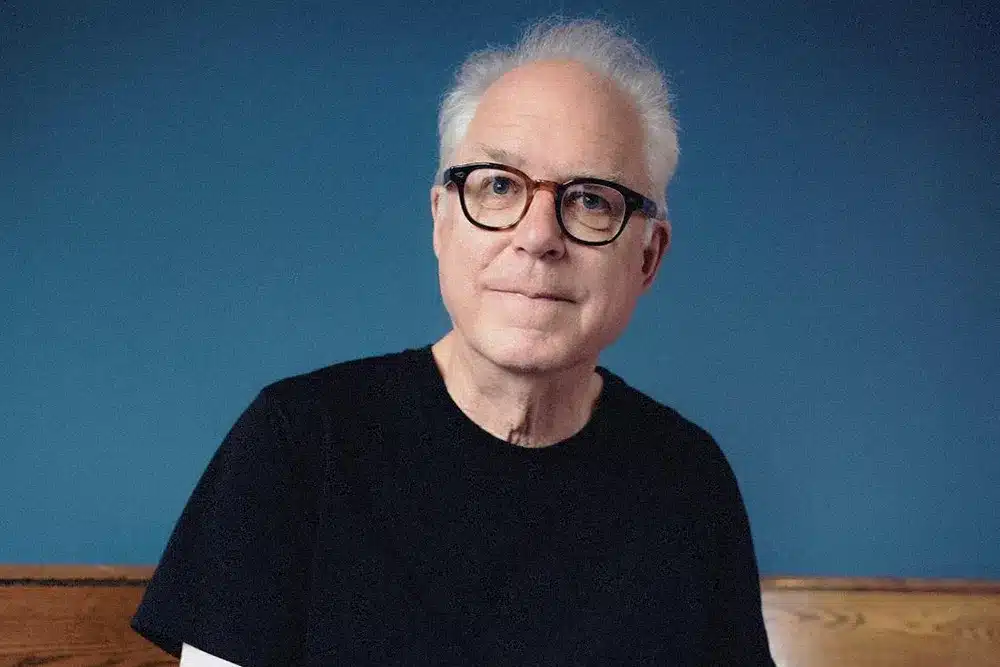

Jazz guitarist Bill Frisell makes strange music by keeping things deceptively simple. On his latest album, In My Dreams, he’s a bandleader who often plays behind his side musicians. Think of Frisell as the equivalent of a movie director who tells the actors what the scene is about but does not give them any lines. The script is improvised. After the scene is finished, the director decides what the audience will witness on the screen.
Long-time collaborators, including Jenny Scheinman on violin, Eyvind Kang on viola, Hank Roberts on cello, Thomas Morgan on bass and Rudy Royston on drums, join Frisell on his current project. The guitarist calls the ensemble a “family reunion”. Even though they may never have played on the same Frisell album at the same time, they have all worked with Frisell on a host of projects over the past four decades.
Bill Frisell has released more than one hundred full-length albums during his more than 40-year career. He’s known for blending disparate sources into his distinctive style of creative playing and composition. One can hear elements from that old weird America, where blues and church music, folk and avant-garde tunes, peek out and change the direction of what’s happening at the forefront of jazz. That’s certainly true of his latest release, In My Dreams.
According to the record’s notes, “All of the core tracks were recorded live in 2025, at concerts in Brooklyn, Denver and New Haven”, and for certain songs, “additional recording took place under Muñoz’s guidance at Opus Studios, in Berkeley, California — and not simple note corrections, but full sections and soundscapes”. The record was produced by Frisell’s long-time partners Lee Townsend and Adam Muñoz. The resulting hybrid melds the live and the studio takes into a seamless ambience. There are no jarring moments or juxtapositions. As the album’s title suggests, the music has a dreamlike quality. The atmospherics are generally soothing.
The song selection reveals Frisell’s obsessions with historical arcana, experimental sounds, and jazz traditions. He and the band perform a soft rendition of Stephen Foster’s “Hard Times Come Again No More” (here billed simply as “Hard Times”), with a sentimental slowness. Scheinman plays the fiddle part as if it were written for a classical violin, stretching out the notes to show their individual beauty. Frisell responds in counterpoint, finger-picking his strings in contrast.
The strings on the old chestnut “Home on the Range” tend to disrupt the melody as if the players were slightly inebriated. Perhaps they are meant to sound intoxicated by the view, as one can’t help but hear the lyrics in one’s imagination as if there were a cowboy on a horse (or maybe Bing Crosby on a saddle) singing along. The tracks are divided into two parts, with the second half offering a more ominous sound.
The most notable cover is Frisell and the band’s take on the Billy Strayhorn and Duke Ellington composition “Isfahan”. The song is brighter than the rest. It may not swing, but it offers more rhythm than the other tracks and allows the different instrumentalists to take turns setting the mood. There is something sumptuous about the mix of musical textures. Frisell pays homage to Strayhorn and the Duke by keeping things mellow.
The other tracks are original songs. They share an eerie quality, as if Bill Frisell and company were ghosts performing from a room down the hall, where the acoustics were subject to shifting dynamics. There’s a spaciousness in tunes such as “Why” and “Never Too Late” that makes them seem purposely haunting.
The title song offers the greatest pleasure. The playing is elegant. The musicians start quietly playing these simple tunes. Then they increase the tension a notch and let the beauty of the melody mysteriously build without ever reaching a climax. The instrumentation remains peaceful but not cool in the jazz sense. It’s a sonic version of looking at someone with a beautiful face and then realizing it’s one’s own reflection.