
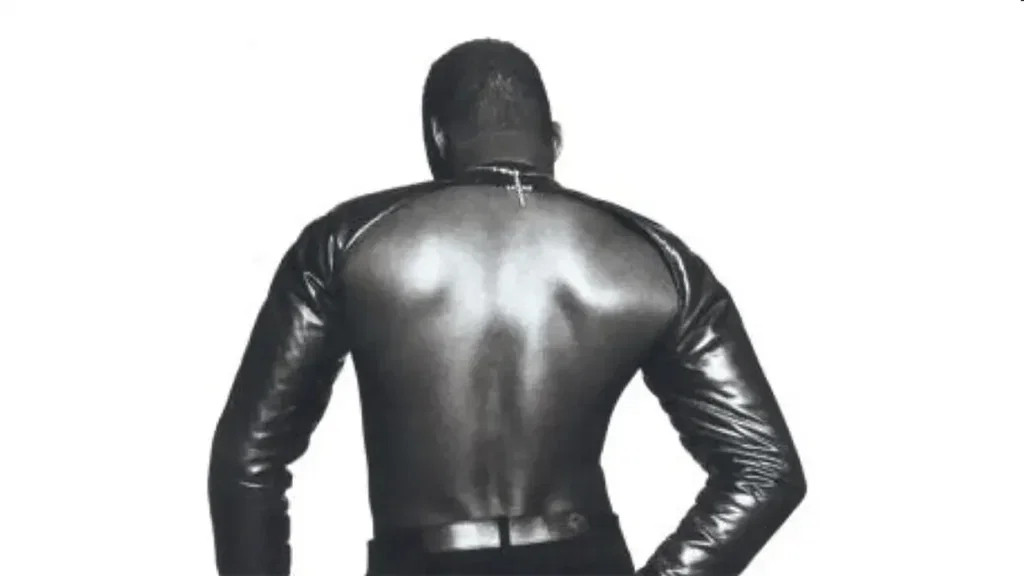

The intended concept for Bobby Brown’s eponymous third studio album, released in 1992, was simple: just keep it Bobby. For the better part of two years, beginning with his 1986 departure from New Edition, the genre-defying quintet he had founded at the age of 12, and then a subsequent debut, 1986’s King of Stage, which was largely ignored, the singer had seemingly lost track of who he was.
“We had to regroup and find out what my identity was as a singer,” Brown admitted in Fred Bronson’s 1985 book, The Billboard Book of Number 1 Hits. He found it with 1988’s Don’t Be Cruel.
In its time, Bobby Brown’s second studio album was as ubiquitous as Le Coq Sportif tracksuits, asymmetrical haircuts, and Roger Rabbit. Shedding the bubblegum, teeny-bopper image of his boy-band past, he served as an aural photonegative that matched his unapologetic, hard-strutting swagger. R&B with attitude. He opted for funkier, hip-hop syncopated rhythms that packed a kick like the “Heartbreak Kid” Shawn Michaels, and the kind of slinky synth-driven arrangements that conceive electric footwork at house parties and block parties. The result was a smash hit that shook the pop world.
Don’t Be Cruel topped the Billboard 200 chart for a stunning six weeks and spawned not two, but five Top 10 hits on the overall pop chart, including the biggest of them all, “My Prerogative”. Produced by Harlem-bred maestro Teddy Riley, “My Prerogative” would become the raison d’être for the sonic movement that Village Voice writer Barry Michael Cooper famously defined as “new jack swing”.
As for that originally intended concept for album number three, Bobby Brown figured that after having fully defined his identity with a blockbuster album to boot, he didn’t have to dig any deeper. “You don’t fix something that ain’t broke,” he shared in a 1992 interview, when referring to recruiting Riley to produce a bulk of Bobby. By then, there was one problem: everyone wanted a piece of Teddy’s jam; most notably, Michael Jackson.
Backed by popular demand, Riley’s soul-heated fusion of R&B, go-go, gospel, and hip-hop was the sonic Nike Air Jordan of the late 1980s; a musical style that dressed for the occasion, scoring everything from the booming car systems down 125th Street to the vibrant dance parties steeped in films like
Reginald Hudlin’s House Party (1990).
As the story goes, Michael Jackson was so impressed with Teddy Riley’s production that he called on the producer to work on his 1991 album, Dangerous. On Jackson’s part, the timing of it couldn’t have been a coincidence. Bobby Brown’s ascendancy during his Cruel era earned the singer plenty of “next Michael Jackson” comparisons. The singer’s music videos earned as many plays as Jackson’s; some would even say that Cruel captured more of the aggressive, outlaw spirit that Jackson tried to convey on 1987’s Bad. Brown, for his part, didn’t downplay the competition, either.
In a 1989 interview, Bobby Brown acknowledged his status as the hot new act, stating, “The people was waiting on another solo artist… they was getting sick and tired of the Michael Jackson’s and the Prince’s, and all these different kinds of images, these people that make themselves to be something that they’re not.” Whether or not Jackson caught wind of the comment, his working with Riley put Bobby in limbo.
“If Michael hadn’t been in the picture, Bobby’s album would have been out last year,” Riley admitted to the L.A. Times in 1992. Though Brown had enough material to release the album before then — having worked on material with Kenneth “Babyface” Edmonds and Antonio “L.A.” Reid, the in-demand hitmakers who crafted a bulk of Cruel’s genre-defining jams that would literally and figuratively birth generations — he needed the Teddy sound.
The final song added to Don’t Be Cruel was “My Prerogative”, and it was after the singer traveled across the country to record in Riley’s St. Nicholas project’s apartment. That the result became the biggest hit of their career wasn’t so much luck as it was a clear indication of their winning chemistry. In Riley, Brown found the ideal vehicle for him to “Roger Rabbit” over the yellow median line between hip-hop and R&B’s then-two-way road. In Brown, Riley found the charismatic superstar capable of long-darting his rhythmic concoction to the masses. Together, they developed the beating heart of New Jack Swing.
Bobby Brown’s Fall from Fashion
In interviews, Bobby Brown ignored the glitter-gloved rumors about the album delay, instead crediting it to perfectionism. “People’d say Hammer was about to drop his album or Michael was about to drop his album,” he told the L.A Times. “I just kept telling them my album isn’t ready. I don’t want to drop it now. It’d get lost in the mixture of everything else.” It did.
When Bobby finally arrived in August 1992, the hip-hopera that Bobby Brown and Teddy Riley perfected in 1988 had no doubt fallen out of fashion. What was once a craze had begun to fade. Singers like Mary J. Blige were double-dutching between “Top Billin’” drumbeats and “Clean Up Woman” samples to usher in a new musical blend known as hip-hop soul.
Dr. Dre and his band of West Coast rhymers widened the aural aperture with their gin-drenched G-Funk. As this new era of Black music was being formed, new jack fatigue was in full swing. By then, any remnants of new jack excitement had been squeezed bone dry by Jackson’s $32-million-selling album of 1991, Dangerous.
Although mistimed, Bobby presented the funkiest last dance of the entire New Jack Swing era.
With earworm-architects Babyface and L.A. Reid also in the wings as producers, every element of the album functions like it’s in service to the dancefloor — so much of it feels as if they transposed the pulse of the hottest Uptown nightclub on a Saturday night. “Humpin’ Around”, the frenetic lead single produced by Babyface and Reid, sounds like the combination of Pop Rocks and Red-Bull, while “Get Away”, a frothy spiritual sequel to “My Prerogative”, packs enough funk to warrant a James Brown “hit me” ad-lib as Riley’s infectious groove wraps around Brown’s commanding vocals like a velvet ropes at a VIP section.
“Ain’t nothing but the funk, baby,” Brown boasts in the song’s opening seconds, as if to cocksurely advise listeners to strap in for what’s to be a Teddy-jamtastic ride.
Funky, operatically street, and gloriously danceable, Bobby is all of these things, all at once. Not a track on it feels enervated, and when the pace does slow down, such as on softer jams like “Lovin’ You Down” and “College Girl”, it’s so that the smoldering, red-light bedroom R&B can be dialed up to the max. Much of its unrelenting, flinty energy is credited to Riley shouldering more of the production load than he did on Cruel. Though Babyface and Reid supply the album’s certified hits in “Humpin’ Around” and “Good Enough”, both easily cracked the Top 10 of the Hot 100, those records sound like invited guests next to Riley’s work.
With Brown, standout tracks aren’t just defined by how sonically polished or catchy they are; it’s the ones that elicit a toe-tap or full-on dance number. That much is apparent in songs like “Two Can Play That Game” and “Til the End of Time”, which sound like they were crafted during an 11PM middle-of-the-club choreographic showdown. His melodic swoons over Riley’s feverish mix fit like a glove, prompting a pop-and-lock or cabbage patch from the listener.
“One More Night” pulls you in with a slinky bass groove Lego-pieced over a riff from Average White Band’s “School Boy Crush” that coalesces with Bobby Brown’s syrupy pleas of a second chance. Before the song could fade, the singer slips into a sticky staccato that amplifies Riley’s syncopated drums into a hypnotic effect:
We’ve had ups and downs but
Perfect love will find us
If you’ll just be patient
And you’ll feel that love sensation
That this batch of bodyrolling records was all released in the twilight of the New Jack Swing epoch makes the timing of Bobby all the more frustrating. The only time the album loses steam is when there are no grooves to step to. The ballads in the second half, specifically the non-Riley set, feel like a “turnt up” house party getting abruptly interrupted to inform the guests that someone’s car is blocking the driveway.
Songs like the quietstorm-y “Storm Away” and Debra Winans’ duet “I’m Your Friend” attempt to put Bobby Brown’s vocal range on full display. The problem with that, though, is that Brown isn’t the heavyweight, sterling-silvered vocalist they require. Although beautifully intended, these songs instead expose a room for growth, rather than showcasing his range.
In an interview 25 years after the release of Bobby, Teddy Riley revealed that there had originally been plans to record more songs for the album. According to the producer, the pair finished 13 songs, but he wanted Brown to pin down 13 more. Bobby Brown, who at the time was gearing up to marry Whitney Houston and rushing to get the overdue album out to the world, refused.
“He’s like, ‘Man, we finished. I’m out of here. I’m getting married,” recalled Riley. There’s no telling whether or not those records would have sonically elevated Bobby further than what came to be — Riley ended up using them for Blackstreet, whose debut album arrived two years later — but what’s indisputable is Brown’s prerogative to stick to the formula that broke the mold in the first place.
Works Cited
Anderson, Trevor. “Chart Rewind: In 1989, Bobby Brown Took New Jack Swing to No. 1”. Billboard Pro. 21 January 2021.
Carter, Kelly L. “Bobby Brown speaks: the secret behind every song on ‘Don’t Be Cruel’”. Andscape. 31 August 2018.
Hilburn, Robert. “How Cruel Can Fame Be?” Los Angeles Times. 17 September 1992.
Hunt, Dennis. “THE WAITING: Bobby Brown has been tabbed…” Los Angeles Times. 1 March 1992.
Levy, Glen. “Top Selling Albums and Singles 1989”. Time. 18 January 2009.
Mao Jeff: Teddy Riley Interview. Red Bull Music Academy. 2017.
Weiss, Jeff. “Dangerous: Michael Jackson”. Pitchfork. 7 August 2016.