

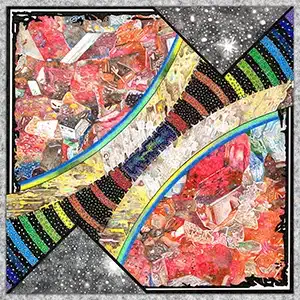
For someone who hasn’t released new music since the height of the pandemic, Brandon Locher’s two 2026 albums sound like an artist who hasn’t missed a beat. In July, the Pennsylvania-based visual artist and musician released the EP The Shadow Planets, nearly six years after his previous album, EP2. Now comes a full-length companion piece, Rahu Ketu, and on it, Locher is positively overflowing with unique sonic ideas that are both inspiring and distinctive.
Raised in Johnstown, Pennsylvania, Locher lived in New York City for seven years before returning to his home state. While the last several years have seen him creating loads of commissioned visual work, his music—a deeply engaging, melodic electronic stew—is, like his visual art, heavily reliant on the practice of Transcendental Meditation and the study of Advaita Vedanta, a non-dualistic school of Hindu philosophy that teaches the fundamental oneness of the individual soul (Atman) and ultimate reality (Brahman).
“What fascinated me about Vedic astrology wasn’t prediction so much as the idea of time and cycles,” Locher explains. “So, when I looked at my own birth chart, I realized that the next period I was entering was Rahu Ketu, a 264-day cycle from September 2025 through May 2026.” As someone who works best within set parameters, Locher saw this timeframe as a temporal boundary for recording both the Shadow Planets and Rahu Ketu.
That’s a lot of philosophical backstory for the birth of a music release, but even without knowing these parameters, Rahu Ketu is an absolutely fascinating listen, like its predecessor. There is an ample mix of organic and synthetic, whimsical but also deep and complex. The tracks collectively use every letter of the alphabet, except for the letters that spell the album’s title.
“B-C” kicks things off majestically, as trip-hop glitches eventually make way for a gigantic, swooping melody that often sounds cinematic, like it’s lifted from a large-scale science fiction epic score. This mix of classic musical gestures and skittish electronic beats brings a refreshing balance of style that keeps the music from ever sounding boring, predictable, or derivative.
Meanwhile, “D” offers a more playful approach, with a light shuffle beat backing melodic lines that add mystery alongside the jaunty time signature. Locher brings a contemplative side to weightier tracks like “F-G”, with sustained notes and melodies that give space to piano, trumpet, and clarinet. There’s an ambient vibe to the airy, noir-ish “J”, as a disembodied choir wraps itself around elastic rhythms, which would otherwise come off as dark and foreboding if not for the infectious nature of the song’s various melodies and motifs.
Locher often fascinates listeners with consistently unique approaches to experimental instrumental music. In “L-M”, the simulation of guitar harmonics floats over strings, vocals, and a skittish beat, as Locher takes cues from a variety of instrumental influences while remaining inimitably his own. As always, an innate sense of jovial positivity shines through, as on the alien funk of “W-X-Y”, alongside a recurring desire to create something anthemic, as on the warm, contemplative album closer, “Z”.
Brandon Locher has always followed his own path, whether through his visual work or his rich, ornately constructed musical compositions. On Rahu Ketu, this unique and refreshingly eclectic artist is back to making music, and will hopefully continue to deliver more of these wondrous musical delights.