

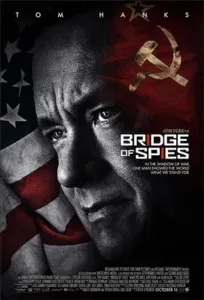
If you’re looking for a corrective to the anti-immigrant sentiment that is a core attribute of the Trump administration, you could do a lot worse than the film Bridge of Spies. That may sound like a strange claim to make about a 2015 Cold War thriller directed by Steven Spielberg and starring Tom Hanks, but before the film’s halfway mark, Hanks’ character delivers a brief but memorable monologue that touches on what it means to be an American, then and now.
Bridge of Spies centers on James Donovan (Hanks), an unassuming New York insurance attorney who, during the height of the Cold War, is “volunteered” for an unenviable gig: provide legal representation to Rudolf Abel (Mark Rylance), a man who has been charged with and is clearly guilty of spying for the Soviet Union. Donovan is reticent, at first, to take the job, but once he does, he tackles the work with a forthrightness that bewilders those around him.
His law partners, wife, and even the judge presiding over the case seem to view his role in the proceedings as all show and no substance. They want him to go through the motions of representing the accused so that the United States can project moral righteousness on the global stage. No one expects Donovan to give an honest effort at shielding Abel from the guilty verdict that is undoubtedly in his future.
This is exactly what Donovan does, and not long after taking the case, he is confronted by a mousy CIA agent named Hoffman (Scott Shepherd) who wants to know what Abel has been telling his new attorney behind closed doors. The two men sit down at a dimly lit Manhattan bar where tasteful jazz music wafts through the air. There, Hoffman makes it clear that he and the men he works for feel entitled to all the salient information that Donovan gleans from his client.
For Hoffman, the case is cut-and-dried. Abel is a spy for the only country that poses an existential threat to American power, and it is Donovan’s patriotic duty to cooperate with the CIA.
Donovan, however, doesn’t share this perspective. He feels obligated by the rules of his profession and the laws of his country to provide Abel with an authentic defense, and he doesn’t hide his annoyance at being asked by a government agent to violate attorney-client privilege.
Hoffman dismisses Donovan’s point of view with the full body equivalent of an eyeroll, then belittles him for acting like a Boy Scout. Hoffman says that when it comes to the Cold War, there is no “rule book” and implies that by withholding information, Donovan will jeopardize the security of his country. Donovan, who never appears threatened by Hoffman in the least bit, responds by saying:
You’re Agent Hoffman, yeah? German extraction? My name’s Donovan, Irish, both sides, mother and father. I’m Irish; you’re German. But what makes us both Americans? Just one thing. One—one, one. The rule book. We call it the Constitution. And we agree to the rules, and that’s what makes us Americans. It’s all that makes us Americans.
In those few sparkling sentences, Donovan nods at the idea that America is a collection of immigrants bound by nothing more than a shared adherence to a set of rules. Those rules compel all Americans to apply the law without bias, even when doing so entails ensuring an enemy spy is granted the right to a fair trial.
The potency of the logic is matched only by the equanimity of the delivery. Donovan doesn’t raise his voice or appear the least bit perturbed as he calmly sets Hoffman straight, and the scene is a microcosm of his entire performance.
Throughout Bridge of Spies, Hanks rarely betrays any sense of stress, even when his character is forced to deal with one remarkably stressful situation after another. In the actor’s hands, Donovan comes across as a principled man whose professional competence is buttressed by an understated confidence in his convictions. Donovan knows that if he follows the “rule book” and defends Abel to the best of his ability, then he will have advanced America’s interests by showing the world that his country’s willingness to uphold its ideals, even in times of conflict, is the key to its superiority as a nation.
Donovan’s defense of Abel is just the opening chapter of Bridge of Spies. Abel is convicted, but Donovan persuades the judge not to hand down the death penalty, and he does so by delivering another eloquent and convincing monologue.
When the pilot of an American spy plane is captured by the USSR, the CIA recruits Donovan to negotiate a prisoner swap: Abel for the pilot. Donovan agrees and travels to East Berlin just in time to witness USSR troops laying the final bricks of the Berlin Wall.
He negotiates with various representatives from East Germany and the USSR and eventually secures the release of both the pilot and an American graduate student. Steven Spielberg, working off a snazzy screenplay by screenwriter and playwright Matt Charman and filmmakers the Coen brothers, presents this behind-the-scenes Cold War story with a degree of skill that reminds us he is so much more than a maker of fantastic summer blockbusters. Bridge of Spies is an engrossing, rewatchable film filled with small, tense moments, but the scene that sticks out the most long after the closing credits roll is Donovan’s little speech about the “rulebook”.
Bridge of Spies was released in 2015 during the last gasp of the Obama presidency, a period characterized by ebullient optimism about the social progress America was allegedly in the throes of under its first Black president. The film is very much a product of its time, an unabashed “encomium to American decency” as the critic Anthony Lane put it.
From the vantage point of the second Trump administration and its ongoing assault on both the U.S. Constitution and all things decent, the self-satisfied belief in the essential goodness of America that animates the film (and much of Obama-era pop culture) can register as naïve at best and cringeworthy at worst. Not long after its release, Bridge of Spies received six Oscar nominations, including Best Picture. Today, its unapologetic endorsement of the rule of law and immigration as core American values makes it feel like a relic from some bizarre, barely remembered past.
Those are also the qualities that make Bridge of Spies essential viewing today. We are living in a moment when what’s needed almost as much as the willingness of private companies, local governments, and average citizens to stand up to the depredations of the Trump administration is the ability to frame such resistance as an extension of a coherent political philosophy.
There is an influential cohort within the American right that is not shy about espousing the notion that someone is not a true American unless they can trace their ancestry back to white Anglo-Protestant and Scotch-Irish settlers. This Heritage American movement is awash in nativist nonsense and chintzy aesthetics; it is also providing the intellectual foundation on which the ICE raids that are terrorizing American communities and the efforts at revoking birthright citizenship currently stand.
Wannabe autocracies have a habit of framing their policies as steps that are deemed necessary to save the country they seek to rule from some ruinous force. Trump and his acolytes are tacitly justifying their policies of cruelty with the belief that non-whites don’t share America’s true “heritage” and therefore pose an existential threat to this country.
This ideology is, of course, pure hooey. To quote none other than Lindsey Graham, “America is an idea, not defined by its people but by its ideals,” and one of those ideals, as articulated by Donovan in Bridge of Spies, is that what makes a person an American is not where they or their parents were born but their willingness to uphold the Constitution.
What those who seek to resist the Trump administration must realize is that challenging individual actions, like unlawful immigration raids, is just step one. It is also necessary to counter the misguided beliefs undergirding these actions. We need leaders and public figures and everyday citizens to argue out loud that immigration is and always has been intrinsic to the American project. If Americans cede the fight in the arena of ideas, they have no chance at stopping ongoing efforts to trample immigrant communities. The strand of nativist thinking that has infected the American right will threaten to spread more broadly.
A ten-year-old Steven Spielberg movie starring Tom Hanks may seem like a strange place to find inspiration to fight anti-immigrant efforts in 2026, but that’s exactly what the film provides. Donovan’s rule book monologue isn’t terribly long or particularly in-depth, but it gets its point across clearly and concisely. It offers an idea of where Americans can start today if they want to remake the country into one that celebrates its immigrant roots rather than punishes immigrants.
Bridge of Spies also offers a glimpse into one of the key elements of Hanks’ onscreen persona. Hanks is often described as a modern-day Jimmy Stewart, which is to say a relatable everyman whose ability to project fundamental decency and unshakeable integrity makes him a stand-in for all that is good and noble in the American character.
However, this association has never felt quite right because the two actors’ best work uses very different emotional registers. Stewart’s calling card as an actor is the near manic fervor with which he often expressed himself onscreen. It’s a quality that’s on full display in his most acclaimed performances. In Frank Capra’s 1939 political drama, Mr. Smith Goes to Washington, Stewart’s Jefferson Smith literally collapses on the floor of the U.S. Senate while delivering an impassioned speech about the threat of corruption. It’s a gonzo-acting job made plausible by the emotional earnestness Stewart exudes, and it was far from the only time in his career where Stewart portrayed an all-American character in the midst of coming unglued.
This is where Stewart and Hanks differ. Losing control of his emotions has never been one of Hanks’ calling cards. He can certainly match Stewart’s wide-eyed innocence but betrays none of his tortured vulnerability. In his most all-American films – Apollo 13 (Ron Howard, 1995) and Saving Private Ryan (Spielberg, 1998), Hanks characters are the personification of self-possession.
A more apt comparison is Gregory Peck. Like Stewart, Peck inhabited a persona that doubled as shorthand for everyday American values. Unlike Stewart, Peck’s best performances were marked by restraint rather than raw emotion. Watching Hanks in Bridge of Spies reminds me of Peck’s masterful performance in Robert Mulligan’s 1962 legal drama, To Kill a Mockingbird, another film in which a preternaturally composed attorney accepts a challenging case because of a deep-seated commitment to abide by America’s rule book.
The even-keeled nature of Hanks’ performance as Donovan is also an antidote to the toxicity of our current political climate. In Bridge of Spies, Donovan never shouts or gets flustered or resorts to grandiose gestures to get his points across. He doesn’t belittle those who don’t share his points of view. All he does, whether he’s speaking with a judge or negotiating a prisoner swap with a foreign bureaucrat, is explain what he believes and why he believes it.
Donovan understands the essence of America and is confident enough to fight for what he knows is right. Making big, emotional fusses would not make his beliefs more compelling. It would only make him look smaller.
Works Cited
Boone, Daniel. “The Online Right’s Favorite Nativist Slogan Is Gaining Traction in the Real World”. Politico. 31 July 2025.
Conn, Jordan Ritter. “Inside the Hidden Network of Resistance in Minneapolis”. The Ringer. 19 February 2026.
Herron, Patrick. “Maryland Joins 24 States Opposing Executive Order on Birthright Citizenship”. Mocoshow.com. 27 February 2026.
Jones, Nate. “That Feeling You Recognize? Obamacore”. Vulture. 20 August 2024.
Lane, Anthony. “Making the Case”. New Yorker. 19 October 2015.
O’Brien, Matt and Toropin, Konstantin. “Trump orders US agencies to stop using Anthropic technology in clash over AI safety”. AP. 27 February 2026.
The White House.gov “Protecting the Meaning and Value of American Citizenship”. 20 January 2025.