
There was a guy who lived in the apartment complex where I grew up who everyone—and by everyone, I mean the six or eight other kids I more or less ran with—said had been on Death Row, but who had been released after he’d survived the electric chair three separate times. The rumor was that if the prison wasn’t able to kill an inmate on three separate occasions, the law mandated that person be set free.
I believed it. This was the 1980s, after all, perhaps the high-water mark for American culture’s belief in local urban legends, a phenomenon that has been replaced in the digital era by a belief in large-scale conspiracy theories so fundamentally insane that I often wonder if the majority of the American populace is suffering from a diagnosable collective derangement.
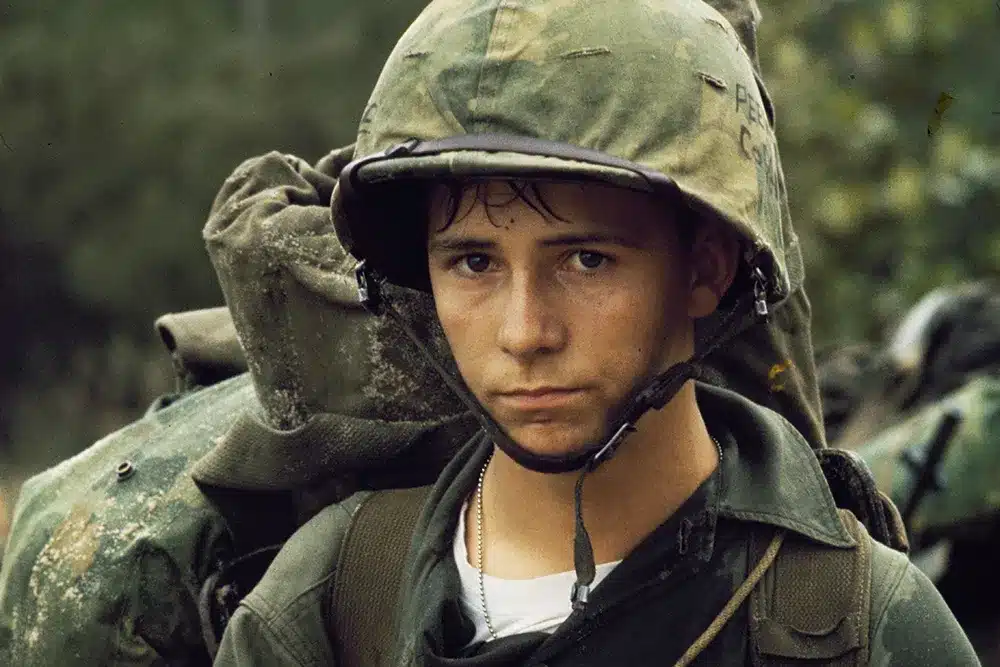
Anyway, this guy, whom I thought of as essentially a Terminator T-1000 come to life, turned out (I learned this from another kid in the complex who was five or six years older than me, and therefore far more intellectually able to call bullshit on something like this) to be a veteran who had done a tour in
Vietnam. In other words, though the man had never served time in prison, he had, in a way, survived the electric chair.
It was around that same time when I first heard Bruce Springsteen’s “Born in the USA”. It was impossible not to, given the song’s omnipresence on the radio, music television, and in general American culture in 1984. While the rest of pop radio was dominated by horror homages (Michael Jackson’s “Thriller”), Freudian psycho-dramas (Prince’s “When Doves Cry”), and camp feminist anthems (Madonna’s “Like a Virgin”), the title track of Springsteen’s blockbuster album was clearly about something far weightier, even if so many listeners and critics, badly misinterpreted what that something was.
Of course, the misinterpretation of Springsteen’s song as a jingoistic anthem has been discussed to death, as have the necessary counter-readings of it as the deeply observed, fiercely devastating anti-Vietnam War song that it is. The only thing I’d like to add is that, to my eight-year-old ears, his voice sounded more desperate than anything I’d ever heard. Especially in the song’s final verse, where the narrator, like so many of Springsteen’s protagonists (“Meeting Across the River”, “Atlantic City”, “Highway 29”), is about to cross the kind of line one can’t come back from. Except in this case, and in the case of Springsteen’s other “Vietnam songs”, that line is one he should have never had to consider crossing in the first place.

Never Shut Out the Light
Bruce Springsteen has worn many faces over the course of his career: Bob Dylan disciple, Jersey Shore wharf rat, blue-eyed soul singer, Woody Guthrie acolyte, working-class icon, limousine liberal, Steinbeckian chronicler of the poor, the wayward, and the immigrant. No one in his generation has worked harder on stage, and no one’s recorded output over the past 50-plus years has been more consistently strong. Only Taylor Swift and Michael Jackson have flirted as routinely as he with a pop messianism that is by turns absurd and off-putting.
Of his rock ‘n’ roll peers, only Tom Petty composed as many radio-friendly pop songs, and only Bob Seger wrote as beautifully, and as thoughtfully, about the past. Every hard-core Springsteen fan has their favorite Bruce: the “Rosalita”-era boardwalk striver; the Darkness on the Edge of Town-era lost soul; the Born in the USA-era national treasure; the 9/11-era chronicler of America’s collective grief.
There are aspects of Springsteen that have endured through each of his many incarnations, perhaps none of them more significant than his refusal to allow himself, his listeners, or his country to forget the men who served in Vietnam:
“well deep in a dark forest, a forest filled with rain
beyond a stretch of Maryland pines there’s a river without a name
in the cold black water now Johnson Leneir stands
he stares across the lights of the city and dreams of where he’s been”
There are forests everywhere. The ones in the United States can’t help but remind the protagonist of “Shut Out the Light” of the other nameless forests he’s done time in, forests that, no matter how far he may now be geographically from them, he will never be able to fully leave. The song, and the man at the center of it, is a tragedy, made all the more devastating because we know so much of the United States was all too willing to leave its sons who had served in Vietnam to rot in the metaphorical forests of their own traumas, and to leave the entirety of the Vietnamese population—those we had slaughtered, those we betrayed—entirely out of our collective psyches for good.
Whether it be the US government’s refusal to admit the devastating health risks of Agent Orange exposure, its unwillingness to acknowledge Post-Traumatic-Stress-Disorder as an official medical condition until 1980, or the overwhelming lack of public initiative to ensure the V.A.’s administrative ability to care for the vets who’d returned from the multi-front war in Southeast Asia, the years (and decades) following the cessation of conflict in 1975 consigned an entire generation of ex-soldiers to lives spent in the proverbial shadows. Therefore, it was no small thing for one of the biggest American pop stars of the 1980s to regularly deliver mini-speeches from the concert stage that emphatically praised these forgotten soldiers for their service, and for him to consistently compose songs centered on the physical and psychological effects these men had to deal with upon returning from battle.
In “Shut Out the Light”, that man is Johnson Leneir, whom we first meet as the plane that is carrying him home from Vietnam has begun its descent:
“the runway rushed up at him
as he felt the wheels touch down
he stood out on the blacktop
and took a taxi into town
he got out on Main Street
and went into a local bar
he bought a drink and he found a seat
in a corner in the dark”
We are a long way from the rah-rah homecomings of so many World War II films here. No one from Johnson’s hometown has shown up at the airport to greet him, and it is clear from his decision to retire to a dimly lit bar before going to see his wife that the baggage Johnson carries is not just of the literal variety. The song’s darkness finds its closest parallels in New Cinema-era masterworks such as Michael Cimino’s The Deer Hunter (1978), Hal Ashby’s Coming Home, and John Flynn’s Rolling Thunder (1977). Like those films, Bruce Springsteen’s “Shut Out the Light” understands that the Vietnam War didn’t necessarily end with the cessation of armed conflict.
As the song’s verses progress, we realize that – though Johnson’s wife is excited to see him, her mother is on babysitting duty, she’s done her makeup, and, in one of the song’s many excellent details, she’s undone an extra button on her blouse –Johnson is in permanent panic-attack mode, lying beside his wife late into the night:
“mama mama mama come quick
I’ve got the shakes and I’m gonna be sick
throw your arms around me in the cold dark night
hey now mama don’t shut out the light”
Never mind that there were no parades for Johnson through the main streets of his hometown, and that no one is stopping him in line at the supermarket or at the local movie theater to thank him for his service. It’s far worse than that. The entire country has moved on. Lyndon Johnson is long dead, and Richard Nixon is living the good life in Southern California.
After years of the American nightly news endlessly streaming images of soldiers in body bags and the stern faces of trusted newsmen like Walter Cronkite and Dan Rather telling the populace that their leaders are lying to them, it seems that everyone has collectively decided to memory-hole the entire Vietnam experience. By the time Springsteen released “Shut Out the Light” in 1983 as the B-side to the “Born in the USA” single, the country was a few years into the Ronald Reagan administration, the tenor of whose entire presidency was a conscious attempt to act as if the 1960s and 1970s had never existed.
No wonder, then, that Johnson Leneir is stuck lying in bed and trying not to let the ghosts of the Vietnam War get him. He had spent his years in the Army fighting a war his country had no business being involved in, and one can only imagine the things he had seen and done. The Vietnam conflict was 12 years of chemical weapons, the My Lai massacre, Robert McNamara insisting to the American populace that the opposition was on the verge of surrender, Nixon illegally bombing Cambodia, too many members of the “Best and the Brightest” insisting that scores of apolitical Vietnamese farmers were instead radicalized enemy combatants, of the country of Vietnam being plunged into an extended state of ecological catastrophe.
Except, unlike the films alluded to earlier, “Shut Out the Light”, doesn’t end with anything remotely resembling hope. While The Deer Hunter concludes with the surviving characters sitting around a dinner table and singing “America the Beautiful”, and Coming Home ends with Jon Voight’s veteran addressing a group of college students on the importance of questioning authority, Springsteen’s song closes with him endlessly repeating the chorus, albeit now with a subtle shift.
The line is no longer “don’t shut out the light”; it is instead “don’t you shut out the light”, which means that Johnson is no longer merely speaking to his wife or to God but to all who hear his song. In the song’s final moments, we hear a man made desperate by his trauma and the knowledge that he will likely remain alone in his despair, given that his country has always left its own behind.
Post-Vietnam War Life in America
Some national wounds never heal. Some are made worse as the years pass, and those who exploit the causes of those wounds for commercial gain. Yet Bruce Springsteen never took that bait. His songs about the Vietnam War, as he moved into the 1990s and 2000s, only grew sadder and angrier.
Take, for instance, “Brothers Under the Bridge”, first included on the sprawling, four-disc, 68-song rarities compilation, first released in 1998. Not only does it lack the sonic bombast of “Born in the USA”, which therefore means it is impossible to misinterpret the track’s abiding sense of grief and devastation, but its narrative is defined by a sense of personal alienation and loneliness that makes even something as tragic as “Shut Out the Light” seem filled with possibility by comparison.
After all, Johnson Leneir may be experiencing Post-Traumatic Stress Syndrome, but he at least has a wife and children who love him, a devoted mother-in-law, and a house to live in. By contrast, the unnamed narrator of “Brothers Under the Bridge” has been homeless for a significant period of time, and though we know, given that he is telling his story to his grown child, that there had at one time been a woman in his life, we know that she, and the life they shared together, is long gone.
We also know that the details of his day-to-day life, living as he does in the mountains above Los Angeles seems lifted straight out of the hard-luck 1930s narratives that John Steinbeck used to write about. Americans were laid low by a Great Depression that lasted for well over a decade, and even with the manufacturing boom brought on by the onset of World War II, they never did get back on their feet:
“campsite’s an hour’s walk from the nearest road to town
up here there’s too much brush and canyon
for the CHP choppers to touch down”
It’s easy to forget how many veterans of the war in Vietnam were never able to reintegrate into daily life, and would instead spend the rest of their lives on the margins of a country still vast enough to disappear into. Similarly, there is a terrible irony in our narrator knowing that the ideal place to set up a rural campsite is where the California Highway Patrol helicopters cannot land. What is unsaid in “Brothers Under the Bridge” but obvious is that this is the kind of knowledge he acquired during his years overseas, when he and his men were constantly moving through dense forests and beneath skies often filled with both allied and enemy helicopters.
This man’s post-war life has been so consistently awful—one line tells of a fellow homeless friend dying in a brush fire, and another of how often he has wound up on the wrong end of someone’s knife—that by the time we get to the song’s concluding verse, which takes place at a Veteran’s Day parade, it seems the song has crossed over into the type of existentialist parable one often finds in Kafka:
“Come Veteran’s Day
I sat in the stands in my dress blues
I held your mother’s hand
As they passed with the red, white, and blues
One minute you’re right there
then something slips”
That’s it. Nothing follows that line. Whatever wisdom he hoped to communicate fails in the face of America’s willingness to offer patriotic kitsch when something more, something much more, is needed.
History and Bruce Springsteen’s Vietnam War Songs Are Ageless
It isn’t true that the best popular music is always created by the young. Painters get better with time, as do poets, novelists, photographers, filmmakers, and classical musicians. Why then, shouldn’t the same be true—or at least possible—for popular songwriters? For every artist who created their most significant and meaningful work in their late teens and early 20s (Elvis Presley, Little Richard, Pete Townshend, Ray Charles, Brian Wilson, and Eddie Van Halen), there are artists whose most complex, enduring artistic statements have come well into middle and old age (Bob Dylan, Paul Simon, Yoko Ono, Kate Bush, Peter Gabriel).
I think about this every time I listen to “The Wall”, a late-period song of Springsteen’s about a veteran writing a poem to a deceased friend and fellow veteran about why he was unable to visit him at the Vietnam Veterans Memorial Wall in Washington, D.C., last year (I couldn’t find anyone to drive me), as well as catching his friend up on life in contemporary America (Now the men that put you here/ eat with their families in rich dining halls/ and apology and forgiveness/ got no place here at all).
Bruce Springsteen, well into his 60s by the time of this recording, is so far past his American he-man days that they might as well have happened to somebody else. His voice is deeper now, more weathered, and the song, which possesses next to no melody and is entirely devoid of a chorus, feels like the work of an artist who not only has long stopped chart-chasing but whose compositional instincts have come to prioritize narrative directness above all else. “The Wall” reminds me most of certain sections of James Joyce’s Ulysses, where the hero’s interior narrative voice is so strong and so specific that the barrier between writer and character has been thoroughly breached.
For a song about two former Vietnam veterans (one living, one long dead) released in the second decade of the 21st Century, this is as it should be. The Vietnam War has been over for nearly 40 years by this point, and if America was still not willing to collectively reckon with that catastrophe in any meaningful way, it was by then clear it never would.
The narrator knows this. Just as he knows that the villains of that particular story ultimately found their complicity in one of the great humanitarian crimes of the 20th Century have not, in the eyes of mainstream American society, mattered all that much. Therefore, whatever resolution our narrator hopes to find will have to be found on his own terms, in private acts of humanity and generosity. Such as, in the case of Springsteen’s song, writing a poem for his long-deceased friend and fellow veteran.
That Springsteen allows for none of the usual E Street Band pyrotechnics (no sax solos, no bombastic drumming, no call-and-response choruses with fellow guitarists Steven Van Zandt, Nils Lofgren and Patti Scialfa), the listener, by the track’s end, feels as if he has been granted access to something so deeply personal that we are not certain whether we even have the right to listen. It is, in truth, closer to a work of confessional poetry than it is to rock ‘n’ roll; more Robert Lowell and less Chuck Berry.
Perhaps most importantly, his “Vietnam War” songs are further proof that, in addition to Bruce Springsteen’s many other admirable qualities as a popular musician, his work has been consistently willing to reckon with even the least palatable parts of American culture, past and present.