
During Buck Owens’ lifetime, he and his band, the Buckaroos, were well-known for their live performances. They released nine full-length albums, beginning with the groundbreaking Carnegie Hall concert (1966), which reached number one on the Billboard Country Albums chart and demonstrated that country music was no longer just hick music, but belonged in the most prestigious venues. Buck Owens and His Buckaroos then released three live LPs: In Japan! (1967), Buck Owens in London “Live” (1969), and Live in Scandinavia (1970). These records revealed the group’s international popularity as well as country music’s reach.
Buck Owens’ “Live” at the White House was recorded in 1968, when Lyndon B. Johnson was President of the United States, but not released until 1972, when Richard Nixon was in office. This was one of the first times country music made it to those hallowed halls. Buck continued to record live albums during the 1980s and 1990s, before his death in 2006, as well as 39 studio albums.
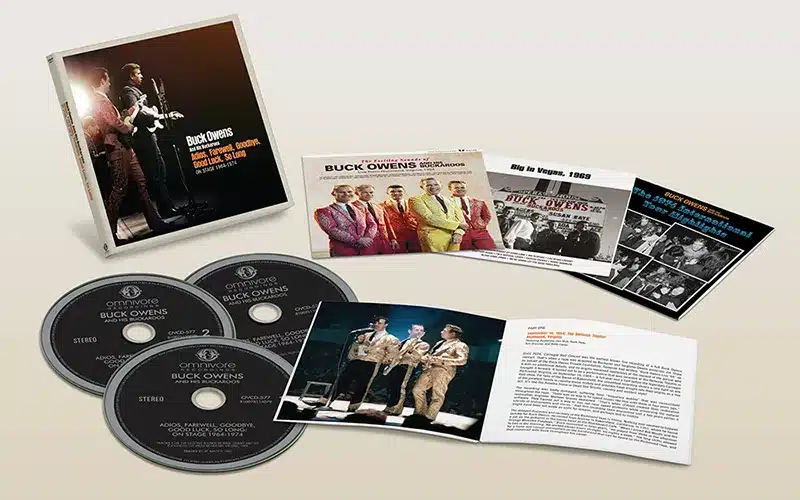
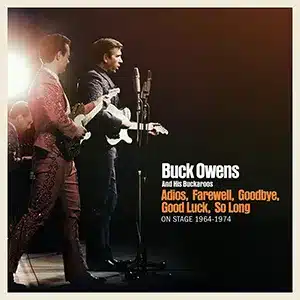
Death has not stopped new live Buck Owens material from hitting the marketplace. Ten years ago, the wonderful full-concert disc When Buck Came Back: Live San Francisco 1989 came out to rave reviews. Now, Omnivore Recordings has issued Adios, Farewell, Goodbye, Good Luck, So Long: On Stage 1964–1974, a jam-packed three-CD set featuring 78 live performances and 20 previously unreleased tracks.
The contents range from several versions of Buck and the Buckaroos’ biggest hits, such as “Act Naturally”, “Love’s Gonna Live Here”, and “Together Again” by themselves and as part of medleys. There are also a host of unusual covers that showcase Owens and the band’s versatility, such as the Coasters’ “Along Came Jones”, Booker T. & the M.G.’s “Green Onions”, and the Beatles‘ version of “Twist and Shout”. The songs were recorded everywhere from the Bellevue Theater in Richmond, Virginia, in 1964, Macy’s flagship department store in New York City in 1967, a Golf Tournament in Bakersfield, California, in 1973, a performing arts venue in Christchurch, New Zealand, in 1974, and lots of places in between.
This hodgepodge of concert clips reveals Owens and the group’s high-energy performances. They showcase both Owens’ abilities as an entertainer and a musician, as well as the band’s technical prowess. Whether Owens is telling a corny joke or the Buckaroos are playing an intricate instrumental, the liveliness never lets down. Don Rich’s contributions are worthy of special mention. Buck refers to him as his “right-hand man”, and Rich consistently provides examples of his deep talents on Telecaster, fiddle, and backup vocals. He is the one constant in every band (that does change members over the year).
Adios, Farewell, Goodbye, Good Luck, So Long: On Stage 1964–1974 is a collection of highlights, but even among them, some moments stand out. My favorite is when Owens spots his mother and father in the audience at the Bonanza Hotel in Las Vegas and points them out. He says his mother and grandmother used to sing him the traditional American folk song “Rovin’ Gambler” when he was a child. He then does a sincere rendition of the song about the card player who gives it up for love to the enthusiastically receptive Sin City crowd.
While Buck and the Buckaroos’ studio albums may provide more polished versions of the songs included here, the musicians show how important they were as a live act. This LP is a welcome addition to their catalog. The anthology also comes with a 56-page booklet that includes an essay by Grammy-nominated writer Scott B. Bomar that traces the Buckaroos’ evolution and impact. Bomar offers insight into the context from which the band emerged, as the times change dramatically over ten years.