
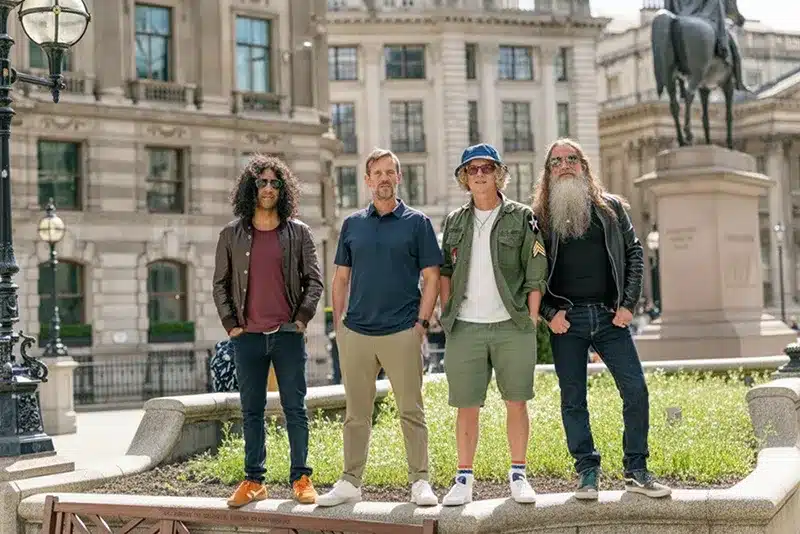

Liverpool has produced many great bands, but for Cast, there is only one worth listening to. There’s no greater testament than the title of their latest record, Yeah Yeah Yeah. “Don’t Look Away” is punctuated by John Lennon-esque sneers, particularly during the chorus. To call the comparison derivative and clinical is too simplistic; compared to Cast, Oasis sounds particularly vital and original. Judging by the 2026 effort, it seems John Power’s personal vinyl collection consists solely of Rubber Soul, Abbey Road and The White Album for the weekend.
In their efforts to re-create the 1960s, Cast nevertheless make a comment or two on the 21st century: “Weight of the World” looks at the state of the political climate in England. The blinding “Say Something New”, lit up by swampy guitars, proves to be an intriguing critique of fragile male psychosis. By contrast, “Free Love” is so embarrassingly trite and faux-naïf that erstwhile Beatle drummer Ringo Starr would have passed on it. A panoply of strings, singers and guitars emulating Indian instrumentation, “Free Love” desperately tries to ape the optimism of John Lennon’s “Give Peace a Chance”, failing miserably as it does so.
Truthfully, the opening number “Poison Vine” sets a standard the record rarely lives up to. Backed by P. P. Arnold’s soaring harmony, Power’s vocal races to the kaleidoscopic brass undulating beneath. Tension emanates from the wild hooks and mercurial drumming, as the band abandon a Beatles template to create a soul rocker which wouldn’t sound out of place on Sticky Fingers. Wisely, Powers doesn’t go full Mick Jagger in the microphone, but the stinging guitars recall Mick Taylor’s biting countermelodies. It’s as if Arnold’s presence made the band step up their game, admittedly a Beatlesque philosophy, considering how Billy Preston’s arrival pushed Lennon and co. to write stronger material for Let It Be.
Yeah Yeah Yeah never fully recovers from the scintillating first number, but Power sounds animated on “Teardrops”. He isn’t following anyone’s example other than his own, and “Teardrops” is all the stronger for it. Unfortunately, bassist Jay Lewis doesn’t walk his own path, playing the instrument as Paul McCartney would have in 1967. “Devil and The Deep” finds Power virtually alone, questioning his penchant for friendship as solitude offers cleaner, clearer solutions. A pretty sentiment, admittedly, but I would be very surprised if Power didn’t know that George Harrison recorded a song with the same name on the Brainwashed album.
Cast make no effort to hide their influences, a pity considering how well the men can play their instruments. Drummer Jay Lewis decorates all aspects of the kit over “Birds Heading South”; producing a quick double tap during the outro which adds a pulsating counterpoint. “Birds Heading South” boasts an orchestral line, tastefully transforming the rock number into something grander. Once more, the song is sullied by backwards tape done as a supposed homage to Lennon; on this occasion, the studio interference is minimal and doesn’t dampen the song.
This unit recently toured with a reformed Oasis, a band that ignored their more derivative work for the rock numbers which inspired so many across English council estates. Yeah Yeah Yeah shows a group who have lost touch with their roots, and could follow Oasis’s footsteps in re-creating the excitement of their debut record. All Change, a canon of jangly riffs and Northern attitude, showcased a band confident in their purpose and sound. Three decades on, Cast have become dependent on the imprints of their forefathers. With “Poison Vine” and “Birds Heading South”, the group show there is vitality to be mined, so it’s a pity it’s buried beneath these Beatly flourishes.