
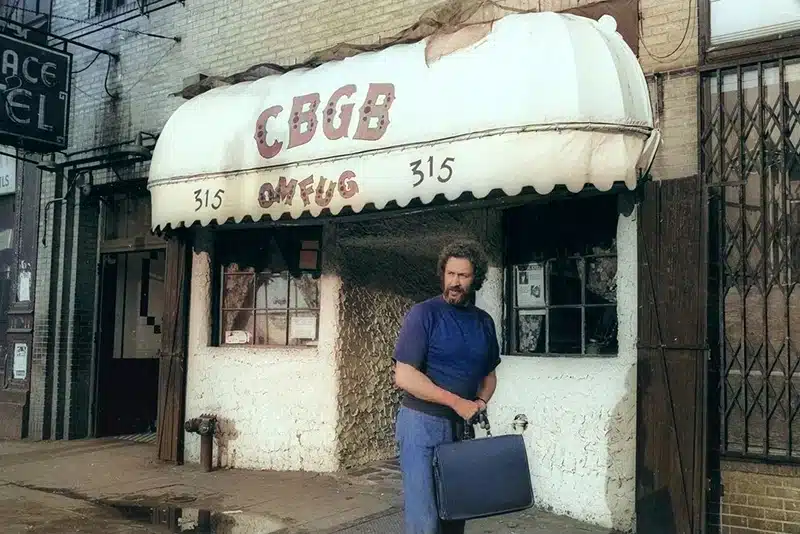
If the Rock & Roll Hall of Fame had a “dive bar” category, the late, lamented CBGB would be at the top of the list. The small club on New York City’s infamous Bowery was the Big Bang birthing center for a revolution in rock, and this four-CD set reproduces what shot out of that dark, dank space.
The set includes mostly studio recordings from 102 bands whose careers took root at CBGB. Some of the bands that the album calls “The Big Five” went on to international fame: Patti Smith, Blondie, Talking Heads, the Ramones, and Television. The collection also features beloved local bands who rode the era’s new wave but barely sloshed out of downtown.
The compilation tacitly puts forward a thesis statement that there was a loosely fitting CBGB sound, mostly electric-guitar-based and aggressive, with various shades of clever, smart-aleck, and creative. Punk certainly took root here, but the roster includes bands that also touch on free jazz, power pop, heavy metal, and no wave, and are full of attitude, cynicism, and iconoclasm.
While rock continued to be a genre dominated by white males, the collection is a reminder that women, LGBTQ and Black people also established beachheads—albeit small ones—at CBGB. There was a sense of community at the club and in that area of downtown Manhattan, though of a different flavor than the hippie era, brought to fruition in part by a city suffering through difficult economic times. It was an era ripe for disillusionment and snarkiness: Watergate led to Richard Nixon’s resignation, yet Barbra Streisand‘s “The Way We Were” was the year’s top seller.
After shutting down a previous venue, owner Hilly Kristal named his new club CBGB OMFUG, an abbreviation for “Country, Bluegrass, Blues and Other Music for Uplifting Gourmandizers”. After initially booking groups playing those genres, Kristal booked (for one dollar) Television in March 1974. Other rock bands began to play there, and soon the club became a Mecca for downtowners seeking alternatives to the era’s ascendant progressive rock. It was a return to rock’s roots, but with a rejection of sentimentality.
The club stayed open until 2006, but by 1986 its singular place in the downtown space was being supplanted by other clubs playing similar music and the movement of bands like Talking Heads, the B-52s and Blondie into larger venues.
The Ramones, who had some of their earliest gigs at CBGB, are here with the stripped-down, dark humour of “Beat on the Brat”, which helped inspire the subsequent punk movement. Lesser-known acts like the Brats (“Be a Man”), Sylvain Sylvain (“Teenage News”), and the Stimulators (“Loud Fast Rules”) show the broad alliance that featured furious, electric-guitar-led short songs, in contrast to rock’s pursuit of longer, more complex ones.
Patti Smith, who returned years later to close the club in 2006, is here with “Free Money”, melding her poetry with a hard-hitting rock sound. Talking Heads, represented here with the previously unreleased “A Clean Break”, showcase the more experimental aspects of the downtown scene, as does the Love of Life Orchestra on the retro-futuristic wonkyness of “Revolution Is Personal” and Chemicals Made from Dirt on the deadpan mechanical beats of “Oriental Television”.
While Television were one of the signature bands of CBGB, Tom Verlaine’s extended guitar solos echoed progressive rock. Still, his surrealistic lyrics and the group’s punchy delivery made it a fit for the hardcore rockers at the club. They are represented here with the characteristically cryptic rocker “See No Evil” (“I want a nice little boat made of ocean”), and Verlaine as a solo artist, with the Television-like stomping guitar workout of “Breaking in My Heart”.
The bands here generally have an air of hipper-than-thou and are anti-establishment. While a few groups are singing about typical infatuation and heartbreak, such as the Revelons’ “You Way (You Touch My Hand)” and Mink DeVille’s “A’ Train Lady”, many of the songs take alternative perspectives on love and sex, such as the in-your-face “Fuck Off” by the Electric Chairs.
Though they are a small portion of the overall bands on the collection, there are the proto riot grrl bands such as Helen Wheels’ “Room to Rage”, the Bush Tetras “Things that Go BOOM in the Night”, and the Stillettos with “Pink Stillettos”.
In “Dreaming”, iconic singer Deborah Harry and Blondie bring their hipness and arch humor to radio-friendly pop. They fit within the grungy confines of this dive bar, but it is easy to see how they easily slid onto the pop charts.
A CBGB regular who was from another world was Genya Ravan, singing here with Lou Reed, on “Aye Co’lorado”. Born in Nazi-occupied Poland in 1940, Ravan was a veteran singer by the time CBGB opened. While the song’s piano-and-harmonica boogie was a thing apart from the usual thunderous distortion at the club, her soulful delivery earned her a place in the downtown club scene. Another demographic and sonic outlier is Nona Hendryx, who has a space-funk number “Transformation” that seems to point to the parallel dance-club world outside CBGB.
Hard chunks of off-kilter rock appear throughout the four CDs. James Chance & the Contortions’ remake of “Jailhouse Rock” shows the movement’s determination to defy expectations, as do the quirky angles of “Do the Wrong Thing” by the Lounge Lizards and the jangly funk of “Tight Turn” by the Raybeats. Stretching even more into previously unexplored territory is James “Blood” Ulmer on “Open House” and “The World Looks Red” by Sonic Youth.
CBGB OMFUG: A New York City Soundtrack 1975-1986 opens a window into a particularly colorful era, even if the colors were mostly shades of black. The club did not spring from an initial vision of the owner, but he was the catalyst for an incredible explosion of creativity and energy brought by musicians and fans. The musical happenings that erupted there every night reflected a tumultuous time in New York City, and they echoed around the world and through the decades.
After a long battle with rising rents and changing tastes, the club was closed in 2006 and became a high-end clothing store. Its ironic demise would have spurred a cynical laugh from the struggling musicians who, back in the day, raged against the capitalist machine.