
Idealism is a tricky prospect in 2026. Just ask award-winning Australian songwriter Charley, whose debut album arrives at a juncture where, in her words, “the world’s gonna burn and burst into flames.”
She has spent the past three years braced for impact, sifting through the wreckage of her relationships and redefining her identity. The result, The Chronicles of a Serial Idealist, is an impressive exercise in mind over matter, in which Charley weaves a 12-track tapestry of enchanted poptimism to counteract very real pain.
Charley‘s chronicles are framed as a modern-day fairy tale. She slips “time” – as in, once-upon-a – into the album’s opening line, and “the end” into the title of the closing track. At a listening event in Sydney, the concept manifested as performance art: perched on a wicker chair, with nets of white lace adorning the walls, she explained the songs in rhyming verse, reading aloud from a large, leather-bound book.
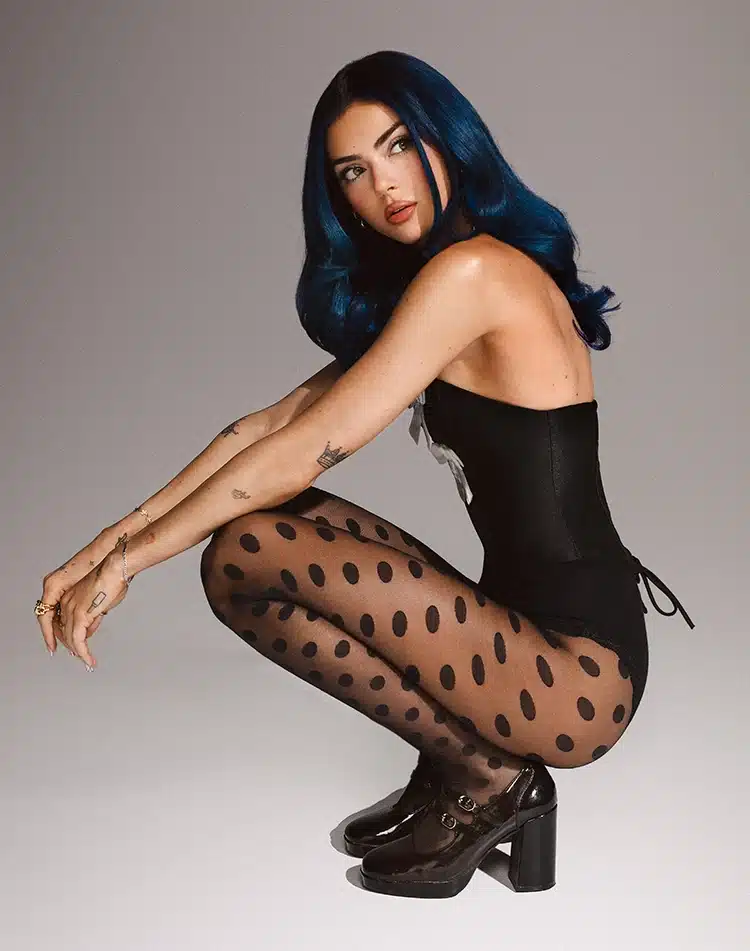
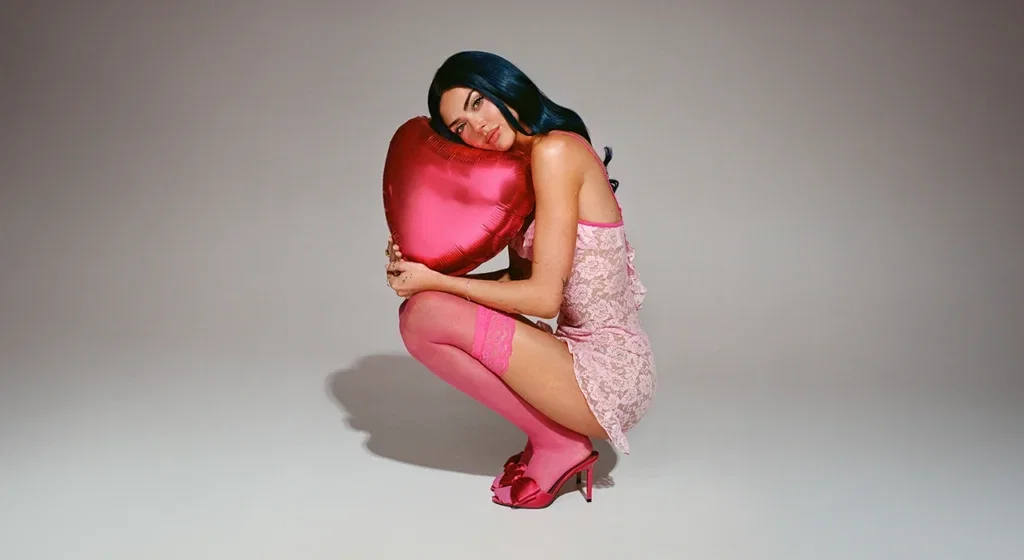
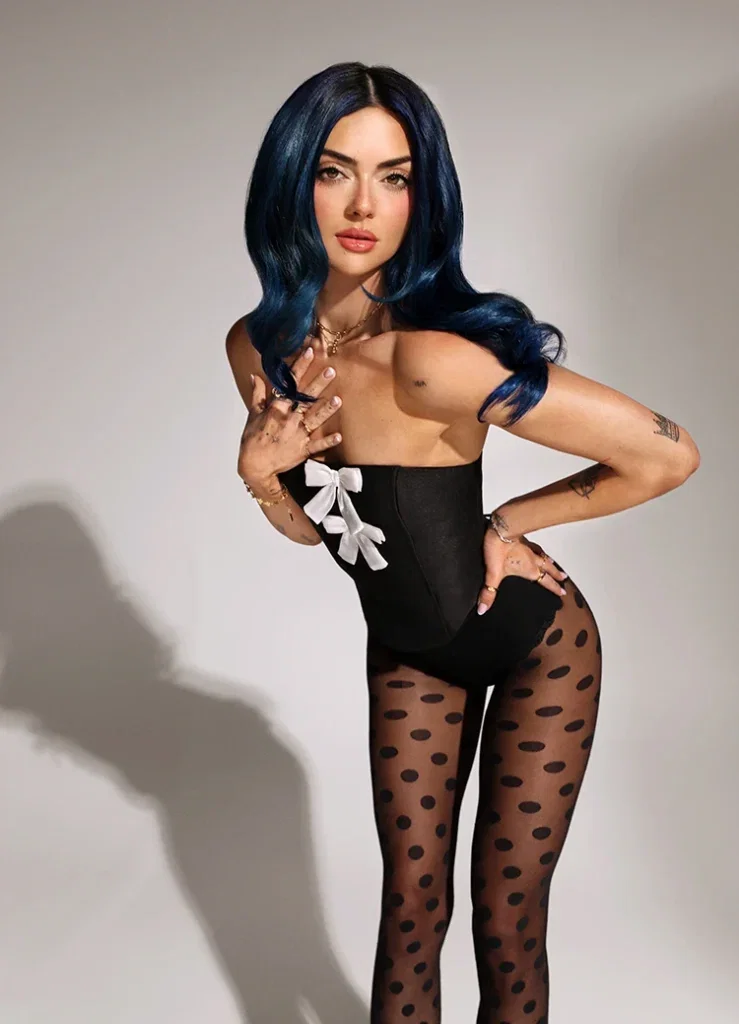
There is a certain déjà vu in this hunger for escapism. Charley‘s vintage pin-up fashion and ink-black hair dyed midnight blue hark back to pop’s last major renaissance, borne out of a similarly troubled climate. On the cusp of the 2010s, when she was barely a teenager, global economic collapse heralded the rise of recession pop, a hyper-stylized genre prioritizing revelry over self-pity. Katy Perry, Rihanna, and Kesha were its most prominent avatars, and Charley’s high-octane vocals on tracks like “Bite My Tongue” recall the war cry of these ancestresses.
A generation on, however, Charley’s outlook is not merely reactive. It is a deliberate effort to rewrite her story after a wave of personal challenges almost broke her. “I was going through such a hard time. Life’s f—king difficult,” she says, “and the only way to really get through it was to try and be as positive as I could.” She competed to represent Australia in the Eurovision Song Contest in 2022 and packaged up an EP, TIMEBOMBS, in 2023, but describes the process of making a full-length album as “so sacred”.
While its gestation spanned three continents, the bulk of The Chronicles of a Serial Idealist was formulated close to home. “I’d finished the entire album, and my label were like, ‘No, you’re not done,'” laughs Charley. “So I booked a whole retreat away with Harry Charles and Ned Houston … and [seven] songs came out.” She calls Charles and Houston the “two people I feel the safest with”, co-pilots capable of delivering soft landings for her autobiographical lyricism. For example, in the jittery come-on “Muscle Memory”, Charley verbalizes she is still “learning the rhythm” of romantic relationships, an admission that provides context for the initial run of songs on the record.
Inspired by the lakeside setting of the writing retreat, the title track, “Serial Idealist”, is a breathless fantasia of love as seen through the starriest of eyes. The production glides along on plumes of dry ice, bringing to life tableaux of candlelit dinners and rain showers like a scene from a 1980s movie. By comparison, the neon-lit pulse of “Limerence” pulls away from chimerical daydreams and lands somewhere in the middle of a club. Here Charley intuits the difference between love and infatuation, but when the clock strikes midnight, she simply feels too good to care.
At the album’s midway point, these gauzy reveries crystallize into “Cherries”, a confident, sapphic supernova. Anchored by a gurgling, bass-heavy foundation, shaped partly by Ariana Grande‘s musical architect, Tommy Brown, “Cherries” ripples with tangible frisson. In the sumptuous video, which Charley deems “gay as f—k”, she embodies Marie Antoinette via Sofia Coppola as a can-can line of ladies-in-waiting stage a food fight – and there is enough cake to go around.
“I feel like it is very important for the younger generation to know that it’s normal to be queer and for [my] music to be pop and in-your-face,” she asserts, before clarifying, “A lot of my music videos, I’ve wanted to have people with different genders, but for some reason at the end it hasn’t worked out.”
Even if the video-verse of The Chronicles of a Serial Idealist was not intended to be exclusively female, its effect is potent. For “Other Side of the Room”, the director, Roman Anastasios, inserts Charley into well-trodden milieus – 1950s suburbia, a Wild West saloon, a private investigator’s office. In each, her attraction to women is treated as unexceptional, offering retribution for historical prejudices that impeded same-sex storytelling on screen. “I really enjoyed doing classic stuff but recreating it with a queer lens,” she explains, relishing the thought of what Hollywood’s golden age would have looked like “if the next-door [love interest] was a masc lesbian.”
The album’s preoccupation with yearning connects the dots across decades of music that have been embraced by gay audiences. “I think it’s quite a natural thing for me as I experienced it myself,” she states. “I was going through something where, after a break-up, you see that person everywhere you go, and you cannot get rid of them, then they’re in your brain.” Charley’s constant craving also shares the DNA of the crying-on-the-dancefloor sound pioneered in Sweden, where some of The Chronicles of a Serial Idealist was created. (Although, as per the depiction of watching her ex fall for someone new in “Used to You Two”, an emotional high point on the record, “crying alone in the bathroom” might be more appropriate.)
A surprising influence is revealed in “Lil Rockstar”. Produced during a session in Nashville, the track casts Charley as a spellbound superfan of another musician, and its irresistible yee-haw spirit indicates a songwriting instinct that runs deep. “Dolly Parton was a big influence. Maren Morris, her Hero deluxe album is one of my favorite albums of all time … It’s weird, it somehow comes out in my voice sometimes as well,” she muses. Charley is not kidding: the twang of a slide guitar turns up in “Liar”, and she premiered one track at Saddle Club, a weekly line dancing social in Sydney. “My goal in the future is to put a country element in a couple of songs from each record so that by the time I’m older, I could do a whole country record.”
In the home stretch, Charley’s idealism ruptures, as do tightly held beliefs about how the world works. In “Boys Scare Me”, a clever inversion of the sexual experimentation in Katy Perry’s “I Kissed a Girl”, her anxiety around dating men challenges the myth of patriarchy, for strength does not guarantee safety. “You don’t know what’s going to happen when you walk home,” she says. “Even the stories about David killing Goliath with one stone, men hold so much power … It’s so interesting hearing people finally be able to speak about that,” observes Charley, emphasizing that “it’s a way bigger song than just [dating].”
However, it is “Man on the Moon”, winner of an Emerging Global Songwriters Award, which finds her most private moments laid bare. Charley recounts coming out to members of her family and the temporary estrangement that followed, fortifying the tale with one devastatingly authentic detail: her real name.
“This song will always be a touchy one for me, even though I wrote it, like, two years ago,” she admits, her eyes immediately brimming with tears. “I really want to speak about this because I feel like it’s quite important for my story, and for other people as well [who] go through that with their loved ones. It’s hard to sing about it because I feel guilty in a way, but I just felt like I needed to be really raw and honest. And it was nice to be able to have ‘Claire’ as a lyric. I think that’s really special because I’m constantly being called ‘Charley’ and so saying ‘Claire’, it’s personal.”
The album closer, “The End of Everything”, straddles hopefulness and resignation in a manner that seemed impossible when her chronicles began. Over an arterial drum beat and the warm strum of an acoustic guitar, she contemplates asteroids obliterating Earth and appears content to “stand open-armed, right there in my grave.” Her chirpy delivery is oddly comforting: if we are all going to die, what does any of it matter? Charley’s serial idealism has been supplanted by serious pragmatism, which has triggered some much-needed perspective.
“In the end, music is a form of bringing people together,” she reminds herself. “We’re all trying to say the same thing, whether it’s about heartbreak or love. Even trying to stand together while the times that we are in are shit and awful. Hopefully, more music about that can come out in the future as well.”