
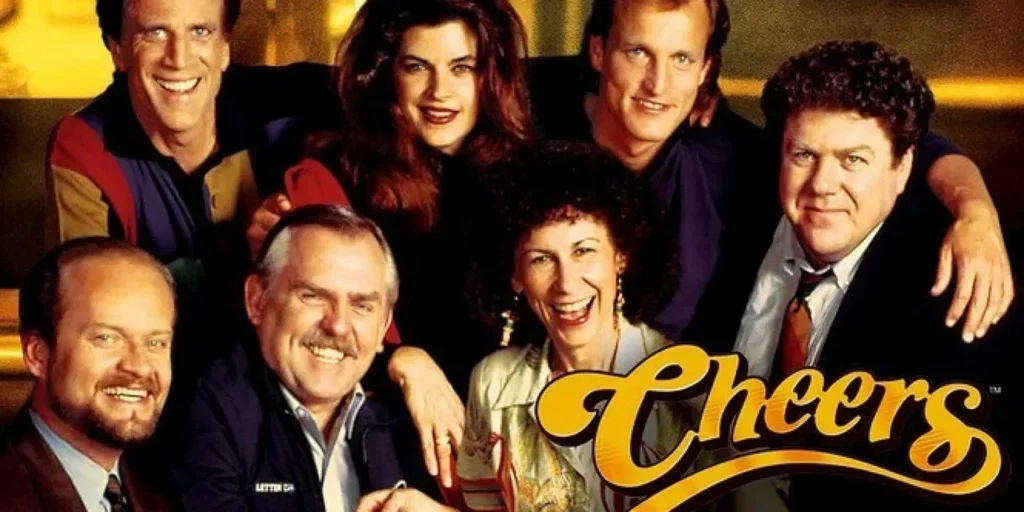
I get the cosiest feeling when I watch the old 1980s sitcom, Cheers (streaming on Hulu at this writing). There are several reasons for this. First, of course, is that it reminds me of being young: its run ended when I was 14. Second, it was part of the glorious 1990s Friday nights on British TV, where you got all the best American imports (The Golden Girls, Roseanne, Cheers) and British youth-oriented TV (Red Dwarf, The Word, Whose Line Is It Anyway?). Third, and most importantly, the show itself presents a cosy, recognisable world of memorable characters who accepted – just about – each other’s glaring flaws.
Cheers‘ characters are often essentially losers, but that makes them all the more endearing: Norm, Cliff, Rebecca, Coach, Carla, Woody, Paul, Diane, even ladies’ man Sam: they are all comic incompetents, but what feels soothing is how this was accepted. They are economic failures: George Wendt’s Norm is an escapee from the rat race; Ted Danson’s Sam is in decline from his glory days, Rhea Perlman’s Carla is always broke, and Kristie Alley’s Rebecca relies on her Daddy.
They are also intellectual failures: Shelley Long’s Diane and John Ratzenberger’s Cliff are both striving to use knowledge for status, and failing. They are emotional failures: Sam again, Cliff again, Carla again, and Rebecca again. They are social failures: Woody Harrelson’s Woody is made fun of for his naivety, Nicholas Colasanto’s Coach is barely competent as an adult, Carla’s vicious tongue would probably get her fired anywhere else, and Paul Willison’s Paul somehow thinks the others are better than him.
This acceptance of character weaknesses works particularly well through the series’ long-running arc. Other shows of the era (1982-1993) have characters resolve their issues at the end of episodes. The Golden Girls lampshades this with cheesecake, ending episodic conflicts with pleasing emotional resets. Roseanne dramatises working-class struggle and resilience drawn from family. (Whereas the slightly later Seinfeld is nihilistic in denying any growth).
Cheers, however, doesn’t reset or progress; it just continues. The characters are in conflict in storylines that can last a season or more. Diane and Carla never stop hating each other. Frasier is always jealous of Sam. Norm never makes more of himself. Woody marries the beautiful woman, but only because she is his intellectual counterpart. Rebecca perhaps gets chewed out the most for failing at managing the bar. Meanwhile, Cliff and Norm become ever more co-dependent.
Which means that the tableau Cheers presents is deeply reassuring. It is where everybody knows your name. It has been said that that’s why people liked the show: it’s a world of disparate personalities who would have no reason to interact. Diane and Carla would never meet otherwise. Nor would Sam and Frasier, or Robin and Cliff, or Norm and Rebebcca. Their interactions power so much comedy through their varied outlooks.
Cheers‘ spin-off, Frasier, was perhaps more schematic in its character creation, as you can define them all through what Derrida called the Nature/Culture dichotomy. Frasier (Kelsey Grammer), Niles (David Hyde Pierce), and Lillith (Bebe Neuwirth) are culture, whereas Roz (Peri Gilpin), Daphne (Jane Leeves), and Martin (John Mahoney) are nature. Frasier‘s greater focus gives the comedy instant depth, whereas Cheers’ ensemble cast meant it took time to grow. However, that focus meant Frasier could appear as its own caricature: “Frasier and Niles squabble over a dinner party”, again.
The broader nature of the Cheers characters allows for more themes to be addressed, from parenting to isolation to civic politics to sexism to ambition to masculinity to addiction to social class. Each is explored through interaction, but none of the characters are transformed by it. Even as a Boston councillor, Woody remains Woody. Frasier might be shattered when Lilith leaves him and when Diane jilts him, but he remains quintessentially Frasier.
This comes at a cost. Cheers facilitates belonging, but in a peculiar way. The characters interact and clash to great comedic effect but do not resolve, which allows the show to go on and go. Cheers is where characters never grow, because growth requires friction, risk, or departure, and the bar setting removes all three. That’s alright, because you might not be liked, but you can be accepted. That’s how drinking buddies operate: they enable only one facet of your personality. Bar bonds are the weakest of all human connections.
Cheers is thus a bounded world, with fixed roles. In its 11 years, Sam never matures. Cliff and Norm regress, if anything. Rebecca may come in with the most ambition, but her irrepressible klutziness keeps her stuck there. Frasier becomes one of the guys to fit in. Carla is always mean. These are not personalities, but roles. The warmth of Cheers is thus the siren call of familiarity. You are known. It’s where everybody knows your name.
The three characters who do strive for progress are, interestingly, all women. Diane is a wannabe writer and intellectual, but she eventually leaves for Hollywood. Rebecca, her replacement, is a send-up of the 1980s power woman, who wants it all but can’t manage the door knob. Her arc is the most tragic: because she dislikes Cheers so much, she is the one who is stuck there.
Lilith is the real thing, shown to be Frasier’s intellectual superior and the stronger of the two, but she has to leave. There is no room for growth. Sure, she may flirt with Sam, and show a surprising facility with knife-throwing at Woody’s wedding, but these are comedic foils, not character developments. She is one of the few who has a life beyond the bar that actually matters. The men remain because the structure suits them. The women leave because it does not.
Cheers is a distinctly male social structure, for all its women. It offers identity preservation at the cost of development. In Cheers, that phase has hardened into a condition. The characters are suspended in a version of life that never demands more of them. It’s like an amniotic fluid or an opiate, except it’s beer and undemanding company. The appeal is obvious: relief from the pressures of work, ambition, and emotional anxiety. The relief is structural, not temporary. It is less “a break from all your worries” than a space in which worry is never fully confronted.
Hence, Cheers enables acceptance but only in its most illusory form. Familiarity replaces reciprocity. Real friendships and romantic relationships require adjustment, negotiation and change over time. Cheers removes that burden. Instead, roles are fixed, expectations are known, and interactions repeat. As sociologist and psychologist Erving Goffman argued, the social self is situational and performative: requiring adjustment and constant calibration. The bar, Cheers, like other environments, is where personas become stuck, frozen in that process.
So Norm never adjusts; he enters and exits the same man. All we learn of him in 11 years is that he has a flair for interior decoration. Cliff delivers the same performance, never recalibrating. Carla endlessly repeats her vituperation, even when she’s in some kind of love with Keene Curtis’ John Allen Hill. They wear the mask of their personas so well that we don’t know who they truly are. (Who exactly, for example, is Norm’s never-seen wife, Vera? We never find out).
Cheers thus enables the illusion of stable identity by removing the pressures that normally require the self to adapt. To Goffman, the self is made through interaction, but in Cheers, interaction becomes ritual, and the self stops evolving, or is banished. No wonder this sitcom is comforting, even if it is the most insidious form of cosiness. By enabling stasis, Cheers creates a velvet trap: the seduction of companionship without demands. Everything is permitted. Nothing is required. The show’s comfort is the mechanism of its danger.