
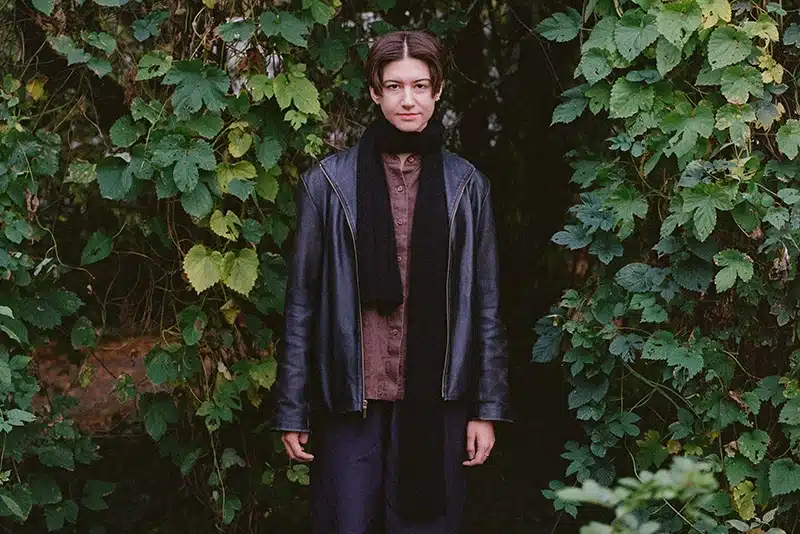

Jazz is a category of music that tends to catch experimental musicians in 2026 who happen not to be playing “classical music”, even if their music sounds more like, say, Björk than like Sarah Vaughan. Hello, Claire Dickson.
Dickson studied music with Vijay Iyer at Harvard, and I first heard her as part of pianist Lex Korten’s ensemble on 2025’s Canopy. That makes her at least jazz adjacent, even if her new album, Balance, indeed, sounds very little like Sarah Vaughan. Rather than thinking about how Dickson’s music diverges from some imagined jazz mainstream (if there is such a thing anymore), I prefer to see it as evidence that “jazz”, in 2026, is a radically expanding category.
Balance is a collection of seven Claire Dickson compositions that were built in the studio from a series of vocal melodies and lyrics, which Dickson then opened up to collaboration from her community of musicians: Korten, saxophonist Zoh Amba, drummer Lesley Mok, Cleek Schrey on violin, pianist Maya Keren, Jon Starks on drums, and harpist Kitba. She took their work, added her own textures, samples, and electronic effects, and mixed it into a dreamscape of sound.
The music is exceptionally beautiful and atmospheric. Though these are hardly pop songs in the sense of having verses and choruses, Dickson builds them with an ear for securing your attention, for luring you under their spell.
For example, “Doors” begins with a four-note synth line that sits below Dickson’s layered “ahh” harmonies, then colored by percussive electronics and piano. A poetic but specific narrative arrives in Dickson’s distinctive, gauzy singing voice, an alto that whispers and croons. The words blur as her voice interacts sonically with the atmospheric accompaniment and effects: “Hands of marble thread my core / I am walking through your golden doors / Going where I went before / I am walking through your golden doors.”
The synths swell and recede as piano chimes. “Riding outside in the wind / I feel I’m already there / Riding with hands in the air.” Amba’s tenor saxophone insinuates itself here, also feathered, in sympathy with Dickson’s vocal sound, even as she moves into her soprano range, singing a downward gliss that loops quietly above the next lyric. Mok’s drums enter first, playing rolls against the snare, cymbals tumbling. “Talk is loud between the doors / Though I hear a distant river roar / Footsteps on the marble floor.”
Then they are a jazz band — saxophone, drums, piano — briefly. The vocal harmonies re-enter, with arpeggiated piano and Mok playing like an orchestra, as the saxophone finds one overblown note in its upper register.
Each of the eight performances has an equivalent yet different structure, as sounds whoosh in and out, constructing small avant-symphonies that are nevertheless built from the materials of jazz and pop. “Eyelid” stands on a two-chord vamp as surely as many soul songs, merely interrupting the flow with an interlude and reconstituting it with a deeper drum groove and more atmospheric. “Sign” doles out rattles of electronic percussion and bursts of samples (or Dickson singing stacks of reverbed harmony) like a hip-hop song. “Waterfeel” sounds like a piece of chamber music, with a steady flow of keyboard outlining a 13/8 time signature layered with simulated and real strings.
For all the artfulness of Balance, its connection to the universe of both classic and modern popular music is worth considering. “Hurt Me” presents a series of ambiguous chords married to a narrative of a difficult personal relationship as confidently as any Joni Mitchell song. Like that genius, Dickson allows her band to take over the track, with an explosion of drums that suggests that the story is not one of pure vulnerability.
Similarly, the title track “Balance” sets up Claire Dickson’s vocal line as a centerpiece over an easy-to-dig triple meter. “You keep a pencil in your hand”, she sings. “Body destructed and controlled — it’s morning, a true existence, the order of your movement. Eyes with arrows when you’re resistant meets the need for balance. Balance.” A collage of instruments circles her repetition of the song’s title, and then Mok rises from below it to add more pulse, which is mimicked by pulsing synths. Do I know what this song is about, lyrically? Perhaps not, but I feel it. It gives you what good pop music must — a sense of connection and emotion.
I started this review by connecting Dickson and her new album Balance to jazz, of course. While we hear one central element of jazz, improvisation, throughout the album, it is not in the form of “solos” by instrumentalists over the songs’ forms or harmonies. The instrumental elements sound fresh and improvised, but were then broken into pieces and orchestrated around the compositions. It is an interesting way of thinking about what a musician can do with the artistic practices of “jazz” to reimagine them in a world of electronic music and hip-hop without simply letting a saxophonist blow over a new kind of groove.
Listening to Claire Dickson, my ears were drawn back to another singer, Emma Franks, whose tone and delivery are similar — cool, breathy, but intense — but whose art is closer to that of a singer-songwriter. If you like one, I suggest checking out the other.
Claire Dickson is also unlike anyone else. She is constructing music using an unusual method that doesn’t sound forced, angular, or strange. She is making art music that casts a spell and might just be a sensation, at least a quiet and beguiling one. There is a power here that mixes popular, personal, and jazz elements into a daring, delicious whole.