
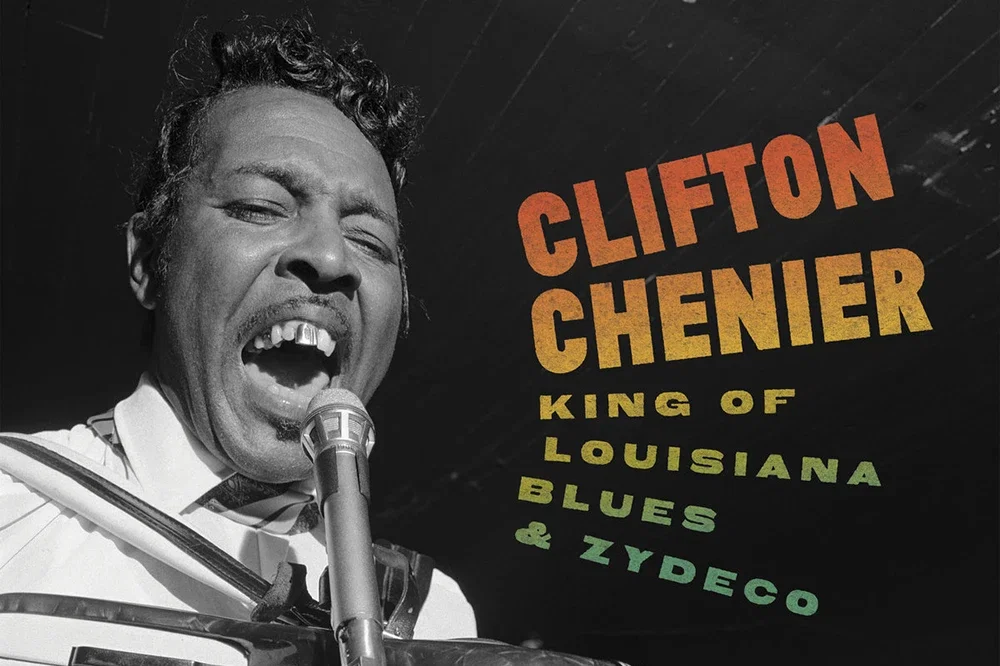
Accordion-averse people (it may be hard to believe, but such folks do exist) may want to steer clear of the music made by legendary zydeco master Clifton Chenier. Anyone else who wants to explore a discography filled with tunes that are historical, danceable, and just plain fun all at once ought to at least dip their ears into some of the 67 songs to be found on the career-spanning Smithsonian Folkways compilation, King of Louisiana Blues and Zydeco.
Born on 25 June 1925, near Opelousas, Louisiana, Chenier was just a boy when he decided to become a musician, specifically an accordion player. He was soon playing the genre now recognizable as zydeco, lively dance music played by Black French-speaking artists in Southwest Louisiana. Starting at his local dance clubs, Chenier would eventually carry zydeco to concert halls and recording studios around the world, in a career that had highs and lows but lasted until Chenier died in 1987.
After some initial success in the 1950s, Chenier endured a career slump before meeting Chris Strachwitz, owner of Arhoolie Records. Strachwitz was devoted to recording the music he loved for Arhoolie, and he loved Clifton Chenier’s music. Starting in 1964, Arhoolie would serve as the launching pad for many of Clifton Chenier’s singles and albums. Smithsonian Folkways acquired Arhoolie Records in 2016, ultimately leading to the comprehensive new collection.
King of Louisiana Blues and Zydeco opens with “Louisiana Stomp”, a 1954 single Chenier recorded at a radio station studio for the Elko label. An upbeat instrumental, “Louisiana Stomp”, might seem like a template for the zydeco sound, but Chenier was an eclectic music fan and was already incorporating a wide array of genres into his work. “Louisiana Stomp” has a jump-blues kick to it, while the song featured on the B-side, “Clifton’s Blues”, is indeed a down-tempo blues tune.
Taken together, “Louisiana Stomp” and “Clifton’s Blues” represent Chenier as the pioneering artist he was, grounded in his own musical traditions but musically curious enough to continually expand his palate with nearly everything he heard around him. Chenier’s desire to mix and match zydeco with many genres never dissipated – he even recorded songs called “Zydeco Cha Cha” (included here) and 1982’s “Zydeco Disco” (sadly, not in this collection). The resulting music acknowledges and celebrates the regional music of Chenier’s home, while demonstrating how so many other styles could be seamlessly and often tremendously folded into zydeco.
Clifton Chenier was the subject of two documentaries by noted filmmaker Les Blank. One of them, Hot Pepper (1973), documents his immense talent as a live performer, as he and fellow musicians metaphorically tear up dance halls in and around Lafayette, Louisiana (for Paul Simon’s perspective on experiencing the King of Zydeco live, listen to his Graceland track, “That Was Your Mother”, which namechecks Chenier).
Given Chenier’s reputation as a performer, the compilers of this set have wisely included many live performances alongside his studio work. The live tracks feature Chenier and his red-hot band performing a five-song set from the first season of the seminal live performance show Austin City Limits, culminating in an incendiary take on Ray Charles‘ “What I’d Say”. It’s practically punk rock, but with an accordion.
Whether you sample a few of the 67 tracks on King of Louisiana Blues and Zydeco, or spring for the four-CD or six-LP box sets that include a 161-page book filled with essays, photos, a detailed track list, and more (the pdf looks fabulous), everybody ought to dive into the wild, eclectic, joyful music of Clifton Chenier. Even the accordion averse might decide they love it.