

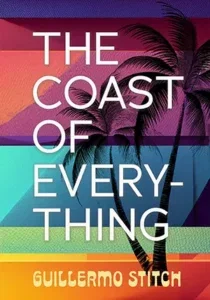
How far into The Coast of Everything by Guillermo Stitch must one wade before feeling qualified to review it? About 900 pages, probably, which is awkward because the novel itself is only 747 pages long.
It resists quick judgment, obviously. Its conclusion refuses tidy answers to its tangled weave of philosophy, neo-noir, metafiction, and literary pastiche. Vladimir Nabokov once observed that “there is no reading, only re-reading,” and Stitch’s novel seems to operate by that principle. Only after finishing The Coast of Everything does one appreciate how little of it one grasped. It is like you only half-read it.
This is not a complaint. There are novels one admires, novels one enjoys, and novels one circumnavigates. Stitch’s enormous, unruly, magnificently overeducated contraption belongs in the third category. The Coast of Everything is the sort of book that makes you feel simultaneously more intelligent and more illiterate. Like Ulysses, Gravity’s Rainbow, or a dinner party attended by people who actually understand the Mandelbrot Set, it produces the persistent suspicion that you are missing half the references and most of the jokes. Fortunately, Guillermo Stitch appears to regard confusion not as an unfortunate side effect but as the reader’s proper condition, a sign, not of failure, but of creative exertion.
The Coast of Everything is a suite of nested narratives – novelettes, novellas, and supernovas – that should not fit together but somehow do. It opens with Clara, a bed-bound young woman carried through the one-horse town of Einpferd by two dwarves, whom she entertains with stories to keep them motivated. One such tale concerns Billy Stringer, a journalist drawn into the illegal exchange of books in a Philip K. Dick-style future where fiction has been outlawed, and literature survives only through underground circulation.
Before Stringer can fully enter that demimonde, however, he must help his co-conspirator, Vince. Vince, a secret writer himself, confides his own story. He is haunted, not by the anxiety of influence, but by the ghost of Charles Dickens, who survives chiefly on breakfast cereal while composing a science-fiction novel of his own. That novel deals with colonists on the Isle of Truth discovering an archive of lost fiction. Perhaps even the fiction lost by the failure of Billy Stringer and his covert cohort to save literature.
Surely, one thinks, this is the point where the novel tips over into self-indulgence. Yet the more absurd Stitch’s machinery becomes, the more compelling it is. As the threads of narrative grow yet more labyrinthine, one becomes more determined to find the true, definite path through. There must be a way through and a way out, right?
At the centre of the labyrinth, we find Liam Téad, a weak private detective who never becomes hard-boiled, despite being completely submerged in hot water. He is the runny core of things, bewildered, but somehow beloveable.
Hired by the daughter of a media tycoon to locate her missing sister, Liam wanders through Tangiers and the novel like a man dispossessed. The family he investigates made its fortune not through technology itself but through the technology of storytelling. “It was about media and message. It was about narrative,” the mogul explains to his wife, who tells his daughter, who tells Liam. It is all a game of Chinese Whispers. Thankfully, the reader overhears the whispering, just in case they failed to notice that The Coast of Everything is interested in storytelling.
Stitch is not subtle about his themes, but then, subtlety is not the point. The novel asks, repeatedly and from different angles, what stories do for us, what survives through them, and whether identity itself is inseparable from narrative.
Sherry Zade, the daughter, gives Liam a copy of The Arabian Nights, the novel’s master key, less an influence than the operating system of the whole thing. Like Scheherazade, who told her stories to distract her murderous husband, characters throughout The Coast of Everything tell stories to postpone destruction – literal, emotional, and cultural. Clara tells stories to keep herself moving. Stringer smuggles books to preserve literature against erasure. On the Isle of Truth, an archive of forbidden fiction is hidden inside the body of a child, as though stories themselves require human hosts to survive.
When detective Liam finds his temple at the wrong end of the Mayor of Tangiers’ pistol, he is offered one way out of certain death: say something interesting. He doesn’t merely sing like a canary, he disgorges narrative like a condemned man bargaining for one more dawn, and in so doing gives up his darkest secret: his story. Everyone survives by postponing endings, and everybody in The Coast of Everything seems to understand, consciously or not, that the end of stories might also mean the end of themselves. Stitch’s vision of culture is simultaneously comic and desperate: humanity as a species talking against the dark.
What makes the novel remarkable is that these ideas rarely feel merely theoretical. Despite its intellectual density, the prose remains agile and pleasurable. Stitch can move effortlessly from gritty noir to Dickensian comedy to postmodern fragmentation without losing tonal control. His sentences are alive with literary memory but rarely paralysed by it. One feels the presence of Borges, Calvino, Pynchon, Barthelme, and Joyce, yet the voice remains distinctively Stitch’s: playful, melancholy, encyclopedic, and slightly feverish. He writes as though every idea reminds him irresistibly of six others.
That said, The Coast of Everything is not an easy novel. Its abrupt shifts in mode, embedded texts, fake Wikipedia entries, recipes, and relentless allusiveness can exhaust as often as they exhilarate. At times, the story threatens to collapse beneath the sheer weight of its own literary self-consciousness. There are stretches where the novel appears less written than metastatized. Some readers will find its density alienating; others will consider that density the point. It just means that the body is alive.
Still, the novel’s tangled structure ultimately serves a coherent vision. The Coast of Everything is not a puzzle to be solved so much as a process to inhabit. Stitch repeatedly returns to the ideas that “writing is rewriting” and “reading is rereading”, that stories endlessly recycle and transform one another. Billy Stringer literally retypes the books that pass through his hands to keep them alive, improving them, perhaps, like Pierre Ménard. Stitch folds his earlier novella, LiteratureTM, into the architecture of this one, turning his bibliography into part of the fiction’s recursive machinery.
Lesser metafiction delights in eventually revealing the trick. Stitch is after something stranger and more difficult. The Coast of Everything suggests that stories are not codes to be solved but habitats to be lived inside. The recurring concern is not meaning but continuation. Books survive by being rewritten. Human beings survive by turning experience into narrative before oblivion catches up with them. When Liam Téad is held at gunpoint, he is merely experiencing the condition under which all writers operate.
In the end, the maze is never solved. Rather, the novel loops back on itself in a kind of Möbius strip of narration, where stories generate stories which generate storytellers who require more stories to continue existing. By the end, re-reading the beginning feels less optional than inevitable.
The Coast of Everything is long, difficult, excessive, and at times maddening. It is also one of the most ambitious literary works in recent memory: a maximalist meditation on storytelling, identity, and survival that insists stories matter because life itself depends on them.
Scherezade told stories to her captor to survive another night. Stitch, one suspects, writes for much the same reason.