
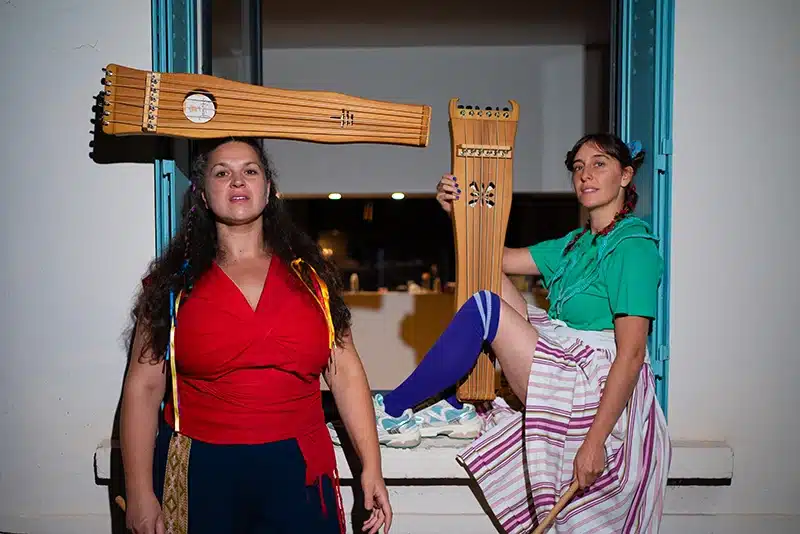

Cocanha transmit an energy more befitting a choir than two singers. Such is their energy that vocalists Caroline Dufau and Lila Fraysse dot Flame Folclòre with a multitude of harmonic jumps and counter-melodies, mostly through articulated energy alone. “Diurê Tremblar” is one hugely impressive collage, an audio sample making way for bustles of chorale singing. Could it be a hymn or a prayer? Performed in Occitan, the message may not be entirely clear to the listener, although there’s no denying the impact every syllable makes on the ear.
As a rule, Flame Folclòre seems to defy genres: only time will tell, but Cocanha’s third record could be a harbinger of other minority-language rock albums to come. The record arrives following the news of Moya Brennan’s death. While it would be spurious to say that this duo could pick up where Clannad left off—it is a different language, for one thing—Cocanha have nonetheless shouldered a similar crusade, enchanting audiences with the sounds associated with this particular dialect. “A L’Amistat”, virtually empty of instrumentation, thrives on rhythm and general bonhomie. “Diurê Samsir” is lit by handclaps a la Queen‘s “We Will Rock You”, an exercise in start and stop calls.
“Fòrabanda” begins with the rattle of a buzzing instrument, perhaps a sitar, before the ghostly whispers grow giddier and more agitated, inviting listeners to move their hips and cogitate. This project as a whole feels fairly turned on, boasting a hypnotic power more often heard on songs from India than European tunes. “Adissiatz Palhassonaira” is a passionately tormented tune, the pair singing in entirely different pitches and lyrics, joining together during the angelic middle eighth. If this song tests the nerves, then “Au Nòst’ Casalòt” obliterates them with ticking clocks and banging drums: BOOM!
Conceptually, Dufau & Fraysse’s third work is best enjoyed in one sitting; notes rippling into the following vocal line. Autumnal in flavour, Flame Folclòre is unafraid to wash itself in longeurs, permitting the singers to breathe with their intended audience. Out of the compositions on offer here, “Lo Mes De Mai” is the most conventional: a chiming riff swiftly superseded by a rising melody, the acoustic doing the heavy lifting for once.
“Jana D’Aimet”, by converse, is a monstrously challenging melody; soaring pockets interchanged by softer, more solemn deliveries. Frontpersons Dufau & Fraysse cackle and croon, as if summoning a malevolent force beyond a fiery surface. Unsurprisingly, “Jana D’Aimet” climaxes this album. What on earth could follow with sufficient conviction or integrity?
Cocanha started as triumvirate, only to downsize following Maud Herrera’s departure in 2020. Impressively, the two consistent artists blend well with one another, curating an invisible third voice. Only time will tell whether the performers select a third singer; judging by this effort, it will most likely be excessive baggage. There’s enough electricity and vibrancy heard here, at least in vinyl form. A studio papers over reduced membership, as the Rolling Stones discovered when Brian Jones proved less and less reliable to meet demands.
The title track exudes charm; in a past life, it would have been a shoo-in for the esoteric television show The Old Grey Whistle Test. One can almost picture the boho-frocks and tousled hair swaying to the grooves; “Flame Folclòre” screams psychedelia and percussion. Continuing this “turned-on portrait” of the 1970s, stage pundits would use percussion to embrace the fusion. That the two singers can conjure sound paintings with little more than their mouths and a minority language shows they are in complete command of their journey.