
When a failing democracy degenerates into an autocracy, opposition forces need to turn their attention from feelings of despair and disorientation to a more pragmatic concern: what can we do about it? Such is the current situation in the US. Most Democratic Party reactions have been stymied by the reality that the House of Representatives and Senate are currently controlled by the party enabling the authoritarian, while the Supreme Court has permitted many of his worst excesses. As a result, frustrated citizens are donning the mantle of responsibility and expressing their disgust in mass protests against the ongoing atrocities.
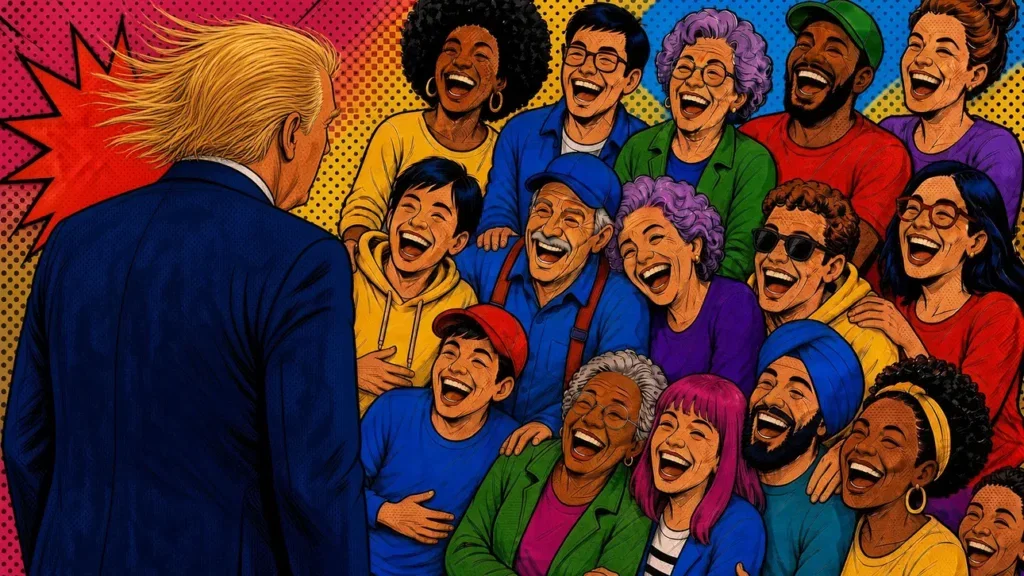
Humor has been ubiquitous in these protests, used to maintain a peaceful presence while projecting a joyful contrast to the aggressive cruelty Trumpism embraces as its brand essence. Whether it’s folks in inflatable frog costumes or Robby Roadsteamer singing anti-MAGA songs while dressed as a giraffe, the resistance has smartly recognized that humor might be one of its most effective weapons in fighting creeping fascism.
This is nothing new. Satirical humor has long been used as a way for citizens to show their opposition to undemocratic regimes. As early as the 6th century BC, comic poets helped steer Athenian democracy in the right direction, while carnivals not dissimilar to the “No Kings” demonstrations ridiculed repressive medieval rulers millennia later. Such humor is baked into American history, too, with political cartoons providing the cultural clout the last time its people decided they did not want to be governed by an imposing monarch. This tradition of political satire runs from Benjamin Franklin to Mark Twain to today’s late-night talk show comedians, with many more notable contributors along the way.
Political humor can operate as an antidote to authoritarianism because of the contrasts it highlights. Whereas Trumpism seeks to divide and conquer, fostering fear and anger by scapegoating “others”, humor unites us in a common laughter that signifies a common understanding of common human mores. Even despotic ancient kings welcomed the mockery of their court jesters, a gesture of concession to the universal moral code an effective humorist can remind us of.
Scholar John Morreall explains that “laughter can serve as a social corrective to get wrongdoers back in line” (5). Shakespeare dramatically employed this instructional comedy, chastising the kings and oligarchs of his time, just as Jimmy Kimmel does today as our most effective political satirist in the age of Trumpism.
Humor Corrodes Authoritarianism’s Iron Will
Politically, the opposite of authoritarianism is democracy; cognitively, it is humor. “[People] with a sense of humor can never be fully dominated,” Morreall (101) states. Even when physically silenced, they will mentally vent; their disposition to the imagination, liberation, and possibilities humor fosters makes them the enemies of rigid regimes. Sometimes, as scholar Chaya Ostrower documented about Nazi concentration camp prisoners, (gallows) humor becomes a survival mechanism, a means of coping, of temporarily rising above hopeless circumstances.
Fascism demands both fear and hero worship, but humor is incompatible with both. Fascism tries to provoke raging anger against others, whereas humor brings joy and flexibility. MAGA supporters often revel in charging the opposition with “Trump Derangement Syndrome”, but this is projection; it is they that are deranged by their obsessive fanaticism. Because satirical humor challenges the mind to perceive hypocrisy, incongruities, and moral shortcomings, it will always be incompatible with systems that demand unthinking obedience and absolute conformity.
Unfortunately, the more repressive the regime, the less likely its critical humorists are to exist. This applies to both extremes of the political spectrum. In the Soviet Union, humor—like other arts—had to serve the state (i.e., the Communist Party), while in Nazi Germany “joke courts” were established; citizen-comedians were punished and imprisoned should they have the temerity to name their dog “Adolf” (Morreall, 102).
As a populist operating within a prima facie democracy, Trump is not afforded the same dictatorial power to silence his critics. Still, his attempts to do so should serve as a warning for if or when America’s democratic guardrails are removed. Like Stalin and Hitler, Trump hates critical comedians because they diminish his illusion of omnipotence. Thus, he defines comedic slights as public threats, and upbraids our late-night talk show hosts for abusing the freedom of speech that “his” FCC has so generously gifted them on the public airwaves.
Aspiring dictators like Trump are triggered by critical humor because humor is the kryptonite of narcissists and egotists. They project an image of certainty, seriousness, and superiority; moreover, this identity must be accepted and believed by enough people, or the house of cards collapses. To enable and sustain this thought-controlled environment, a humor-free zone must exist in which obedience and submission constitute the norms of human conduct. We see such a society in North Korea, where citizens have long been cowed into silence. However, as long as critical humor openly flourishes, such a nation cannot exist.
This is why comedians like Jimmy Kimmel and Stephen Colbert serve as important bulwarks against an incipient autocracy. Their political humor matters not because it scores partisan points, but because it registers and resonates morally, meeting an obligation to tell truths amid the state-sanctioned lies flooding the zone.
American journalists’ failure to answer the call of this moment—to fulfill their professional and civic duties—has made our critical comedians all the more important as spokespeople for the collective conscience. More citizens today trust the news as presented by late-night comedians than from regular newscasters—and for good reason. Unlike in other democracies like the UK, where journalists hold politicians accountable with relentless questioning, in the US, Trump has learned that a dismissive insult is all it takes for a journalist to drop a line of inquiry, fearing that persistence might lead to exclusion from the favored press corps.
This weak-kneed journalism has led people to turn to comedic reporters for their news. At least they offer forthright rebuttals to their government’s patently undemocratic practices. They are also more informative, more accurate, and less beholden to the “fair and balanced” bromide that distorts reality.
Scholar Geoffrey Baym, focusing on The Daily Show, argues that our late-night satirists, through their interrogations of both politics and journalism, offer “a model of deliberative democracy”. They provide a “rhetoric of challenge” that encourages civic participation by meeting audiences at a moral rather than political place. Baym cites the “fake correspondents” of The Daily Show, played over the years by the likes of Ed Helms and Rob Corddry, as illustrations of how parody can both expose the false equivalency in “objective journalism” and the ethical improprieties of politicians.
A Funny Thing About Late Night TV…
Political comedy is most incisive and influential today in the form of the late-night talk show monologue. This arrow in the comedian’s quiver has expanded the role of its user way beyond what is usual within the craft. Part joke-telling, part journalism, and part criticism, the talk-show monologue has transformed entertainers into sages trusted by millions.
Adapted from 1940s radio variety shows, late-night talk shows continued their observational comedy of shared experiences. Although the genre was male-dominated, the first of its kind was The Faye Emerson Show, which broadcast on CBS as a 15-minute program in 1949. Politics showed up in Emerson’s monologue just as it did in Steve Allen’s five years later—in a more expanded form—on NBC. Although measured and non-partisan, Allen poked fun at the day’s political figures in the wry, patrician manner that characterized his persona.
Johnny Carson picked up the baton in 1962, adding parody impersonations to the pre-existing satirical fare. Noting how the comedian’s coverage of the Watergate scandal adversely affected President Nixon’s approval ratings, TV critic Andrew Lawrence argues that “Americans came to see Carson as a clearer lens on current events than straight news.” Dick Cavett exploited this expanded role in the 1970s, pitting his wits against the controversial figures he invited onto his show. Most memorable was his back-and-forth with Lester Maddox, Georgia’s segregationist Lieutenant Governor, an incident later captured in song (“Rednecks”) by music’s master of parody, Randy Newman.
Politicians soon got wise to the power and potential of late-night comics, Ronald Reagan cozying up with Carson, Bill Clinton with Arsenio Hall, George Bush Jr. with David Letterman, and Barack Obama with Jay Leno, each attempting to project an everyman front that would blunt the caricatures toyed with in these comedians’ monologues. Even Donald Trump, now arch-nemesis to the late-night fraternity, visited Jimmy Fallon during his 2016 presidential campaign, an event the comedian has since regretted. Mussing up Trump’s hair got some easy laughs that night, but it also helped normalize the budding autocrat.
Trump has since turned against Fallon et al., a tacit recognition of their ability to land punches on him that the regular media haven’t. Once, an unspoken agreement existed: part of the president’s job is to get ridiculed in late-night monologues. Nowadays, the would-be king no longer tolerates these court jesters, using whatever levers of government he has at his disposal to silence them permanently. First on the guillotine was Stephen Colbert, whose imminent cancellation was announced in July 2025, at the same time CBS’s parent company, Paramount, sought a business deal that required government (i.e., Trump’s) approval. Next up was Jimmy Kimmel.
“I hear Jimmy Kimmel is next,” Trump gleefully teased after his successful shakedown of Paramount (Jacobs). Whether pre-ordained or waiting for the next opportunity, the administration pounced two months later. The Charlie Kirk assassination ignited MAGA’s fire and fury in ways few other incidents have. With their thirst for vengeance running high, Trump supporters found an ideal target for their wrath in Kimmel.
During his monologue on 25 September 2025, the comedian noted that in the wake of the shooting, the “MAGA gang” was out for blood wherever they could find it and whatever the facts of the case might be. As is the new norm on the far right, the ensuing outrage percolated within its information silos before boiling over into the larger culture the next day.
FCC Chairman Brendan Carr was then swiftly deployed to take advantage of the situation, fulfilling Kimmel’s prediction that MAGA would be “doing everything they can to score political points from [the shooting]” (Elliott). Carr threatened regulatory action against ABC and its owner, Disney, prompting Nexstar Media Group to pull Jimmy Kimmel Live! from its ABC-affiliated stations. Disney, also beholden to the administration for a potential business merger, then instructed ABC to halt all broadcasts, suspending Kimmel until further notice. In classic Godfather style, the Trump cabal made Disney an offer it could not refuse!
“Great news for America,” declared a triumphant Trump, the comedy world’s most irritating thorn apparently finally removed from his side (Helmore). However, unlike with Colbert, the finish line of this victory lap had yet to be reached. In a startling display of asymmetric warfare, the opposition forces hit back. First, the comedy community rallied around Kimmel, with his usual competitors giving full-throated support and condemning the suspension.
Furthermore, years of trust earned by and given to Kimmel paid dividends, with the majority of the general public voicing support for him. Using people power, they expressed their outrage at Trump’s assault on the First Amendment. Then they threatened to boycott Disney products, and the company’s stock value plummeted. Usually his calling card, revenge became a weapon wielded against Trump, as he, Carr, Disney, and ABC all retreated, with Kimmel returning to the air as a national hero and his approval ratings soaring in the opposite direction.
The Kimmel-Kirk saga should serve as a cautionary tale for wanna-be authoritarians. As long as citizens can resist the overreach of autocrats and oligarchs, they will preserve that right by threatening to withdraw their consumer power. Moreover, their natural inclination to defend free speech and oppose vindictive censorship will always lead them to side with trustworthy comedians over corrupt politicians.
Works Cited
Baym, Geoffrey. “The Daily Show: Discursive Integration and the Reinvention of Political Journalism”. Political Communication. 2005.
Elliott, Philip. “Jimmy Kimmel’s Silencing Echoes Bill Maher’s after 9/11—But Trump is no Bush”. Time. 21 September 2025.
Helmore, Edward, and Chris Michael. “Trump V Kimmel: Simmering Feud Ends with Comedian’s Talkshow Yanked off Air”. The Guardian. 18 September 2025.
Jacobs, Julia. “How Jimmy Kimmel Went from ‘The Man Show’ to MAGA Adversary”. The New York Times. 18 September 2025.
Lawrence, Andrew. “Why is Trump so Obsessed with Jimmy Kimmel and US late-night TV shows?” The Guardian. 20 September 2025.
Morreall, John. Taking Laughter Seriously. State University of New York Press. 1983.
Ostrower, Chaya. It Kept Us Alive: Humor in the Holocaust. Yad-Vashem. 2015.