


Chapel Hill and Asheville get most of the attention when it comes to North Carolina indie rock, but Cor de Lux, who hail from Kill Devil Hill, have preferred to fly under the radar.
This remote small town lets the band carve out their own lane, away from the buzzier towns in the Tar Heel State. “We have a scene, but it’s very small here. Even Raleigh is three hours away. If we were going to see bands every weekend, I wonder if it would have influenced us to sound a certain way,” says lead singer and guitarist Dawn Moraga. “I think that maybe the protection of that, just having our own space here, suits us.”
Cor de Lux‘s third album, Year of the Horse, is one of the best indie rock records of the year; an exhilarating swirl of bands like Unwound, Dinosaur Jr., and Sonic Youth. Moraga and Tim Lusk’s dual vocals recall Thurston Moore and Kim Gordon, but they add shades of vulnerability rather than the detached cool of that legendary pair on tracks like “Ping Pong”, a highlight that explores the complexity of grown-up relationships.
One of the most powerful tracks on Year of the Horse is “Strawberry”, which is about Moraga’s estranged father. “I haven’t had a strong relationship with him, but I’ve come to appreciate him, even though he is a homeless drug addict who lives in Baltimore,” Moraga explains. “I visited him to try to help. In doing so, I realized that he’s this really sweet, kind person. He has a problem, but he is not a bad human. So I wrote the song because I wanted a message for people who have experienced that with parents, but I wasn’t condemning the parents either.
“When I went to see him, he told me he was fine living the way he does,” he continues. “Then he introduced me to all these people he helps with chores and house projects, and they all love him. I was hoping to swoop in and fix the situation, to be the savior, but that is not what he wants. We still don’t have a great relationship. Drug addiction sucks, but he’s not an evil person.”
Year of the Horse is the band’s third album and their first for Ipecac, home of canonical bands like Melvins, the Jesus Lizard, Mr. Bungle, and ISIS. Those bands already had considerable audiences by the time they joined the label, so Cor de Lux is a bit of an out-of-the-box signing, even if not sonically. Moraga said signing to Ipecac was a dream come true, but since she did the majority of the press and booking, it was important to her that Cor de Lux grew their audience organically rather than pushing hard for a deal.
“It’s the feeling that you don’t want to sell out. There are things that certain artists hold on to,” Moraga says. “I like booking our shows, so at first, having a booking agent made me feel guilty. However, I do like having a radio PR person. Before this, I did everything myself. I have all the DJs’ contacts.” Her efforts got them played on Henry Rollins’ radio show. “I messaged him, and I said, ‘I love your brain. I don’t understand how you remember everything, but we’re a baby band. Here’s our music.’ An hour later, he wrote back, ‘I read everything I’m sent. Thank you. I look forward to playing ‘Gravity Kills’ on the show.”
An interaction with Michigan music fixture Fred Thomas, currently of Protomartyr, Tyvek, and Winged Wheel, was integral in getting Cor de Lux noticed by Ipecac. “We were playing at Hopscotch Festival, and I was wearing a Tyvek shirt,” Moraga recalls. “I didn’t know Fred was in that band at the time. We were talking about why we aren’t on a label, and I told him I want someone to watch us and love us, to discover us that way. He encouraged us to send out our music, and I did it because of him. The rest of the band didn’t have the weird guilt I felt about sending our music out. But this is how labels hear about bands, and a lot of labels won’t even bother listening to music that is sent to them, anyway.”
When she did start shopping the band, Moraga started with smaller labels she admired. “I love Exploding in Sound, so I tried them. I was heartbroken to find out that Trouble in Mind was going to end,” she says. “So sad. I waited two years to approach them. I reached out to Eric Bachmann to see if he could connect us with Sub Pop. I decided to contact Ipecac because there are lots of bands on that label that we love, although I didn’t expect them to respond. When we did hear from them, I lost my mind! I was in the middle of the coffee shop when I got the email, and I screamed really loud. We turned out to be the needle in the haystack. It feels good because it didn’t come from a connection. Our music really did stand out.”
Cor de Lux recorded Year of the Horse with J. Robbins of Jawbox and Burning Airlines fame, whose production credits include some of the most acclaimed indie releases of the past three decades. “He let us do our own thing, and he would suggest something to try out. It was like a very mellow experience. He is a patient, nice dude. We had the best time working with him,” Moraga says.
Being a relatively new band on a label of mostly established bands calls for a different approach. “I was so blunt, so honest. I said I don’t know how many pre-sales we’re gonna get, but we will tour the hell out of the record, and we sell a lot of merch at every show. Ipecac understood that 99% of the world doesn’t know who we are. They understand this is a slow road,” Moraga explains. “Ipecac is the best label that we could have gotten on because they are not trying to get us to do fake shit on TikTok. They just care about music. Our guitar player Tim gets teary-eyed when we do interviews about that because he grew up listening to Faith No More. This really tripped him out.”
With Cor de Lux finally getting their chance to find a bigger audience, they are still balancing art and work, practicing and writing around other responsibilities. “We do practice as often as we can, but if we could get two nights back to back, we could probably write many more songs. We already have four new songs since recording Year of the Horse,” Moraga shares.
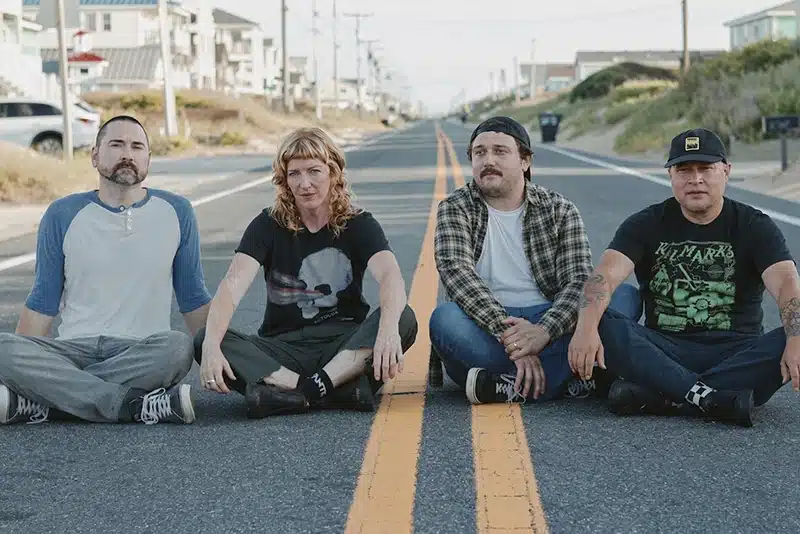
Cor de Lux takes a page from bands like Fugazi and Unwound for songwriting, getting together in a room and allowing themselves to work out songs organically. “We just jam and make up stuff, and whatever comes from that, we piece it together. No one person is in charge of songwriting,” Moraga says. “I think that if I joined another band, it would be very difficult, and also probably wouldn’t work for me emotionally because I like the way we work,” says Moraga.
“We’ve never been a band that writes songs and brings them to the table,” she continues. “Sometimes it takes a while, but we play, and we make decisions about the song in real time. I love the song-building process. There might be some wrong notes, but the energy is there. These newer songs remind me of the rawness of [Year of the Horse highlight] ‘The Cringe.’ It’s exciting.”