
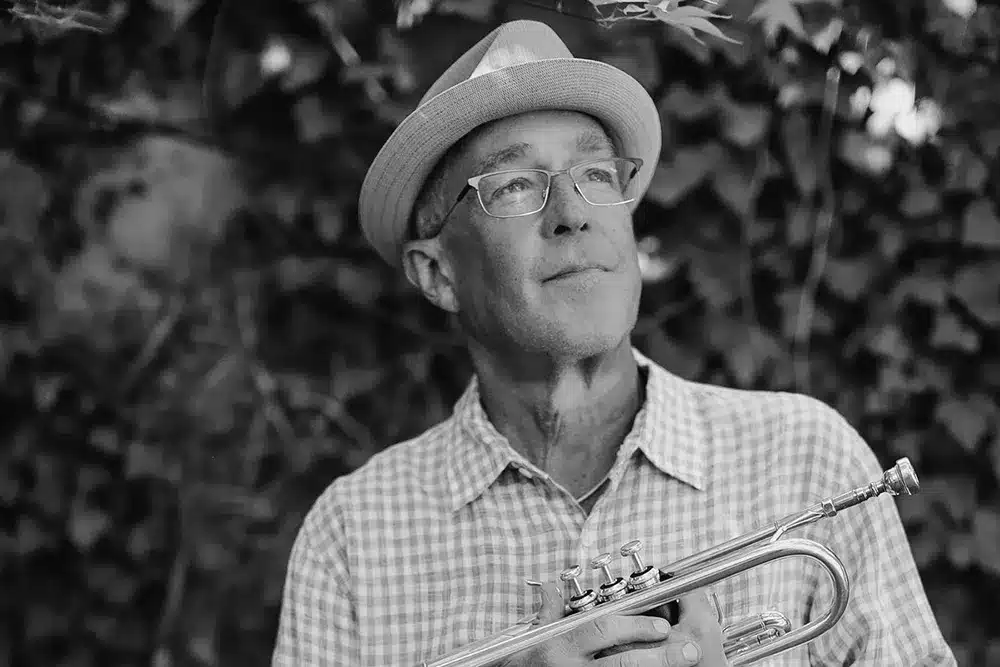

Trumpeter and bandleader Dave Douglas creates (and curates through his independent label, Greenleaf) lots of music, but when you hear it, you know it is his. He is drawn to constructing bands as new sonic explorations, and there is a searching quality to his composing. He writes memorable themes that, as often as not, carry a tinge of melancholy, even when they hop or swing.
On Douglas‘ latest release, Alloy, you hear that shade of blue in how he harmonizes the three winds (himself, Alexandra Ridout, and David Adewumi) in this unusual triple-trumpet sextet. Just check out the theme to “Friendly Gargoyle”, which is jaunty, yes, but uses a nearly static low line that pulls the theme toward a bit of darkness, and then lets the three horns warble together, sliding up and down, in and out of key. As they improvise together, Douglas introduces a recognizable musical quote from the tune “A Night in Tunisia”, suggesting both a source for this non-Western sound and a touch of humor.
How very “Dave Douglas” this all is; one performance rich in ambiguity, creative novelty, and adventure. The next soloist out of the gate on the same tune is vibraphonist Patricia Brennan, who rolls, rattles, and ambles above bassist Kate Pass’ casual thump and Rudy Royston’s sizzling percussion counterpoint. Brennan, who is in the midst of a fast-emerging solo career, fits perfectly into Douglas’ concept: she is melodic but quizzical and, rather than build her solo to a traditional climax, she finds a way to blend her improvisation back into the band.
The main event on Alloy, of course, is how Douglas deploys a small-group ensemble that has no few precedents: three trumpets and a rhythm section. Douglas has long been the person behind the Festival of New Trumpet Music (FONT) in New York, and I have had the pleasure of hearing him perform on stage with nearly 20 trumpet players at once. His passion for the instrument is unlimited. Given the chance to go trumpet wild, what are his instincts?
The answer is this: he deploys the horns in subtle ways, moving them in contrapuntal lines or in thoughtful conversation and never in a blaring manner or in any “cutting contest”. The start of “Fields”, for example, features the trumpet trio in a pulsing collective improvisation (accompanied by the rhythm section and also a cappella) until they coalesce into a set of slow, intertwined melodies that stack up like pastel harmonies. I’m not sure if the notes were composed or not, but the intention is clearly one of empathy, not competition. The “solo” section, over a slow swing from the rhythm section, is also a collective improvisation that includes some of the coolest sounds ever to come out of one horn, not to mention three.
“Future Community Furniture”, a ballad tempo slice of melancholy, begins with only the horns, Douglas improvising as Ridout and Adewumi play harmonized half notes in support. When Pass takes a ruminative bass solo, she is accompanied not only by Brennan and Royston but all three trumpets, muted, in subordinate improvised chatter. Similarly, “The Illusion of Control” begins with a horns-only theme that pops and bobs like a calliope or circus band. They all climb aboard for some collective blowing before the theme repeats with accompaniment.
There are swingers/groovers, too. “The Antidote” begins with some post-bop blowing by Douglas over his rhythm section, working into a brief, attractive theme for the horns. At the mid-point, however, the band cut to half-time, softening the theme into a two-chord vamp over which Brennan takes a shimmering solo. The original tempo kicks back in to bring it to a close. More exciting is “Standing Watch”. After an introductory three-trumpet chorale, Royston and Pass introduce a greasy 6/8 slow drag that runs under a slow blues. The solos follow course, funky and strong, before the chorale theme returns.
This final song and the opener, “Announcement: Vigilance”, define the project as using compelling combinations and musical ideas that exploit contrast. “Announcement” finds Douglas, Ridout, and Adewumi playing unison on a single, repeated note. It is stately and intriguing, but at the midpoint, it develops into a deep, mid-tempo swing for the leader to blow on—modern jazz in every respect, but with no tricky chords, just a feeling of jazz time and delicious conversation between Douglas and Brennan. The trumpets, alone, return in calm indecision.
Alloy shows incredible confidence and focus from Douglas as a composer and arranger. He never seems to be trying to write a “jazz hit” like “Song for My Father” or to make a radical statement, breaking wholly away from tradition. Instead, as he explores a truly new format with this unusual band, he probes possibilities and molds the sextet into sound that reflects the past and evokes our moment. I could listen to it all day.
- Dave Douglas Creates a Magic Encounter on ‘Gifts’
- Dave Douglas Extends His Superb 2022 String of Recordings
- Jazz Trumpeter Dave Douglas Celebrates the ‘Ghent Altarpiece’ with ‘Secular Psalms’
- Dave Douglas Pays Tribute to Jazz Legend Dizzy Gillespie on ‘Dizzy Atmosphere’
- Dave Douglas Shines with Uri Caine and Andrew Cyrille on ‘Devotion’
- Dave Douglas Quintet’s ‘Brazen Heart: Live at Jazz Standard’ Sits Cozily Next to Miles Davis’ ‘Plugged Nickel’ Recordings