
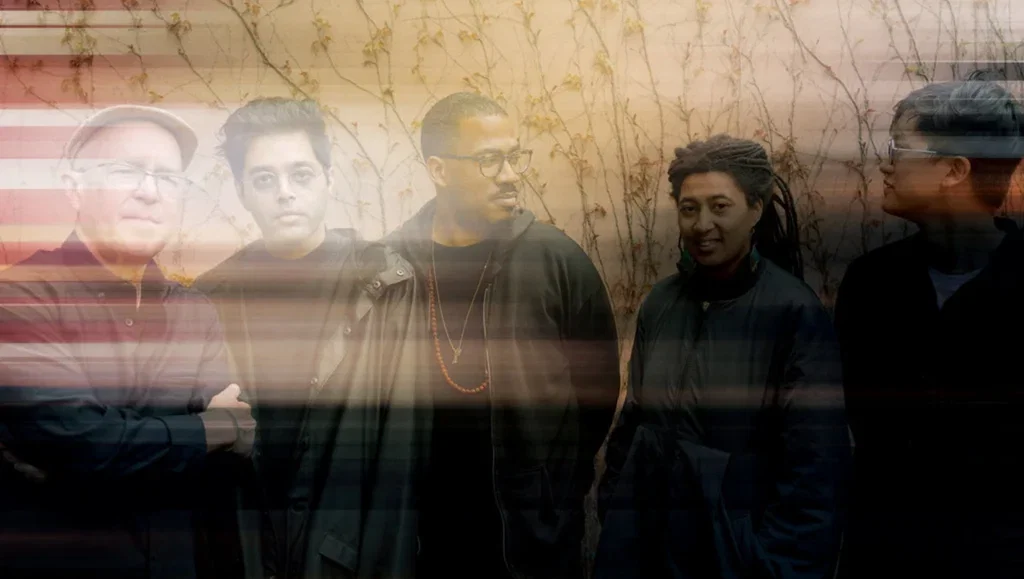
I am a frenetic guy. I don’t nap much, and I prefer my days to be packed with projects, friends, and work. That’s why I was in the Knoxville Airport at 5:00 am on the Monday after the Big Ears Festival had ended. I wanted to get home to start my day after hearing so much great music — including seeing trumpeter Dave Douglas with his latest band playing refractions of the music of Duke Ellington, as well as Douglas playing in a reunion of John Zorn’s first Masada Quartet.
Dave Douglas is another man of frenetic action. When I feel someone tapping me on the shoulder at 5.00 am in the airport and asking, jokingly, why I wasn’t at work to meet my next deadline, can it have been a surprise that it was Dave Douglas himself? We had conducted the interview (see below) a week or so earlier. Dave, just like me, was on the go, as he always seems to be.
A recitation of Douglas’ credits and roles is absurd. He has averaged an album as a leader every year since 1993. As a bandleader he has put together and molded bands too numerous to count in styles from Balkan jazz to electronic experimentation — the range is vast. He composes the great majority of his music and tours often, including Europe every summer. He runs a record label (Greenleaf Music), hosts the Greenleaf podcast, helms an annual festival of trumpet music in New York, and teaches jazz at the New School.
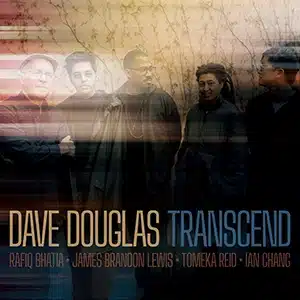
At Big Ears, Douglas was everywhere, playing music and tending to business. His new band, which releases Transcend on 24th April, played one of the festival’s last shows at Bijou Theater. He performed twice with Zorn’s Masada (once to open a day of performances, then again in a late-night show the next day). I bumped into him at the Greenleaf Music table in one of the venues, where he was chatting up recordings by other artists for sale.
Transcend is an extension of Douglas’ 2024 album Gifts. Gifts featured a quartet including tenor saxophonist James Brandon Lewis and the rhythm section from the band Son Lux: guitarist Rafiq Bhatia and drummer Ian Chang (also known for composing the Oscar-nominated soundtrack to Everything Everywhere All at Once). Douglas formed the ensemble to tackle four novel rearrangements of compositions by Billy Strayhorn in addition to complementary original material — and Gifts was an artistic success, giving Douglas a worthy foil to his tart trumpet sound in the front line and demonstrating (yet again) that Dave Douglas’s music naturally blends with electronic sonorities and different ways to swing.
Transcend, quite naturally, pushes this band to explore the music of Duke Ellington, with whom Billy Strayhorn collaborated for decades. Specifically, Douglas has arranged two pieces from the Ellington Sacred Concerts (the familiar “Come Sunday”, but also the sumptuous ballad “Heaven”) and “Oclupaca”, the sinuous opening blues from Ellington’s 1972 Latin American Suite. Additionally, Douglas composed several pieces inspired by the work of visual artist Jack Whitten, who dedicated a work to Duke and created acrylic “slab paintings” inspired by jazz saxophonist John Coltrane.
The new album has one other trump card to play. Douglas has added cellist Tomeka Reid to the group. She sometimes plays “bass lines”, pizzicato or bowed, improvises as a melody player, and can also add chords, textures, and counterlines to the arrangements. The resulting quintet is a wash of intersecting colors and ideas.
If you dip into, for example, Douglas’ “Energy Fields”, you can catch Reid improvising with her bow as Dave Douglas’ jabbing trumpet joins Chang and Bhatia in the rhythm section — with electronic textures joining the conversation, triggered from Chang’s “sensory percussion” set-up or Bhatia’s effects board. Lewis joins Douglas in the fray that rises behind Bhatia’s solos, which leads back to a written line that floats over the electronics before the theme returns.
In short, the band, now a quintet, sounds like it has doubled in size, developing its orchestral possibilities. Douglas’ “Slabs” starts with shimmering percussion and synth conversations, adds a relaxed counterpoint among muted trumpet, cello, and saxophone, then slides into waves of collective improvisation that punctuate a written theme. The main theme develops an odd-meter backbeat that will remind some listeners of Julius Hemphill’s “Dogon A.D.” Across an additional six minutes, the group reinvents its layers (slabs?) again and again: truly a small orchestra.
The Ellington interpretations do not disappoint. “Oclupaca” is sexy and sly, switching from a Latin groove to a 4/4 swing after a shout chorus, just like Duke’s version. “Heaven” is lush, with trumpet and tenor taking turns on the lead on the written theme and in the improvised solo. Lewis shows off his sound to great effect. “Come Sunday” is the revelation, with the rhythm section starting with a reggae-ish bass line, I think played by Bhatia, as cello and tenor lay in harmonized whole notes. Dave Douglas takes the famous melody using his Harmon mute before Lewis gets the bridge. The Ellington song is not disguised, but the fresh underpinning makes you realize the timelessness of that melody and Ellington’s genius.
Other wonders await. “Curious Species” is a frisky track that puts Reid’s most adventurous solo at the center. “Gentle Collapse” is lyrical and layered, with an attractive but unique melody that floats in common time, using moments of silence and space effectively. “Argle Bargle” has a playful theme that directly inspires a ton of improvisational interplay – I particularly like the collective solo that starts up at 2:15, with Reid mutating the lick, beneath the horns.
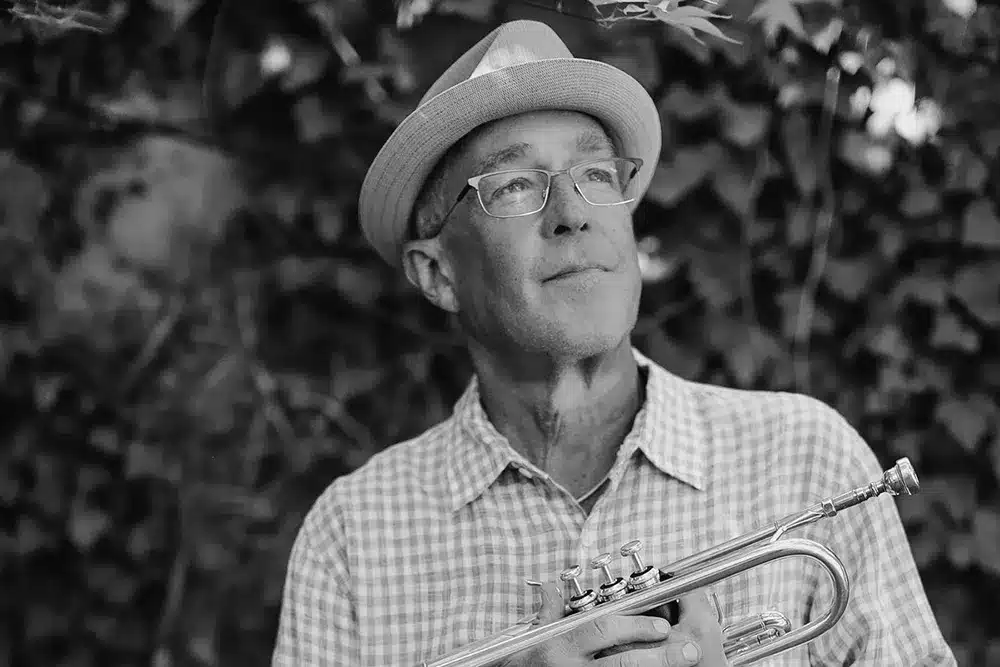
Interview with Dave Douglas
I talked to Dave Douglas in March of 2026 about the new album, the new band, his recent record Four Freedoms with a different group, and the road ahead.
You have to be the busiest man in the world, with your kaleidoscope of bands, styles, tour schedules, recordings, and running Greenleaf Music. How does this pace relate to the kind of artist you want to be?
Everything I do originates as a project idea and comes from the creative side. The different bands, repertoires, touring groups — they all start with me staring off into blank space and doing the thought work. It was no different when I started Greenleaf in 2004-2005. I still take time to think about the label’s direction. Is this where we need to be going? What do we want to put out? Which of my own new projects push Greenleaf forward?
The Festival of New Trumpet Music [of which Douglas is the Artistic Director] works the same way. I have a team of selfless people who love brass. The creative thought work is what makes it all come together.
That is something I had to learn and teach myself. I had to learn to ask the question: what is the right path in this music? I try to speak to this critical lesson in my teaching and sharing with young people. I got this ethic from people like John McNeil and Jim McNeely.
I was really young when I played with pianist Horace Silver for eight months [in 1987]. I picked up so much from that experience, but I must have missed so much, too. I learned how he wanted the music to work, how carefully he monitored his compositions, which were like his children. He was constantly curating his own creative output. And he was very deliberate — for example, he decided to become the best comping pianist in the world.
He could have fired me during that time, but he felt a kinship with the younger artists.
As a musician, you spend a lot of time thinking about what you want to say, about how to make yourself heard in an intelligent, historically informed way. For me, it’s about not repeating myself. I feel like, as a creative artist, once you’ve done it, you’ve done it.
Your last album before Trascend, Four Freedoms, was recorded with a quartet that seems able to go in any direction. The title relates to politics — that was the name given to Franklin Roosevelt’s 1941 State of the Union Address — but also, I assume, to the music you want to make. In that band, you are playing with an old friend, Joey Baron and a new one, pianist Marta Warelis — a combination that certainly requires and represents freedom.
I called it Four Freedoms because, in writing that book of tunes, I had to deal with the freedoms that this band is capable of. The band goes places I would not have planned, so the pieces were crafted to let them go there. It was written for those people: Warelis, Baron, and bassist Nick Dunston. There is music where people have to play at two tempos at the same time. There are pieces where the musicians are playing different things at the same time, or where two improvisers create simultaneously. And they are all great improvisers! Joey Baron is one of the greatest improvers alive.
I have wrestled for years with what it means to make music with political meaning as an instrumental artist. Just yelling a slogan won’t do much right now. Both sides really aren’t listening to each other. So making a statement about what we stand for — about the freedom of individual expression in music itself — is the thing.

The new record, Transcend, brings the group back together from Gifts and adds Tomeka Reid on cello. How did you get together with guitarist Rafiq Bhatia and drummer Ian Chang? What suggested this alliance?
We have spent a lot of time talking about taking my writing and letting them use their own language and do something they wouldn’t do in another context. This was especially applicable to the pieces inspired by Jack Whitten, “Curious Species” and “Slab.”
James Brandon Lewis is making so much great music right now, and Tomeka Reid is one of the jazz all-stars of the last year or two.
I am lucky to have JBL and Tomeka. The whole band is hot, and I’m honored and thrilled to be playing live with them at the upcoming Big Ears festival and then bringing that band into the Village Vanguard for a week in May. Not a single one of these incredible musicians has played at the Vanguard before, though I’m sure they will be back on their own.
Did you give any thought to recording the band live at Village Vanguard?
I love when you play there — there is a sense of the unknown. Different things happen in that atmosphere. So, no, I didn’t want to record there because I prefer not to have the pressure of microphones, as the atmosphere of that club works on the band. I’d rather let it go where it goes in the moment.
Gifts looked at Billy Strayhorn, and now Transcend pushes your music up against some of Duke Ellington’s later compositions, works he included in his Sacred Concerts. Remaking their music seems so natural. What is it about those kinds of compositions that makes them stretch out over time?
This music was like a wrapping up for Duke. He didn’t have many years left. But he chose to keep writing, leading the band, and even changing.
The more I listened to the records of this music, the more it appeared to be a summing up. He seems to have been writing about the universe, never-ending, never beginning, about a communion of the universe. I think this is true of anyone doing sincere work in any sphere.
I have been so lucky and privileged to last this long as a creative artist. To play “Come Sunday”, which Duke included in all his Sacred Concerts, is to sit at the feet of Clark Terry. It is a privilege.
- Jazz Trumpeter Dave Douglas Presents a New Quartet
- Dave Douglas’ ‘Alloy’ Shows Incredible Confidence and Focus
- Dave Douglas Creates a Magic Encounter on ‘Gifts’
- Jazz Trumpeter Dave Douglas Celebrates the ‘Ghent Altarpiece’ with ‘Secular Psalms’
- Dave Douglas Pays Tribute to Jazz Legend Dizzy Gillespie on ‘Dizzy Atmosphere’
- Dave Douglas Quintet’s ‘Brazen Heart: Live at Jazz Standard’ Sits Cozily Next to Miles Davis’ ‘Plugged Nickel’ Recordings
- Dave Douglas with the Westerlies and Anwar Marshall: Little Giant Still Life
- Dave Douglas: High Risk