
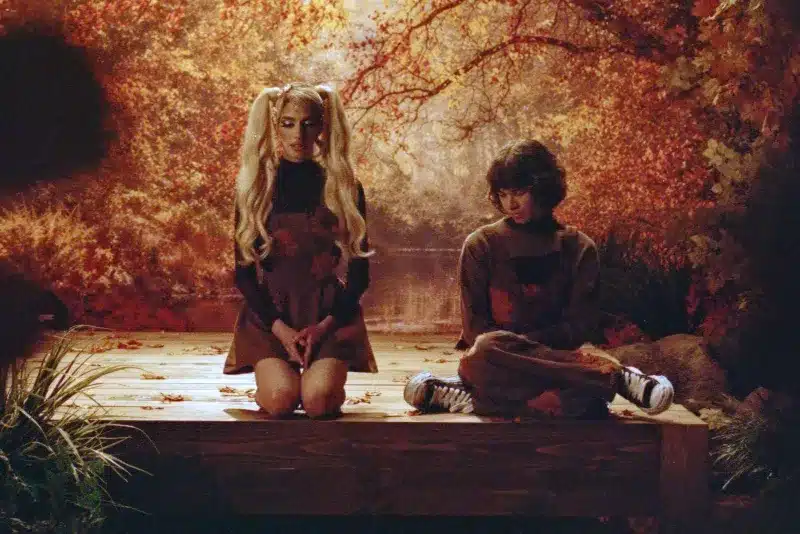

The duo DOMi & JD Beck are jazz’s most “Gen Z” brand. Virtuosic and omnivorous, they positively blow minds. Is it “jazz” at all? Keyboardist DOMi (Domi Louna, born Domitille Degalle in France) and drummer JD Beck (from the Dallas, Texas area) record for Blue Note, and their first album featured guest performers Herbie Hancock, guitarist Kurt Rosenwinkel, and bassist Thundercat. They are the product of a jazz education, each citing influences like Tony Williams and Oscar Peterson alongside Led Zeppelin and Igor Stravinsky.
Most importantly, “jazz” is the only word that might contain the duo’s voracious appetite for fusion. Their music is rhythmically and harmonically complex, informed by hip-hop, classical, rock, and electronica, and capable of dazzling improvisation. It bears a passing resemblance to the new century jazz of artists as diverse as Ches Smith, Robert Glasper, and Esperanza Spalding. Is that stuff jazz?
Hearing the assured music on the duo’s second album, Who Asked?, as just “jazz” won’t do. It is a hybrid of classical music and hip-hop that could only have been created by the duo’s wide lens. Their complexly harmonized and processed vocals are featured on nearly every track, but the center of the music is not the singing, which was added to the mix late in its creation. Rather, what defines DOMi & JD Beck in 2026 is the dodging, complex, rather brilliant music that integrates the singing, detailed and prominent orchestral parts, and the compelling groove they create on syths and drums.
Did I mention that they met at a National Association of Music Merchants show in 2018 when they were too young to order a beer, and then again that year at Erykah Badu’s birthday party? Yeah, they are that kind of freakishly amazing musicians.
This music is a thousand leagues away from the pop instrumental backing you get on, say, a Taylor Swift album. Time signatures shift, overlap, and flutter with hip-hop slicing; melodic notes can sit in place, but the harmonies dodge with as much frenetic beauty as on a John Zorn or Frank Zappa recording. Melodies are of extraordinary invention, defying the kind of typical diatonic (or pentatonic) material you hear on hit songs. The orchestration of keyboards, drums/electronic percussion, and various orchestral musicians playing strictly composed arrangements is consistent and mountain-stream clear.
You should be impressed, most certainly, but is the music good? Does all the technique and invention add up to something valuable, meaningful, or moving?
Yes, but what is compelling about the music on Who Asked? is a great distance from what makes Blue by Joni Mitchell compelling as a highly personal musical revelation or what makes a Lee Morgan trumpet solo suggest the hopes and disappointments of being human. In most of the ways that matter, it is closer to composed “classical” music. It was written by the duo collectively, away from their instruments, using the Sibelius computer program.
Listening to this music, which ranges from impressionistic to driving and insistent and was composed to be heard cinematically in a precise sequence, is like getting swept up in a thrilling ride and an act of creation. It dazzles you much of the time, but the composing also contains gorgeous reprieves from the groove, sections that offer reflection and some degree of revelation. The duo’s technologically advanced tools are, in fact, balanced by a commitment to recording a range of acoustic instruments.
Examining the track “Small Eyes” shows the album’s range in miniature. The brief introduction cycles through a chord progression using “pop” instrumentation but also pastel colors from the orchestra. At first, this seems like it could be the start of a standard song, though the hiccup of a shifting time signature is there. Then, DOMi’s synth bass rushes in on the bottom, with Beck’s drums, and a fluttering combination of woodwinds and synth in the upper register. Beck’s vocal (here, and throughout, processed quite a bit) takes the melody while DOMi sings a counterpoint harmony.
Then, the ground rhythm suddenly shifts to half-time for an interlude featuring acoustic piano. A cousin of the original fluttering pattern comes back in, supplemented by chiming percussion at the slower tempo. The vocals blossom into a slower, simpler bridge section in plain 4/4 time, leading back to the first theme. Through the almost four-minute song, the harmonic content has a slightly melancholy color, but it moves unpredictably, not like a song simply set in a minor mode. It is ambiguous, fresh.
Listening to the larger arc of Who Asked? reveals similar (often sudden) shifts in tone, contrasts in feel, and ambitious musical passages that rush at your feet and, sometimes, your heart. The big construction sounds very much like a symphonic cycle. Both the opening track, “EPIPHANiE”, and the “EPiLOGUE” are entirely orchestral, with strings and woodwinds (multi-tracked and layered) translating the stuttering hip-hop grooves into dancing, watercolor bookends for an album rich in drum grooves.
The opening track, “Had Enough”, is a darn catchy vocal theme that rides atop one of DOMi’s simpler bass lines that holds down the tricky rhythms of Beck. It gets its own orchestral intro and climaxes with an improvised synth solo that would be at home not only on a 1970s fusion album but on many a contemporary jazz record of today. Similarly, “CLiMBING HiGH”, the last of the vocal songs, is the moment when Who Asked? seems most like a rock or pop album. Synth bass and drums lock into a danceable if syncopated groove, and the orchestral parts are integrated with the keyboards. Some of the fussiness of the duo drops away; they just give you the tune.
Tempos and textures modulate from track to track, even as the album can be characterized as filled to the brim with musical information. In “Exit”, for example, the chord changes go by lickety split, and DOMi’s bass line works as a counterpoint melody on its own. “Rain” begins with violin pizzicatos that feed directly into a break-beat track where the two vocal lines feature as call-and-response as well as counterpoint. “Out of Sync” uses a slower push-pull rhythmic pulse that slides in and out of a smooth flow as melodies cascade over each other.
The most distinct track comes toward the end of the sequence, another instrumental track: “CONCERTiNO (FOR PIANO, DRUMS & ORCHESTRA)”. The composition is somewhat more legato than many of the pieces here, with a delicious contrast between Beck’s extremely dry drum parts and the flowing orchestral bed of sound. This piece, however, truly does allow DOMi to play an impressive piano part, running a composed solo across the music, generating the polyrhythms characteristic of Steve Reich. This is the sound of the duo trying to get “serious”, perhaps, but it isn’t precious or sentimental.
The album comes with one video (more are available) showing the duo playing the song “Puzzle Pieces” without the vocals that are predominant throughout Who Asked? This, presumably, is what they will present in concert, including keyboard or other instrumental parts not played live but without their singing. The tune is, in a sense, transformed. DOMi’s keyboards leap to the foreground and, later, the drums emerge in what sounds like a solo, and the influence from years back of Tony Williams—and, to my ear, maybe Roy Haynes—is clear. In other words, the duo’s jazz credentials suddenly show.
It’s not important to label the music with one genre or another. However, this contrast allows your ears to ask interesting questions about DOMi & JD Beck, and maybe about the future of contemporary music as a whole. These two virtuosos are serious (just listen to the chops and the range of their references and influences), but they also want to connect with listeners (they did add singing to a dozen of the 15 tracks). The music is no kind of “pop”, yet I know that its speed and pace can’t help but sound like “jazz for the TikTok generation”.
I look forward to whatever direction they take in the future. I am drawn in by both the intricate and the more pastoral moments on DOMi & JD Beck’s Who Asked? Is it the future of “jazz” or the future of something else? It doesn’t matter because this music is an arrow flying forward.