
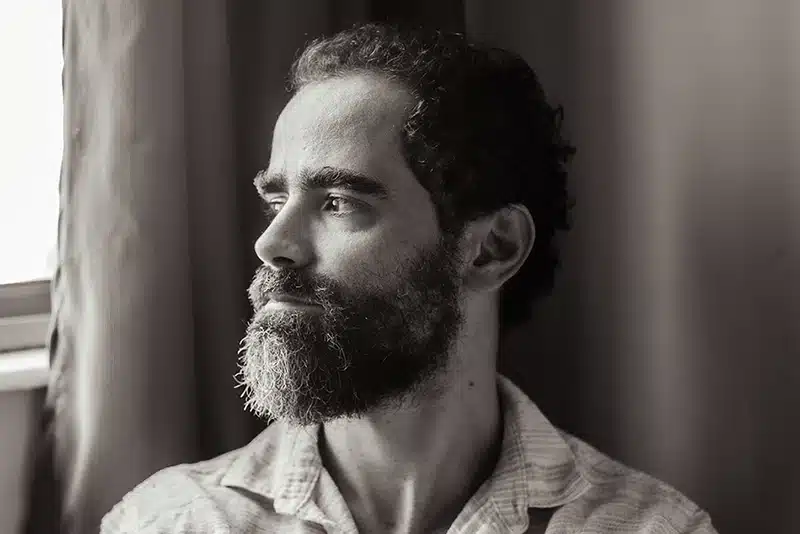

Singer-songwriter Dorea cites the sea as inspiration for his sophomore release O Que Mais Você Quer Saber De Mim. More specifically, he draws on his experience as a lifelong resident of Salvador, on Brazil’s Atlantic coast. It’s a place he loves, one that has clearly shaped not only his thoughts but the forms in which he expresses them. That’s a long way of saying that Dorea here sounds like the sea: alternately gentle and rough, always moving, and unpredictable. At the same time, there’s a true intimacy to this album. The ocean may be vast, but what we’re seeing is specifically Dorea’s view of it, and it’s the details he offers that are truly precious.
Dorea frames his album with a question: “What more do you want to know about me?” On the stripped-down opening track, it’s a question he asks rhetorically to a lover with whom he has a fragile relationship. How much, after all, can someone really articulate about the self in plain words, and how effective can such an explanation be? It’s a fitting introduction to Dorea as a troubadour. Over the course of the record, the stories he tells and how he tells them teach us more about who Dorea is than direct confessionals possibly could.
Aquatic themes abound in these stories, both in content and sound. One especially memorable tale is “Maria Milhões”, a catchy but melancholy song of a woman dancing at sea. It’s set to a tune that evokes the rock-and-roll-tinged sounds of late 1960s MPB, like those of Caetano Veloso and Milton Nascimento, two of Dorea’s main influences. “Pequenas Criaturas” is another standout, in which he ponders the playful movements of the smallest oceanic life forms, set to blissful acoustic guitar lines over luminous electric pulses. In “Sem Ancorar”, he and guest LuÍza Britto harmonize in a swaying duet, evoking rolling waves as they sing of the sea and small boats.
Dorea’s unplugged strings, it’s worth noting, are the ever-shifting foundation of the album as a whole, sands sweeping beneath his breezy voice. They lend themselves as well to Dorea’s more driving pieces as they do to pieces like “A Cidade”, which mourns the ugliness of city life with the help of languid clarinets. At the start of the final track “A Pé No Deserto”, as voices–perhaps jubilant, perhaps restless–call out in the distance, it’s Dorea’s guitar that cuts through, grounding us in a final moment of tranquil, melodic strength alongside our artistic guide.
Using a softer and more organic palette than on his 2023 debut, Dorea gives his understated all on O Que Mais Você Quer Saber De Mim. We hear him at his most vulnerable, without pretense, with the most barebones of accompaniment, and he shines. He shares his innermost feelings and thoughts with us about life, love, and the world he lives in. By the end, we understand his relationship to all of these things. We feel the love he has for song and sea. What more could we need to know about him?