
“You know what would make a marvelous movie…Dracula. Nobody’s ever made it…they’ve never paid any attention to the book…It’s the most hair raising, marvelous book in the world! They’ve never used anything from it…They haven’t even opened the book…It’s all based on the play. “ – Orson Welles, from This Is Orson Welles, by Peter Bogdanovich (1992)
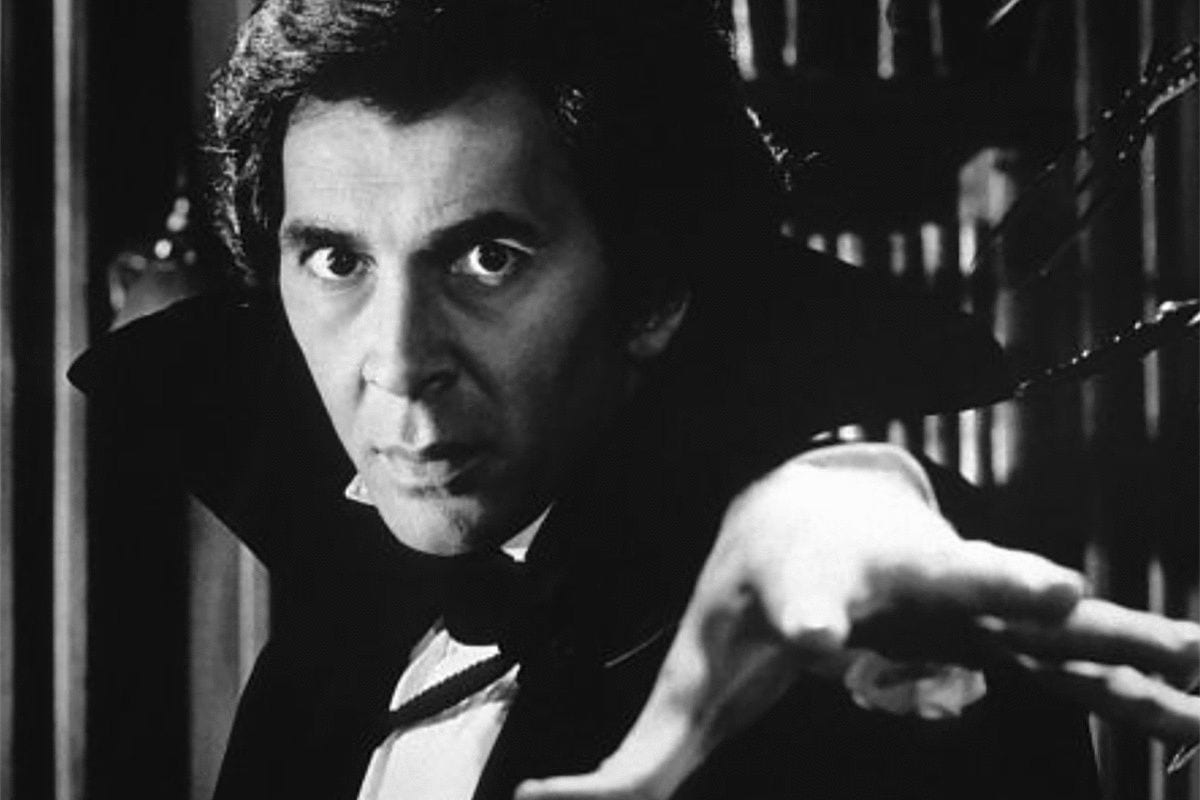
In 1976, actor Frank Langella starred in an enormously popular Broadway revival of the old Hamilton Deane / John L. Balderston play, Dracula. A slightly campy production, the show was distinguished by the dazzling black-and-white sets designed by Edward Gorey and by Langella’s powerfully sexualized Count. Just as the play’s original star, Bela Lugosi, was spirited off to Hollywood for a film version, Langella was also spirited off to Hollywood for a film version.
Of course, most of us know that the Dracula character is the work of an Irish novelist named Bram Stoker. Some of us may have even read the novel or watched the 1994 film by Francis Ford Coppola, which is kinda, sorta Bram Stoker’s Dracula. But when most people think of Dracula, it’s not often that the purely evil, bestial vampire invented by Stoker comes to mind. It’s the more hospitable, and much more socially acceptable, Count Dracula, as depicted in the play by touring actor-manager Hamilton Deane, that took hold of the popular imagination.
Deane’s barnstorming theater company needed a play that would require only a few small sets, which meant that Stoker’s globe-trotting epic had to be pared back to “Dracula Comes to Dinner”. So instead of Stoker’s cadaverous Count with hairy palms and razor-sharp teeth, this Dracula had to exhibit the good manners and personal hygiene required of a drawing-room mystery. This was a charming Dracula who lived next door and could match wits with the lords and ladies while dodging stakes and crosses.
Streamlined even further by American playwright John L. Balderston for its 1929 Broadway debut, it was this play that would define Dracula in our popular culture for years to come. Bela Lugosi’s performance on stage and in the 1931 film adaptation would remain the iconic image of the Count to this day.
The show was already considered to be pretty hammy back in 1929, but when it was dusted off by director Dennis Rosa for the 1976 Broadway revival, the campiness was fully embraced in the Edward Gorey cartoon design. The one element that was not campy was Langella’s Dracula.
Langella took a completely different approach to the character. His Dracula was romantic, gliding across the stage like a dancer. His deep, melodious voice did not imitate Lugosi’s Hungarian version of a Transylvanian accent but landed somewhere in the mid-Atlantic. The Langella Dracula moved deliberately, like a magician, and cast as much of a spell on the ladies in the audience as his victims onstage.
It was Langella who justified Universal Studios’ decision to remake its classic 1931 film, and they found the perfect director: John Badham. Because the director of Saturday Night Fever (1977) is the first person you would think of to direct Dracula, right?
It was actually an inspired choice. This revamped, romantic Dracula is sort of the Saturday Night Fever version of the story, with a stylish, afro’ed Langella walking around with an open shirt looking for girls to take to his Castle Disco. There are dizzying dance scenes as well as a psychedelic love sequence by James Bond title designer Maurice Binder, with lasers and animated bats that have to be seen to be believed.
It’s a very worthwhile film, but in the end proves to be somewhat more disappointing than satisfying. But that can certainly be said of almost any version of the story, including the latest, from Sherlock creators Steven Moffat and Mark Gatiss, airing on BBC One and Netflix.
Dracula isn’t really scary in this version so much as he is like a visiting rock star who decides on a whim to steal your girl at the prom. It’s like Bye Bye Birdie with fangs, but it underscores a theme central to Stoker’s original conception: the idea of a foreign intruder “emancipating” women from English patriarchy. In Badham’s film, Jonathan Harker (Trevor Eve) watches helplessly as his fiancée, Lucy Seward (Kate Nelligan), eagerly asks Dracula to dance with her. Seething with jealousy, Harker just stands there watching her spin round and round, literally swept off her feet by an undead suitor much more virile than himself.
As a more everyman Van Helsing, Laurence Olivier is good in his role but somewhat feeble due to the actor’s age and illness. Screenwriter W.D. Richter’s idea to make Van Helsing the father of one of Dracula’s victims was a smart, narratively economical change from the novel and play. But given that change, the character’s motivations were now personal. The Van Helsing of the novel and play is, in essence, an occult detective trying to solve the mysterious death of Lucy Westenra. “Where does all the blood go?” he asks.
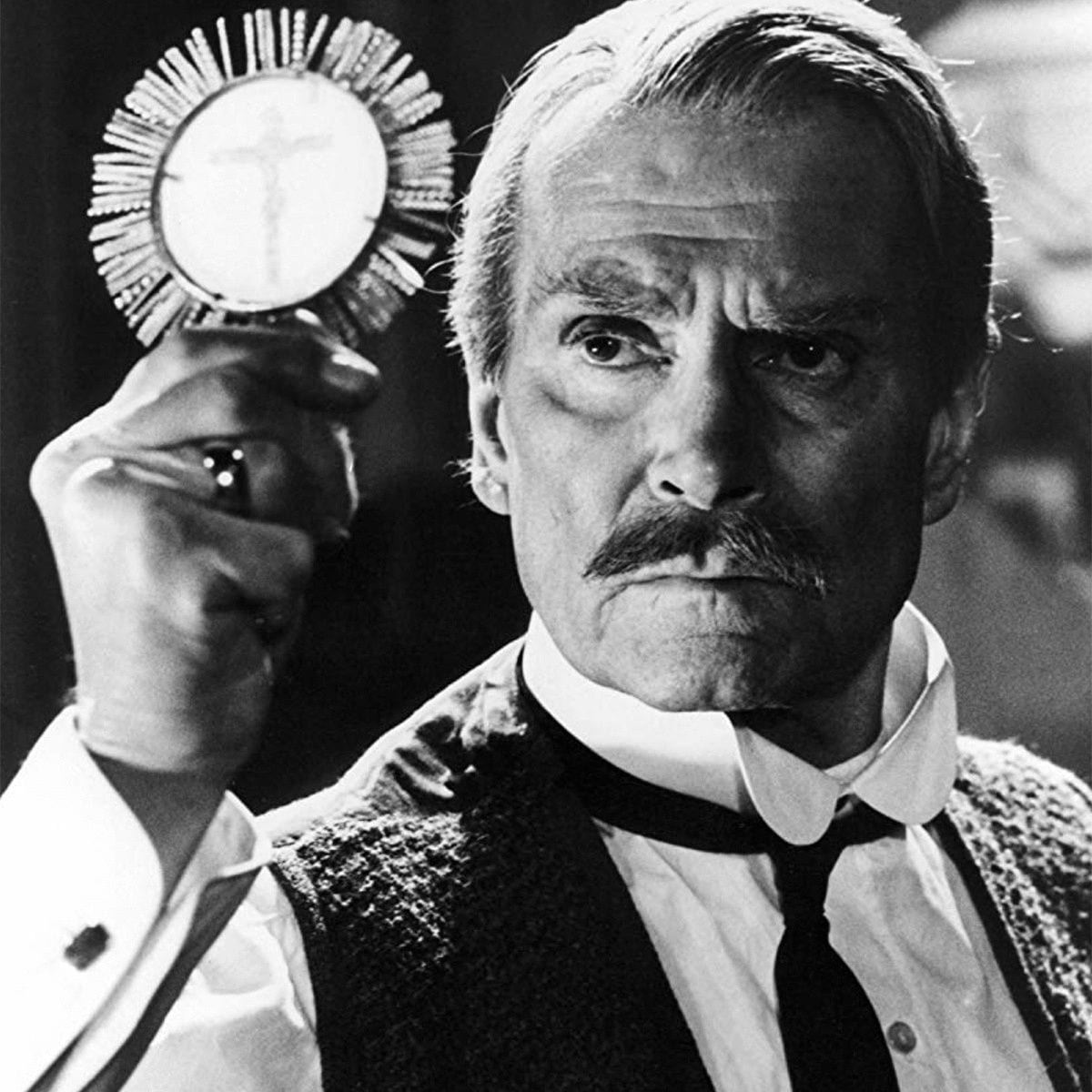
The pursuit of Lucy’s killer is a game of wits and human compassion for Van Helsing, but nothing personal. Richter and Badham improve this characterization by grounding it in personal grief. But they should’ve gone further and made the character lose himself in blind hate and revenge against the monster that defiled his daughter. I kept imagining the rage that swallows up George C. Scott in Paul Schrader’s Hardcore (1979) or its inspiration, John Wayne’s Ethan Edwards in The Searchers(Ford, 1956). Jonathan Harker should’ve also become more impassioned in his attempts to stop Dracula from stealing his fiancée and manhood. This is all absurd, of course, but it’s an important part of the story that this film is never sure it’s telling.
In Hammer films’ Dracula Prince of Darkness (1968), there is a scene which perfectly captures the idea of the patriarchy restoring “order” in which a group of monks hold down and stake the “hysterical” Helen (Barbara Shelly), who has been transformed from an English schoolmarm into a “dangerous” sexual being by Dracula (Christopher Lee). Director Terence Fisher stages the scene as though they were gang-raping her, with each hammering of the stake driving that point home. The scene is crude but effective.
Badham seems to be vaguely aware that Dracula isn’t the villain of this version, but does not fully grasp the idea that the “heroes” aren’t very heroic. He would’ve made a much more interesting film if he had just followed that subversive line of logic to its logical end. But instead, the film reaches the third act, where everyone has to chase Dracula down and kill him because he’s Dracula and he’s bad.
There is one scary scene in Badham’s film in which Van Helsing comes face to face with his undead daughter, Mina (Jan Francis), in the creepy catacombs beneath Whitby Cemetery. This scene is extraordinarily well done and makes you wish Badham had tried to make a more frightening film overall. He certainly had the resources, as this may still be the most elaborately mounted adaptation of the story. The enormous sets and seaside locations drip with misty atmosphere. Peter Murton’s production design and Gil Taylor’s cinematography are both top drawer, as are the beautiful matte paintings by the great Albert Whitlock.
Badham, perhaps under the influence of Langella, keeps pushing the film towards the romantic. There’s an attempt to get the audience to sympathize with the Count, but this is always undercut by the intrusion of horror. It’s a contradictory film that never settles into a groove. Even the busy score by John Williams seems to be struggling to pull the various moods together. It’s a big, operatic score, and along with The Fury (DePalma, 1978), it’s among his most underrated.
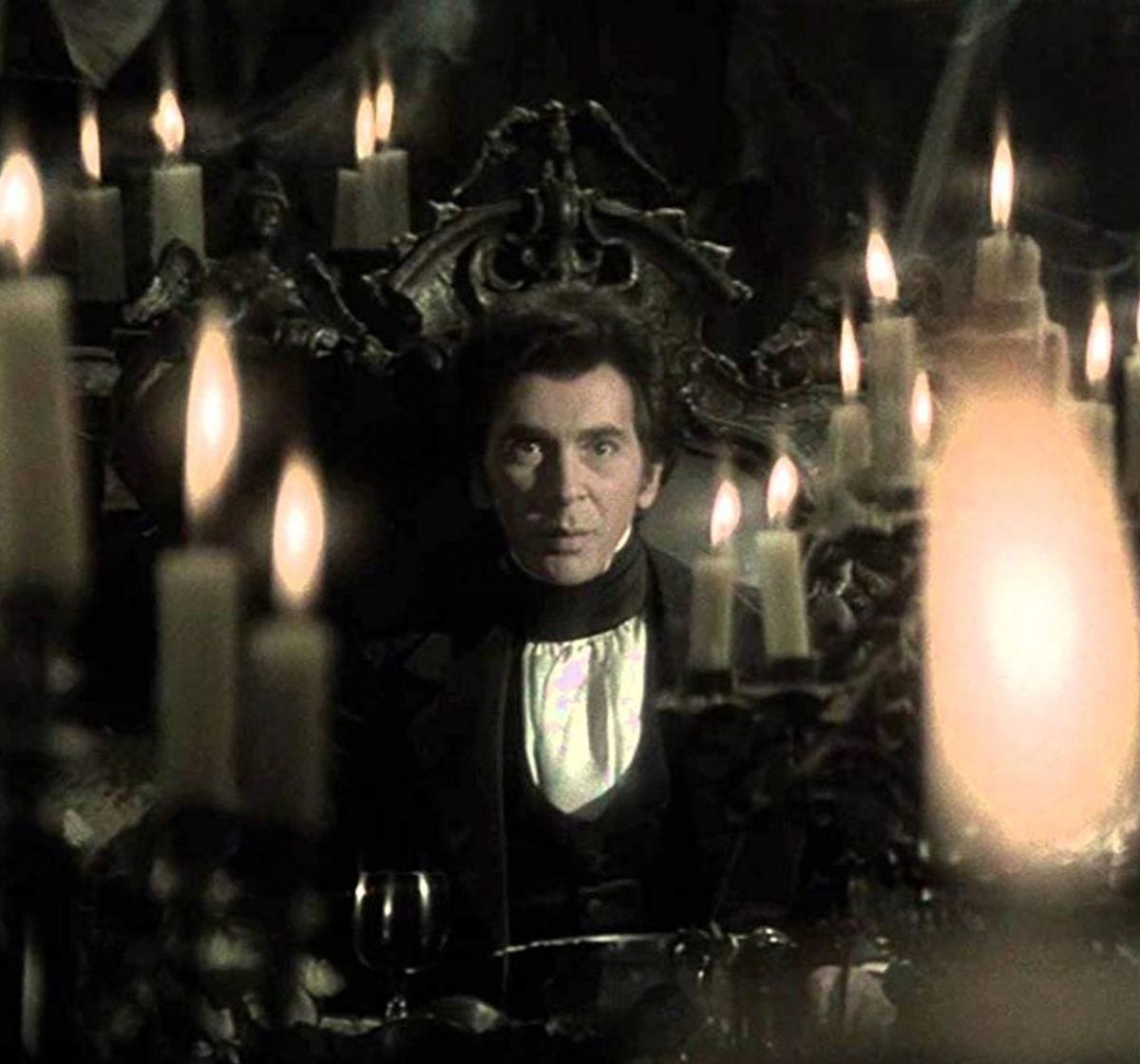
Despite my criticisms, I ike this film. It was my first encounter with Dracula when it aired on cable TV in the early 1980s, so it has a certain nostalgic value. Baham’s film can stand on its own. Of all of the adaptations of Dracula, this one sits in the upper percentile. It’s at least faithful to the idea of Dracula and attempts to blend the best elements of the play with highlights from the novel. The cast is top-notch, from Kate Nelligan to professional scene stealer Donald Pleasence, who spends most of the film stuffing his face with food. Not a weak link among them, and of course, there’s Langella himself, who is charismatic as hell. His Dracula has to be placed on the same pedestal as Lugosi, Christopher Lee, and Gary Oldman’s. Besides, he can vibrate his eyes. How many of us can do that?
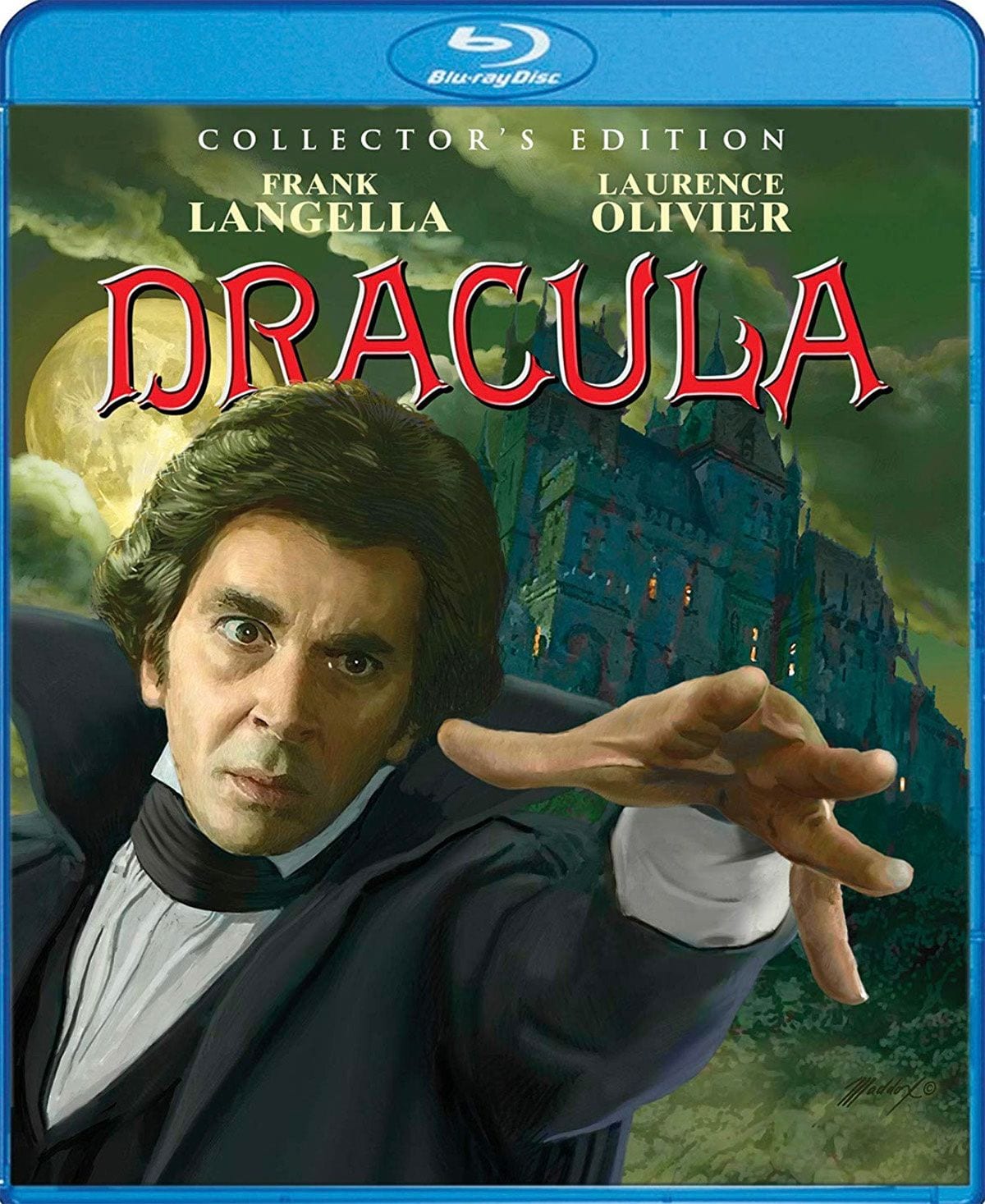
The recent Blu-ray release from Shout! Factory resurrects the film from its home entertainment grave. As he has stated in many interviews, Badham originally wanted to make the film in black and white, or at least in a very desaturated color palette. Not surprisingly, Universal Studios didn’t like this approach for its big-budget vampire movie, so Badham opted for a much warmer color palette instead.
The 1979 release version is the one most people remember and love. It’s a beautifully photographed film with vibrant color. However, when Badham was invited to clean up the film for the laserdisc release, he decided to desaturate the film as originally planned. The result was controversial, to say the least, and although I would’ve loved to have seen Badham’s original concept, I don’t think the retro post-process achieves it.
Instead of a film designed for black-and-white or desaturated color, we get one that looks like it had the blood sucked out of it. This has been the only way to see the film for years now. Thankfully, Shout! Factory has made the original full-color version a choice. Their two-disc Collector’s Edition Blu-ray includes both Badham’s preferred version and the original theatrical release. You can decide for yourself which you would prefer to watch.
Disc 1 is the 1991 Director’s Edition. This is the Badham-approved desaturated version. It includes a new introduction by the director and a new interview. Badham’s audio commentary and the documentary “The Revamping of Dracula” are ported over from the 1991 release, along with individual interviews with almost every living person who worked on the film. The 40-minute documentary is a thorough behind-the-scenes look at the production, featuring interviews with Frank Langella, producer Walter Mirisch, director Badham, screenwriter W.D. Richter, and composer John Williams.
Disc 2 is the 1979 Theatrical Version. This is the long-sought-after original color timing. The only downside is that the elements used for the new 4k scan on this Blu-Ray are a bit soft. The director’s edition is the sharper of the two, but this disc has all of the color. It comes with the original theatrical trailer featuring narration by the great ’70s narrator, Don LaFontaine, a still gallery, and an all-new commentary by film historian Constantine Nasr.
This was easily the best choice Shout! Factory could make for the commentary, as Nasr had researched the film for years while assembling a deep dive into its production for Little Shop of Horrors magazine. Nasr’s commentary is incredibly comprehensive, putting it in the context of 1979, which could be called “The Year of the Vampire”. That year saw the release of this film, Werner Herzog’s remake of Nosferatu, the vampire comedy Love at First Bite (Dragoti), the ABC-TV movie of the week, Vampire (E.W. Swackhammer), and Tobe Hooper’s television mini-series adaptation of Stephen King’s Salem’s Lot. That’s more than enough vampires for one year, and it may have contributed to the somewhat lackluster box office of Dracula.
Since you get everything included on the 2014 Universal Studios Blu-Ray, as well as the original theatrical version, Shout! Factory’s Blu-Ray should be considered the definitive version of Dracula on home video.
- Dracula (1979) - IMDb
- Dracula (1979 film) - Wikipedia
- John Badham: Movies & TV - Amazon.com
- John Badham On Directing: Notes from the Set of Saturday Night ...
- John Badham - John Badham on Directing - YouTube
- John Badham | Faculty Profile | Chapman University
- John Badham on Directing
- John Badham - IMDb
- John Badham - Wikipedia