
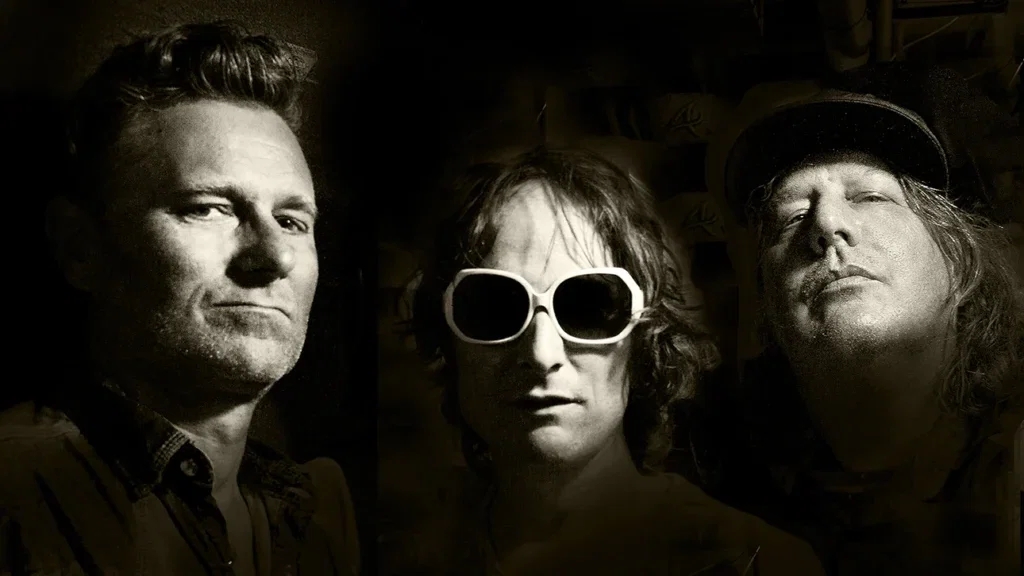
In the dusty little town of Todos Santos, Mexico, a two-week music festival curated by Peter Buck of R.E.M. is coming to an end. Kevn Kinney is here to perform with his band, Drivin N Cryin, but this is an off-night for the musicians. We’ve surrounded him in the water like the eye of a hurricane, but Kevn’s eyes are shut.
“Marco!” he calls.
“Polo!” we shout back, skirting his reach. We slip out of the pool and tiptoe to crouch in the dark bushes.
“Marco!”
We cup our hands over our mouths to quiet our laughter. Through the leaves, we watch him spin, alone in the blue. We storm out of the shadows, jump back in, and he bats back at our splashes.
It’s late. The terracotta town is asleep. But we aren’t ready for the night to end. One more tequila before we go inspires a pact: We will meet for breakfast wearing the matching terrycloth robes provided in our rooms, vowing to follow through in a way that makes this both a legally binding and premeditated crime: the pinky swear.
“You all better be there…” Kevn points a soaked cigarette at us, the little button of sun zipping back to his lips. “Or be square!”
Six hours later, it’s nine in the morning. A puddled path weaves from the door to my bed, and a wet towel sulks on the floor. My head hurts. I wonder if anyone is going to show. I’d rather eat alone in a bathrobe than risk being square.
A pool-length away, the breakfast patio is empty. Five, ten minutes pass before I hear doors open, murmuring voices and shuffling feet behind the Bougainvillaea.
“You all did it!” Kevn says proudly.
One of us has accessorized with a fedora, and another wears a trucker hat. Five of us Polos sit, and Marco clasps his hands at the head of the table, like a benevolent king admiring the sight of his court, each of us enrobed with the same embroidered words on the breast: Todos Santos. All Saints, no squares.
The town square is packed for the festival’s finale. As per tradition, Drivin N Cryin return to the stage for the encore. They are joined by some extras: Peter Buck, Patterson Hood (Drive-By Truckers), Ben Gibbard (Death Cab for Cutie) and Steve Wynn (The Dream Syndicate). Scott McCaughey plays an accordion, and on mandolin is John Paul Jones of Led Zeppelin. A pantheon of indie rock gods sings under the stars that they’re going “Straight to Hell”—with the exception of John Paul Jones, who took part in the construction of a stairway that leads elsewhere.
Arguably, Drivin N Cryin’s most famous song, it’s impossible not to sing along when the chorus comes in. Since 1989, GenXers have cranked the radio to the max, rolled the windows down, and sung at the top of their lungs—Kinney’s inimitable voice still soaring. Like a fiddle, his high tenor can be interchangeably sweet, gritty, joyful, and piercing. At times, his voice carries heavy lament, like bagpipes. He enunciates with peculiar clarity in symbiosis with his storytelling verses. Still, his choruses can be so hooky, the depth in some of his peppier songs can be easy to miss.
For example, the celebratory refrain in “Let’s Go Dancing” is not an invitation to salsa. Something philosophical is going on. The title lyric is spoken from “the firefly to the hurricane”, as if the breeze generated by those tiny wings could spar with a category 3. Or could it? The verses are stacked with the smallest of things, diffusing the mightiest.
“I stopped a freight train with a grain of sand” suggests that brute force can be derailed by a single speck standing its ground. A powerful political statement, one Kinney made in 1991, which arrives still warm from the press on our doorstep now. He’s talking about revolution—not the busywork the cyclone is doing, but the little guy with fire in his belly. But this ain’t 1991.
“What is a firefly to do in this hurricane?” I ask Kinney.
“It has been an interesting year for songs I wrote 30-40 years ago: “Another Scarlet Butterfly”, “With the People”, “The Innocent”, “Scarred But Smarter”, “Pre-Approved, Pre-Denied”. Sometimes I have to explain to audiences that I wrote these when I thought the future was in peril. I had no idea how bad this could get, but I know that a true American will weather this storm and not allow this to become the Fourth Reich. What I’d love to see is a more concentrated effort on the stages of Lollapalooza and festivals, encouraging the youth to register to vote. There’s a freaking hurricane coming!”
Originally from Milwaukee, Kevn Kinney migrated south in 1985 to Atlanta, Georgia, where he formed the band Drivin N Cryin. Despite Kinney’s Midwestern roots, the band are often classified as Southern rock. In particular, “Honeysuckle Blue” meets the aesthetic, both in sound and lyric. Drivin N Cryin had earned national fame by the time I was a teenager, but in Atlanta, where I’m from, the group were as big as the Rolling Stones.
Driving around on weekends looking for something to do, driving is often all we do. Our local rock stations kept Georgia bands in heavy rotation: R.E.M., the B-52s, the Black Crowes. We’d crank “Honeysuckle Blue”, delighted to be singing in harmony with the landscape right out the window—dogwood trees and the Chattahoochee. Meanwhile, the sorrow in his lyrics passed overhead.
“I’m probably the most selfish songwriter I know. I really only write about me. Not only do I write about myself, but I also write for myself and to myself. It’s like I’m singing to myself,” Kinney remarked in a 2015 interview with Songwriters on Process.
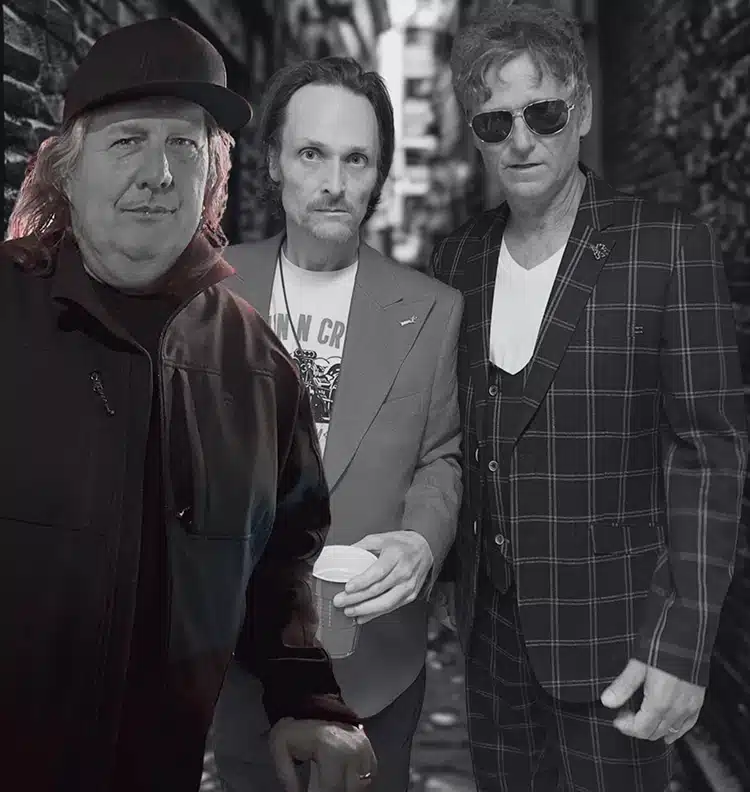
Selfish—but isn’t that what art is, self-expression? Kinney’s voice is often described as authentic, the same adjective applied to the voices of Louis Armstrong, Janis Joplin, and Michael Stipe—none of whom sound anything alike. However, “authentic” doesn’t serve to describe sound; it names the internal location from which it came, one we recognize from the same place inside ourself-ish.
Does he still feel this way, that he’s a selfish songwriter?
“I do. It’s redundant to say all performers are different, but I have always fought for the right place to fit, and that has not been easy. That’s why it’s hard for me to collaborate musically. To me, it’s like a painter—spending months on a piece of work, and I come in and start adding things. I don’t know a painter in the world that does collaborative art.”
He’s being candid, if a bit self-deprecating, and also that it’s poor form to disagree with an artist about his own work, but isn’t it through the personal that the universal is best relayed? In “Pre-Approved, Pre-Denied”, he addresses socio-economic issues by dropping the listener straight into a working-class scene: scrounging for change in the drawer to buy an off-brand soda at the convenience store, nothing left over after bills and rent, while the credit card offers pour in—the help he needs, but isn’t wealthy enough to qualify for. What Kinney sings to himself speaks to the people.
It’s tempting to point out the irony that, when it comes to his name, Kevn relinquishes the i—but this is his gift.
“I haven’t been this captivated by a ‘folk-rock’ performance since I saw Neil Young in London in 1971, and believe me, I have seen a lot since then,” music journalist Mick Skidmore wrote after attending a Drivin N Cryin concert. Skidmore’s quotations around “folk-rock” are the sort we use in the air, and Kinney’s genre of music is fluid, as undefinable as it is specific. His depth is what makes him stand out in that water, and his breadth can strand him.
(Marco!)
Drivin N Cryin toured with Neil Young in the early 1990s, a well-curated pairing, as he, too, blends grit with folk, punk, and psychedelic rock. That Young has reached legendary status is deserved, but Kinney’s talent and longevity ought to have earned him a similar spot by now. His career has spanned over four decades, corralling a devoted fanbase and earning massive critical acclaim. In 2015, Drivin N Cryin joined the ranks of R.E.M., Otis Redding, and the Allman Brothers when they were inducted into the Georgia Music Hall of Fame.
However, this isn’t enough for fans. Social media posts, Reddit threads, and YouTube videos related to his music are littered with variations of: “Kevn Kinney is the most underrated songwriter of our time”, along with reassurances that someday his songwriting will be discussed the same way we talk about Bob Dylan, Neil Young, and Leonard Cohen—a bronzed canon not even Joni Mitchell or Carole King can penetrate.
“Underrated” is echoed by Kinney’s peers as well. The frustration is genuine—a compliment armored in a real sense of injustice. Still, it’s not descriptive of his music, nor is it ultimately useful, and yet I couldn’t agree more. While there are better, less bitter ways to praise his work, injustice exists not just on his behalf. His catalogue is filled with the sort of songs that help us to get through and get by, buoying us in rough water. “Straight to Hell” is a story relatable to any teenage kid with fucked-up family dynamics, whose rebellion is not for the hell of it, but escape from the hell of it. And there’s a nation in peril that needs reminding of just what a firefly and a grain of sand are capable of combatting.
It was not until I attended the first year of the Todos Santos Music Festival that Kevn Kinney made me cry. The raucous, tequila-infused crowd hushed for the ten-minute duration of his song “A Good Country Mile”. I wasn’t the only one driven to tears.
In a story told from three perspectives, Kinney uses narrative lyrics with concrete images, much as contemporary Southern poets are known to do. James Dickey comes to mind, as does David Bottoms, the former Poet Laureate of Georgia. These are poems written by calloused hands, dirt under the fingernails, and tucked in the back pocket at the end of a sweltering July afternoon.
In his poem, “Under the Vulture Tree”, David Bottoms describes a rural, southern scene in which he’s drifting in a boat and looks up through the underbelly of a tree filled with vultures: “The raw fleshy jowls / Wrinkled and generous, like the faces of the very old / Who have grown to empathize with everything.” Nothing eventful occurs in the poem, except that by the end, Bottoms manages to transform vultures into angels in a way even atheists can believe.
Similarly, Kinney’s description of a small town in “A Good Country Mile” employs the literal to do the metaphorical work. Humble details, like the barber who “kept his town trimmed and advised,” are transcended by a twist of empathetic lines: “When this town cries, we all cry together / And when the sky’s dark, we all sleep.” What sneaks up on you is the refrain ending each verse: “I see a white picket fence and a house on a hill / And from there I can see the lights.” These deceptively simple lines shift in meaning each time, and by the end, Kinney, too, has elevated the mundane to the divine.
“The first verse is introspective. It’s about chaos and personal space, and the meditations of calm on the horizon,” Kinney explains. “The second verse is practical. An actual town and its people. They appreciate the simple things like friendships and tomorrows. They know where they come from, where they are, and where they are going. The third verse is an actual passing, lying on the pavement watching the police and ambulance lights reflecting off the leaves, fading in and out of existence. The comfort one feels when they are embraced by purity and love divine.”
My noting similarities between Kinney’s writing and that of southern poets isn’t to suggest they’ve influenced him. If Kinney’s music nods to poetry, it’s to the Beats. Poetic outlaws like Jack Kerouac and Allen Ginsberg used devices like repetition and alliteration to infuse spoken word with jazz rhythms.
However, if the literati marginalized the Beats, they’ve been even stingier about including songwriters in their club. Exceptions are made. Bob Dylan, for example, is liberally referred to as a poet, and in 2016, Dylan was awarded the Nobel Prize in Literature, a choice that appalled some and was praised as innovative by others.
Without the accompaniment of music, lyrics typically read as disjointed streams, and the couplet rhymes that can hook a song flop when left dry on the page. Carly Simon’s “You’re So Vain” provides a good example because it’s a great song. Her famous lines force the rhyme: “You walked into the party like you were walking onto a yacht / Your hat strategically dipped below one eye, your scarf it was apricot.” Over a tricky, syncopated rhythm, Simon’s warm voice smoothes these words into sea glass, but when spoken, it’s a mouthful of rocks.
The inverse is equally unsuccessful. Occasionally, someone will get inspired to interpret poetry into music again and arrange another bouquet of standards by Robert Frost, whose work is misinterpreted enough as it is. But give his words to a wistful tenor, and they will wither into pastel inspirational quotes. A poem Frost composed, if for anything, bagpipes.
If poetry and songwriting are diverging roads, Kinney’s lines in “A Good Country Mile” tread awfully close to achieving poetic verse. As a song, it’s exquisite. One of his best. Belongs on the same table as those Dylan has dished.

To see Bob Dylan perform live is an honor because it is an honor to see Bob Dylan perform live. He’s immaculate, mathematical, and a little guarded, as if bracing to be asked for spare change.
To see Kevn Kinney play live is to bear witness to him experiencing his own words for the first time again. As the lights dim, his doors open wide, and you’re invited to tour the town in his mind. He sees it, you can see him seeing it, and then you’re there: “Down the candlelit road, there’s a white picket fence and a house on the hill in the distance.”
That makes all the difference. No shade to Dylan, of course. The shade is to critics who weaponize Dylan as the mountaintop of unattainable height and then accuse any songwriter who nears of trespassing on his shadow.
In a somewhat scathing critique, longtime music critic at The Washington Post, Geoffrey Himes, referred to Kinney as a “Bob Dylan wannabe”, and I realize I’ve made the same error from the opposite end. We cannot resist measuring male singer-songwriters—but only those who encroach—against the monopoly of Bob Dylan. Certainly not a backhanded compliment, Dylan Wannabe doesn’t succeed as an insult either. The term mostly serves to preserve Bob Dylan, as if he were the roped-off bones of a mythical creature or a jar of homemade jam.
I discovered the Himes piece by accident. His curt review of Kinney’s 1994 solo record, Down Out Law, was published 31 years ago in The Washington Post, but I stumbled upon it on Amazon’s current listing for the album. In response, Amazon users took to the customer review section to heartily disagree with Himes’s take, and to give Kinney’s record a unanimous five-star rating. One customer review in particular caught my eye. Accompanied by a thumbnail photo of a clean-cut fellow, a user named W. Veale utilized the feature to defend Kinney in a brutal takedown of Geoffrey Himes. Veale is a passionate advocate, indicated by his verbose testimony, but all the reasonable doubt his defense needed to rest was contained in the simple, rhetorical question he opened with: “Not Dylan, so what?”
“So what?” I say.
“Every singer/songwriter deals with Dylan, Joni Mitchell, Townes Van Zant comparisons. I’ve never met a songwriter that actually thought he or she was Dylan. Even Dylan doesn’t think he’s Dylan.”
“I know you’re a fan. But at what point is comparison in the arts just journalistically lazy? Wait! Don’t answer that,” I quickly add. “That’s not the question. The question is just: Not Dylan, so what?”
“I absolutely love Bob Dylan,” Kinney replies. “Mostly because he really hit his stride on the third, fourth, and fifth records. Most artists get dropped by then, but once he stopped trying to be Woody Guthrie and just channeled himself, there was no limit. That’s mostly what I’ve taken to heart … persistence to be yourself. I decided I could always just be the best me: an ounce of each and a dash of this and that universal kindness and understanding, forgiveness and wonderment.”
Turns out, Himes was right, if inadvertently. A Dylan Wannabe, Kinney sought his own identity and the courage to be that—a permission Dylan had granted by example, likely using the same slip Woody Guthrie had once passed to him. When we sense authenticity in someone else, it lights us in the belly.
I’ve compared Kinney’s songwriting style to that of Southern poets; ask if anyone else has ever noted this.
“A poet? I think I liked The Archies too much.”
Not a poet, so what?
“When I was 16, I tried writing a story song like Springsteen. I was an early fan, before the Time and Newsweek covers, and it was terrible. But it’s important to be terrible so you can find your own style. What is my style? I guess I’m a working-class, spiritual, self-help, quasi-political, psychedelic folk singer, in [the key of] A minor.”
Some years ago, I invited Kevn to come by my condo for a beer with me and a few friends after a show. He pulled up in a white van packed to the roof with equipment. He’d just finished a solo performance for a sold-out crowd in Atlanta, but when he spotted my guitar collecting dust in the corner, he instinctively lifted it and carried it out to the balcony, which is wrapped in the arms of a giant Southern oak. From the dark corner, he began to play “A Good Country Mile,” and as my neighbors drifted in from the parking lot, they stopped to listen under the tree, but all they could see were our dark silhouettes roosting in the branches.
I hadn’t mentioned the poem about the vultures to Kinney, or that I had already described his lyrics as empathetic. Unprompted, he was, in other words, to say, “If I ever— and I rarely do—ask an audience how they’re feeling, I actually want to know, but my empathy can’t handle the answers most nights, so I don’t ask.”
I wonder if he’s referring to the moment a rock star takes the stage and shouts into the mic, “How’s everybody doing tonight?” A performative question, a cue for the crowd to cheer. Does Kinney…does he mean that he means it? That he takes all that on? I can’t handle the answer tonight, so I don’t ask.
I realize I also hadn’t asked how he was doing. We’d been texting back and forth for a couple of hours, but it wasn’t until after I was remarked upon how promptly he’d responded to my questions that Kevn mentioned he was in bed with a fever. I can only imagine how it felt to be tripping on his own body heat when I appeared through the looking glass to inform him that he’s not Bob Dylan, followed by that threatening riddle.
I feel terrible, empathize, and send well wishes.
“I’m embracing the fever! For more cowbell!”
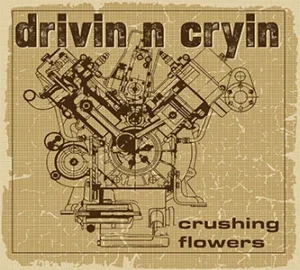
When Kinney’s 60th birthday celebration was thwarted by the pandemic, his wife, artist Anna Jensen, was inspired to create a lockdown surprise for him by asking some of his fellow musician friends to record cover versions of his songs, a project which spawned their starting a record label to release a four album, 100 song compilation featuring artists like Darius Rucker, Great Lake Swimmers, Patterson Hood, Indigo Girls, Mike Mills and Peter Buck of R.E.M., Jason Isbell, and Cat Power, to name a few. Most recently, Kinney has been touring solo, and Drivin N Cryin’s new record, Crushing Flowers, was released on 10th April 2026.
His crowds sell out, surrounding him in the dark perimeter, and he is flooded in a pool of light. Somewhere in a town near you, Kevn Kinney is singing his songs to himself, like an old friend calling out of the blue.
His songs are as relevant now as they were decades back; some have proven to be downright predictive: “They poured a bucket of tar on top of a flower,” he wrote in 1991, a metaphor that reached literal news in 2025, when President Donald Trump ordered concrete to be poured over the historic White House Rose Garden. As if to meet the challenge in the chorus, Trump demolished the East Wing in order to build a ballroom.
Like Kinney himself, the song remains hopeful—and also a bit cosmic. A zen koan tangos with quantum physics in the lyric, “I split a mountain in two with a flake of snow.” A humbling reminder to the mountain that it’s just a bunch of particles shivering.
So what?
So are we.
Let’s go dancing.