
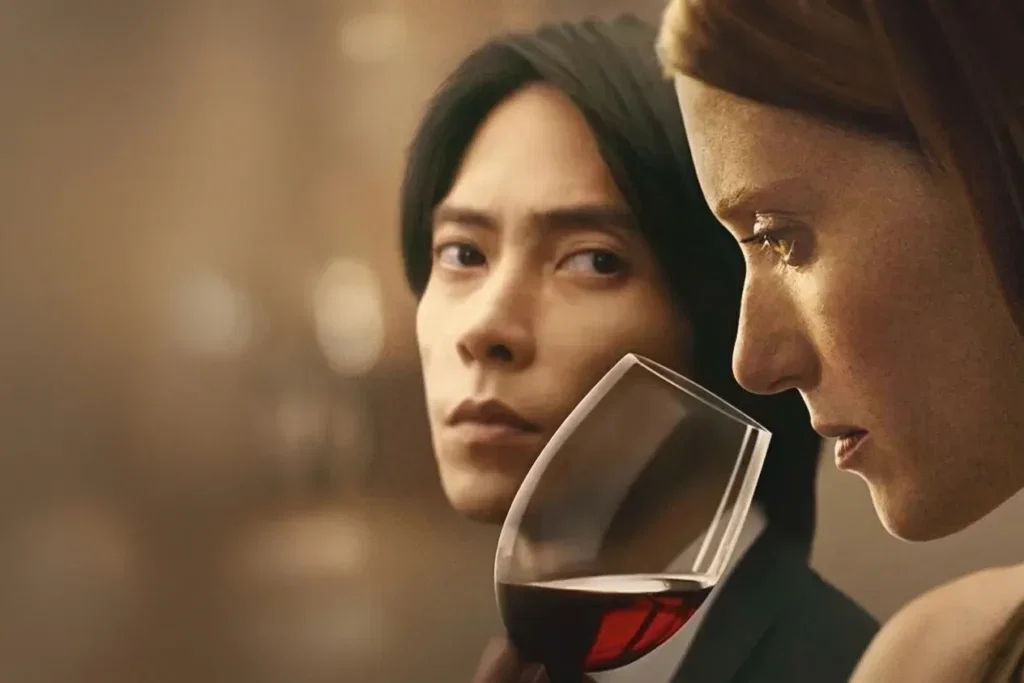

Oded Ruskin’s rich manga adaptation, Drops of God, may look fancy and bizarre, but it is a rare show that meaningfully touches upon art, wine, and philosophy. If you partake, you’ll be squiffed before you know it.
Adapted from Tadashi Agi’s television manga, Kami no Shizuku (2004-14), Drops of God is set across Provence, Tokyo, and Paris The first season, aired in April 2023, narrates the story of Camille Léger (Fleur Geffrier), the estranged daughter of egomaniacal wine mogul Alexandre Léger (Stanley Weber), who had conceived at his deathbed a twisted series of wine tasting competitions for Camille and his esteemed pupil and “spiritual son”, Issei Tomine (Tomohisa Yamashita), to compete for his inheritance.
Drops of God is prestige TV, international, and couth. However, unlike popular, flashy perceptions of luxury TV, such as the ostentatious Dynasty or the glittering girl-glamour of Gossip Girl, Drops of God chooses to speak the language of luxury through philosophy and meaningful cinematography – with drinks.
Drops of God‘s second season takes us to the scenic countryside in Georgia. Camille and Issei, now working as a team of reunited siblings, with some passive-aggressive tension of course, are on a quest to find the origins of an extraordinary yet mysterious wine that their wine-obsessed father sent them from the grave. This wine, later discovered as Herbemont, evokes a vision in Issei and stirs something innate in both sommeliers.
It belongs to a local woman, Tamar Abashidze, and her family, who have been producing the wine in their ancient cellars for decades. The family, to whom this magical wine is sacred, is at conflict with Davit (Tornike Gogrichiani), Tamar’s business-minded mercenary brother, who, bruised by childhood disputes, wants to strike back at them by destroying the agricultural land and cellars.
Drops of God‘s central debate lies in Camille’s actions: stealing a bottle of Hebermont that the gentle yet resilient Tamar entrusts with Issei and unlawfully slipping it into a vintage-wine competition, in hopes of pushing Tamar’s wine as a commercial success, so that Davit reconsiders his decision to stop the wine’s production. Camille, stubborn and typically French, is driven by her determination to rescue this wine from extinction, and she goes against Tamar’s wishes to introduce it to the global market.
Camille’s machinations end in tragedy, but the contention lies in the clash of the ideologies of two women deeply devoted to winemaking and tasting. On one hand, Camille will do anything in her power to conserve this dying wine, and on the other, Tamar will do anything to protect what the wine represents, even if it means the death of the wine itself.
“Sometimes, during fermentation, wine gets sick, but sometimes, miracles happen,” Tamar says when she presents to Issei and Camillie for the first time, the family qvevris, the underground clay vessels in the cellar, putting her faith in them. She says that the wine does not belong to her or to her brother, but to God.
Wine is almost spiritual, medicinal to Tamar; it is her livelihood and the object of her soulful dedication. Camille, though well-intentioned, fails to understand the emotional and spiritual value Tamar attaches to the wine. Yet, Camille’s appreciation of wine-making is no less profound.
Throughout Drops of God, characters speak of wine, especially the Herbemont, as something godly. In wine, some find truth, and others find visceral nostalgia. In the fifth episode, “Trust Me”, Camille is training Davit to drink wine with a certain Proustian sensibility. She first sets the scene by playing background music, then asks Davit to smell the wine and then sip.
She explains how the first sip reveals distinct tastes of three grape varieties, but in the second sip, one senses a sublime unity of three flavours. When Davit closes his eyes and takes his second sip, the background music pauses; there is silence. “Le vin, c’est comme la musique. Il te connecte avec tes émotions,” Camille says to a smitten and flirtatious Davit, as she proceeds to open another bottle and narrates in a trance, what and where she imagines herself, in a dream-like state, that the wine induces.
At its core, Drops of God preaches that drinking good wine unlocks something profoundly sensitive in our psyche, and the process itself is deeply artistic. The renowned philosopher Marcel Proust discovered this treasure of an idea long ago and described it impeccably in the famous episode of eating the madeleine in his 1913 novel, In Search of Lost Time.
I was conscious that it was connected with the taste of tea and cake, but that it infinitely transcended those savours, could not, indeed, be of the same nature as theirs. Whence did it come? What did it signify? How could I seize upon and define it?
The first bite of the madeleine soaked in tea not only evokes this “all-powerful joy” but also takes Proust back to Combray, his aunt’s village. While his aunt did give him madeleines dipped in tea as a child, eating one as an adult brings back a series of visions and feelings about the old house, the village, and its people, and this collection of assorted memories, once lost, is now united. Drops of God explores the idea of involuntary memory, using wine as the ultimate medium: one for appreciating the serendipity we experience as humans, and the other for accessing childhood memories and answering questions of the present, as is the case with Issei.
Issei, a typical tight-lipped, disciplined, somewhat dull yet enigmatic manga hero, begins pursuing free diving to get in touch with his feelings and find purpose. He has a striking vision of the moon and the ocean when he first sips the Herbemont. Issei understands that wine has unlocked something tragic in him, a childhood memory where his mother attempts to drown him in the ocean, a clouded memory that he believed was a filament of his imagination.
However, as Proust suggests, “Memory is not so much a faithful secretary recapitulating the past as it is a creative, fallible, unreliable masquer, presenting images that may or may not reflect what really was.”
Aided by the wine, Issei is certain by the end of Season 2 that Honaka did, in fact, try to murder him as a child. This certainty arises from revisiting his real memory, or rather, the feeling of devastation in that moment. Drops of God asks questions similar to those Marcel Proust toyed with, such as: is the past simply a construct, and is art the only way to retrieve lost time?
To serve justice to the show’s abstract and artisanal themes, its sanguine visuals from various locations, and its polyphonic cadence stand as unwavering pillars. The shots of the vast stretches of Prussian blue with a blossoming round moon, a teal-and-gold-studded coast in Marseille, a sharp montage of Juan Lopez’s young boy performing Flamenco, a family Supra, a hike in the rainforests of Japan and many more detailed clips tell us that the creators believe strongly in the worldview that they pen and direct: true artists and nature are kindred in their pursuit to produce beauty.
Drops of God is astonishingly progressive with its vocabulary about climate change, the pesticide industry, and water conservation in major plotlines. It conveys an all-encompassing awareness that, if we are talking about wine and luxury, it would be almost foolish and insensitive to skip the discourse on agriculture, apiculture, global warming, and the politics involved. We cannot ignore the dialogue around nature, and we cannot turn a blind eye to the emotional labour and the threat of livelihood erasure that true vernacular craftsmen and artists endure to deliver, to those lucky enough, a refined bottle of the nectar of the gods.
References
Jeiranashvili, Nika. “Drops of God: Georgia’s Living Legacy on the World’s Screen”. Natural Wine Association. February 2026.
PopMatters Staff. “Proust Was a Neuroscientist by Jonah Lehrer”. 11 February 2008.
PopMatters Staff. “The Proust Project by Andre Acimen”. 1 February 2005.
Proust, Marcel. “The Madeleine Excerpt from Remembrance of Things Past, by Marcel Proust. Dailygood. ServiceSpace.org. 9 November 2018.
Rusak, Rotem. “DROPS of GOD Creators Talk Season 2’s Epic New Adventures and the Beauty of Wine”. Nerdist. 23 January 2026.
Wijsenbeek, Caroline. “MARCEL PROUST”. American Imago, vol. 2, no. 4. 1941.