
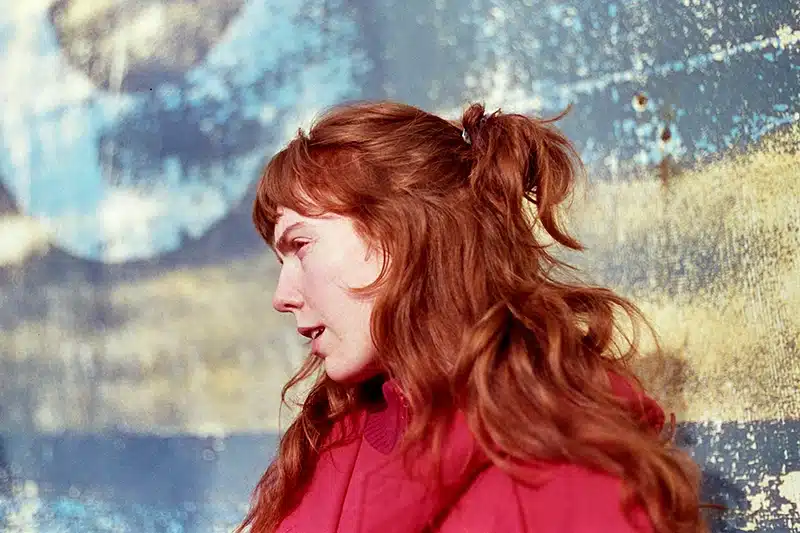

London-based songwriter Elanor Moss’ songs are scorched prayers. Love turns to ash and back to love, a transformation. Isn’t that what love is? Moss suggests throughout her debut album, The Knife, The Needle, that you can heal or be wounded by love. Moreover, there is pain behind beauty, beauty behind pain, which is to say, one cannot exist without the other. A subterranean truth rises to the surface, where violence—real or unreal, acted or imagined—occurs. There are no easy answers in these intimate and unassuming songs; they never eschew the truth. The songs could be lullabies or lovers’ laments, or both.
Moss puts a distance between her and her characters, not to mention the ellipses, with enough of a story to stop you from thinking about the singer’s biographical details. Can you live with contradiction? Therein lies the question at the heart of Moss’ The Knife, The Needle. What you’ll find is a duality: succor and violence, presence and absence, hope and despair, love and hate—all that good stuff that creates entertainment for, and out of, the human condition.
If you come to Elanor Moss’ album for its lyrical content, you have missed the point. The drama is in the quiet moments: the exhalation after “Again, My Love” and a sotto voce spoken-word preface to “Secrets of the Universe”. They get under your skin like a half-remembered memory. Perhaps it is paradoxical that these occurrences stand out, but, then again, maybe not. We recall the minutiae of everyday life, which don’t make sense to anyone other than ourselves; sometimes not even to ourselves. These infinitesimal moments certainly showcase contingency. So you hear a musician shaping sound in real time, giving the false impression that the record can be changed.
Above all, it’s the sparse baroque arrangements that are the real highlight of The Knife, The Needle. In fact, Moss walked away from an almost-finished version of her album. Instead, she re-recorded the LP from scratch, based on a handful of composer Matthew Herd’s arrangements. The pockets of space make the songs feel as if they are lingering or posturing—if they could go anywhere. These orchestral arrangements bring to mind Nick Drake‘s Five Leaves Left, where the baroque embellishments seem to float of their own accord.
The opener, “Fixer”, is where the album title stems from. Both the knife and the needle showcase the Janus-faced nature of love: violence and healing. In other words, the needle can mend a broken heart. It is an engaging number with circular guitar fingerpicking, shot through with succulent strings and woodwinds. The melody of “Again, My Love” could be from Laura Marling‘s album Patterns in Repeat (2024), and her intonation mirrors Marling’s.
As the title implies, The Knife, The Needle, there are all types of violence, such as domestic violence in “Sarah Waiting in the Car”. By the end, the narrator (victim) sees themselves as violent as the perpetrator. There is a stark and cruel beauty to The Knife, The Needle, bolstered by Elanor Moss’ delicate fingerpicking on acoustic guitar, dripping with melancholy, sadness, and forlornness. This tremulous acoustic guitar playing is countered by rough-hewn string squeaks, echoing Clara Mann‘s debut album Rift (2025).
Moss straddles between English fey psychedelic folk and singer-songwriter material, carving out an inimitable space of her own. Lyrically, there are occasional weak moments when the songwriter mixes modern-day tropes with country idioms. For instance, in “Clothes in a Hotel Sink”, there is a clumsy lyric: “I picked up one of those self-help books to read, but it only reminds me of how much help I need,” which throws you out of the otherwise stunning song, where a lachrymose country fiddle soars like a bird. Here, the narrator flirts with a barman while thinking of a lover; if that sounds familiar, it’s because it is: Bruce Springsteen‘s “One Step Up”.
There is a feeling to The Knife, The Needle that, like love, it could fall apart at any moment. It is as if Moss—or, more accurately, the narrators—is singing to herself, her future self, as if hearing the songs from the future, like reading an old diary. So this album carries a wistful nostalgia, kept at bay by a poetic distance.
Elanor Moss’ The Knife, The Needle shows what the songwriter set out to answer: you can live with contradiction. Indeed, love is a knife and a needle. You feel the rain in these melodies; the brutality of love in these torch-ballads. Moss doesn’t flinch away, and doesn’t expect you to.