
Grief needs space. It’s easy to lose sight of this truth in our fast-paced culture, where there’s a rush to drop tributes hours after an artist’s passing. However, sometimes the full impact of a great artist—and person, for that matter—can’t be easily analyzed or even put into words.
It’s been roughly two weeks since Éliane Radigue, the beloved French composer of feedback, drone, and synthesizer music, passed away, and it’s still difficult to fully explain her legacy. Radigue’s impact went beyond words because she sought a form of artistic transcendence that went beyond words, much like the Tibetan Buddhism that heavily inspired her.
Consider this: Éliane Radigue’s most famous work, Trilogie de la Mort, comprises three hour-long drone compositions. A low, fuzzy tone predominates throughout each piece, with higher tones and minimal synth motifs popping up here and there, but for the most part, the music hardly changes. Even by the standards of drone music, it’s glacially slow, moving along in some geologic timeframe where the concept of BPM hasn’t even been born yet. It’s hard to describe how a piece this trudging and toilsome can be so uncannily beautiful, but it is. I’m sure anyone who has sat through the three hours of Trilogie can attest to that.
Perhaps what sets Trilogie de la Mort apart from other ambient recordings of the time is how unabashedly human, how emotionally-overpowering it sounds—how unstuffy and unacademic, compared to most drone. This emotional push-and-pull is largely due to the grief that inspired it: Trilogie de la Mort was composed after Radigue lost her son, Yves Arman, in a car accident. The result is a harrowingly beautiful meditation on loss, because she understood that to capture and reflect grief adequately, you have to give it space. You can’t jump to conclusions or easy explanations, or in this case, melodies, harmonies, or rhythm. The key ingredient is slow reveal, not sudden reward.
The intersection of sound and space is at the forefront of all of Éliane Radigue’s work. She was more than a musician—she was a hypnotist of sound, interested in music’s spatial, embodied qualities as much as what it could accomplish aurally. Tom Johnson, writing for the Village Voice in 1973, had this to say about watching Radigue perform her piece “Psi 1847” at one of her concerts:
“Perhaps the most interesting thing about ‘Psi 847’ is the way its motifs seem to come from different places. They were all produced by the same loudspeakers, and many of them seemed to come directly out of the loudspeakers, but some of the sounds seem to ooze out of the side wall, and others seem to emanate from specific points near the ceiling.”
To achieve this effect, Radigue would position the loudspeakersdifferently around the room, allowing sounds to bounce from one surface to another. Even her studio work bears a semblance of this strange effect. Different sounds seem to emanate from different places in your hearing range. The same way that being in a shower or a room with loud air conditioning can occasionally make you hear pitches or tones that aren’t there, listening to Éliane Radigue’s music makes you hear things that call your powers of perception into question.
About 30 minutes into “Kyema”, the first track from Trilogie de la Mort, a low, submerged rumbling breaks through the drone-scape, but it comes on so slowly and imperceptibly that it almost tricks you into thinking you’re imagining it. It’s deliberate—Radigue is interested in sound as a three-dimensional phenomenon, in the ways that acoustic frequencies come together and come apart, creating pitches and tones that are subjective to the listener.
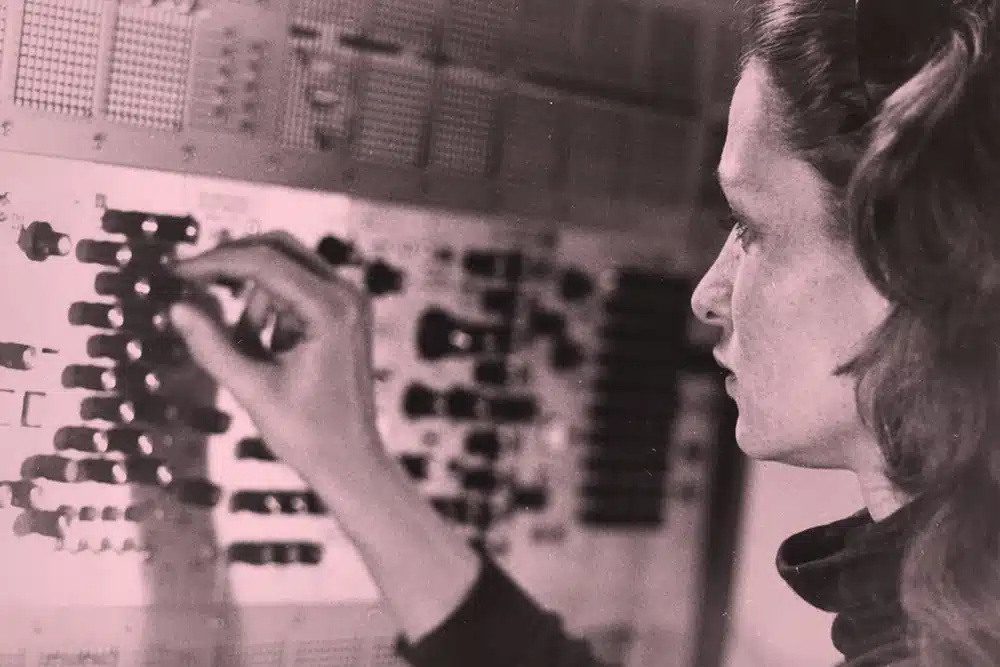
Throughout her life, Radigue used various kinds of synthesizers, including Moog, Buchla, Serge, and—most famously—her trusty ARP 2500, which she nicknamed Jules in the early 1970s. Though she studied under the famous musique concrète composers Pierre Schaeffer and Pierre Henry, she eventually broke away from the influence of musique concrète to chart her own course in electronic music.
Since the beginning of the 21st century, however, Éliane—ever the shape-shifter—began composing music exclusively for acoustic instruments. That culminated in the OCCAM recordings, a series of atmospheric compositions featuring acoustic musicians from the 2010s and 2020s. Each Occam piece was improvised, using as its basis a single image—often involving one of the four elements—and no musical score or notation.
Radigue passed away on 23 February 2026, at the age of 94. Although she was never a household name, her influence on modern music is impossible to put into words. Even calling her music “ambient” or “drone” almost feels wrong—it’s so much freer than that. There’s something huge, expansive, and enveloping about it because of the way sounds are seemingly let go into the open air, becoming something different as soon as they reach the listener’s ears. That creates a sense of being literally engulfed in the music, of being submerged in some oceanic panorama of sound, silence, and the space between.
Indeed, oceanic may be the best term of all to describe Radigue’s music. One thinks of oceans forming, tectonic plates shifting, firmaments being rent asunder in the Genesis creation narrative. People say that there are four oceans, but one could reasonably argue that there’s a fifth: the one created by Éliane Radigue and her legion of cosmic drones.
