
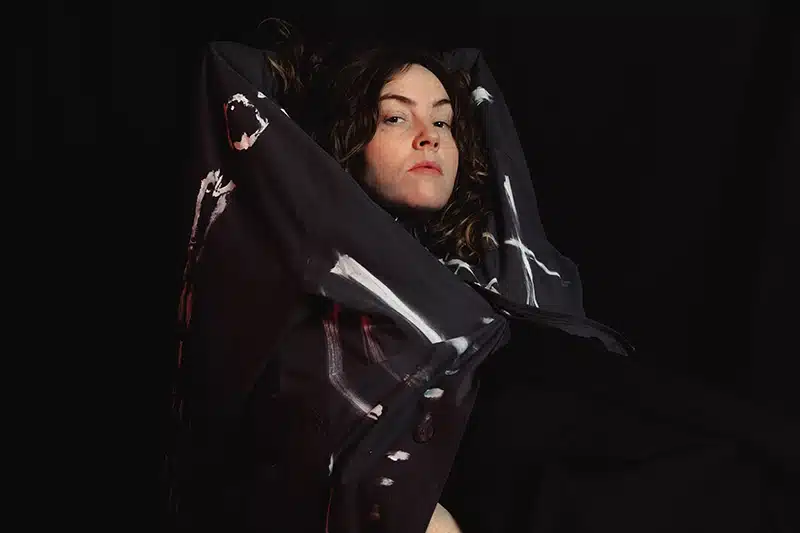

Emma Ruth Rundle’s latest album, These Killing Times, marks the integration of the artist’s divergent leanings (metal, folk, ambient). Distorted, doom-laden soundscapes à la 2016’s Marked for Death (and Rundle’s subsequent collaborations with Thou) are crossed with airier acoustic settings reminiscent of 2021’s Engine of Hell. Well-vetted adornments, informed by 2022’s EG2: Dowsing Voice, enhance the project atmospherically. It’s Rundle’s voice, however, that displays the deepest maturation, as the singer offers urgent proclamations, mysterious pleas, and despair-soaked confessions. These Killing Times is a rivetingly multifaceted yet unwaveringly cohesive project – Rundle’s career-defining set.
From the opening track, “Powerless”, Rundle offers a masterclass in vocals that combine tenderness, defiance, and outrage. Buoyed by elegant and reverb-washed piano chords, verses are sensual and sultry. Grittier guitars and heavier drums join in the chorus, then fade as the piano resurfaces. These contrasts between sparseness and density highlight Rundle’s attunement to instrumental and production-related dynamics.
Lyrically, Rundle works with potent paradoxes. “Let me die here with a hammer in my hand / One for smashing, one for making something better,” she sings toward the song’s end. It’s as if she invokes Kali, the Hindu goddess who destroys illusions to reveal the truth. She also, perhaps, expresses Daoist sensibilities, vowing to work with reality rather than against it. Rundle encourages us, by extension, to face the facts about who we are and the worlds we live in, empowering ourselves and those around us.
“God’s Picture” reaffirms Rundle’s affinity for moody folk arrangements and minimal yet evocative orchestration, as her piano part interweaves with Patrick Shiroishi’s breathy sax. The piece illustrates Rundle’s heightened precision in composition and development, as she uses volume, textural accents, and layered vocals to nudge the track toward a crescendo.
A Catherine wheel can refer to a firework, a circular window, or a torture device. Rundle’s employment of the term tilts toward the latter: “Sometimes I just can’t take this place / The cruelty of its flesh, of its pith, of its peel.” Melodic/orchestral metal meets body horror meets contemporary Gnosticism. In this single piece, we hear echoes of the witchy Chelsea Wolfe, the tragic Romantic A.A. Williams, and the furious mystic Kristina Esfandiari (as well as the identity-seeking Ethel Cain). Yet, Rundle rises above each of these touchstones, forging her own voice and sound, her own distinct blend of acceptance and rebellion, faith and agnosticism, love and misanthropy.
“Don’t Delay Heaven” drips with dark romance and prayerful longing, a cogent blend of sexuality and reverence that occasionally recalls the devout heretic Lingua Ignota (Kristin Hayter). Rundle’s voice is as expressive, unhampered, and evocative as we’ve heard. “We, here in Babylon / We, where we don’t believe / We, where we don’t belong,” she moans, capturing how it feels to be spiritually exiled, lost in a world fueled by selfishness and greed. Framed by understated guitar and piano parts, Rundle’s voice commands center stage as she delivers one of the most moving performances of her career.
“Enough”, too, underscores Emma Ruth Rundle’s remarkable growth as a singer. Undergirded by driving rhythms, she segues effortlessly from lower to higher pitches, straining, relaxing, at once carnal and otherworldly. Her performance brings to mind a priestess who can cast a mean voodoo spell, a hierophant who can hold fire in her hands without getting burnt, a sage who knows and can relate to the clench of heartache.
In “Human Kindness”, Rundle plunges into cryptic yet stirring abstractions: “The milk is spit, the milk is kiss / After all we are stripped / And all the horses of your fear.” The lines point to the tension between our mammalian wish for belonging and the way conditioning separates us. Our natural proclivity for “kindness” and compassion, Rundle suggests, is eclipsed by learned “fear”. The piece is vocally, poetically, and atmospherically gripping, and it concludes with a protracted noise-sprawl. The eight-and-a-half-minute epic then collapses, as it were, into the stripped-down and hyper-melodic coda, “Oceans of Time”, where Rundle is joined by guest singers Lukas Frank, Cinder Well’s Amelia Baker, and Marissa Nadler.
With These Killing Times, Rundle’s songwriting is imagistically edgier yet more melodically enrolling. The album’s sonics are wide-ranging, as Rundle coalesces her penchants for gothic folk, post-rock/orchestral metal, and synthy experimentation. Her voice, above all, has evolved into a superpower, conveying hope, dejection, rage, and yearning, often in a single phrase. With these songs, she rises to the level of her above-mentioned colleagues, on several tracks exceeding them. This is the album Emma Ruth Rundle has long wanted and been destined to make, the Rundle set we’ve been holding our breath for. These Killing Times marks the actualization of a signature artist.