
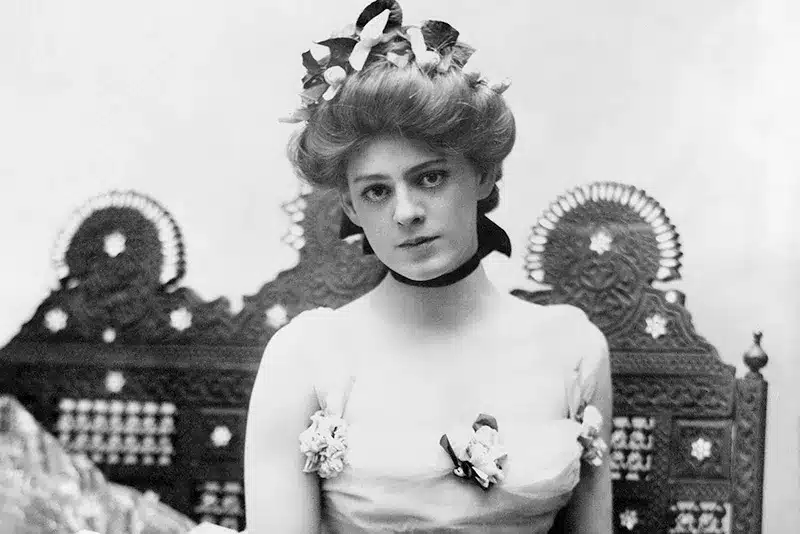

What do we talk about when we talk about the Barrymores, including Ethel Barrymore, discussed here? Are the Barrymores an American performing arts dynasty that exists outside of time? In a culture quick to condemn “nepo babies” for riding the coattails of their celebrity parents, Drew Barrymore often takes pride of place as Exhibit A on listicles promising insights into the entertainment industry’s famous families. It’s through these very articles that the uninitiated learn that she is a Barrymore, not the Barrymore—proof of a talented bloodline that pre-dates the film industry.
Her traumatic upbringing and professional achievements aside, Drew Barrymore is a living thread that takes us back through the annals of Hollywood and theatre history. What of the other Barrymore women? Of Jaid, Drew’s mother, we remember her daughter’s emancipation and estrangement. Of actress Diana, we remember her tragic and untimely death by suicide. What of Ethel, sister of distinguished actors Lionel and John, granddaughter of theatre doyenne Louisa Lane Drew?
In Ethel Barrymore: Shy Empress of the Footlights, Kathleen Spaltro centers Ethel as a woman whose acceptance of her fate as a serious actor came at a great cost to her individual pursuits, particularly her desire to become a concert pianist. Her story thus rehearses a familiar, unsurprising narrative of familial obligation.
Directed to follow in the steps of her father Maurice Barrymore (born Herbert Arthur Chamberlayne Blyth, whose stage name was intended to protect the Blyths from the “shame” of having an actor, rather than a barrister, as a son) and her maternal ancestors (the Drew theatre dynasty) to become an actor and theatre manager, she became “the keeper of the flame” and the manager of the family’s finances.
Despite Ethel Barrymore’s commitment to the stage, her later work in film, television, and radio was largely financially, rather than artistically, motivated. Though her performances “remained subsidiary appendixes [sic] to her stage career,” her four Oscar nominations in the 1940s—including winning the Academy Award for Best Supporting Actress for her 1944 performance in Clifford Odets’ None but the Lonely Heart—prove the range and flexibility of her artistic excellence.
Still, the recognition of her talent did not confer financial stability: financial literacy proved not to be a family strong suit, and the IRS loomed over Ethel Barrymore as she supported her brothers, eagerly reaching out its hand to collect back taxes and interest. The woman who later became the grand dame of MGM was quietly supported by loyal friends, including director George Cukor, towards the end of her life.
Notwithstanding a handful of increasingly frustrating repetitions that somehow survived the editing process and a needlessly recursive chapter structure, Spaltro’s biography offers striking portraits of the profoundly influential women who shaped not only Ethel Barrymore’s career but also her philosophy on life. Spaltro’s research into the Sisters of Notre Dame de Namur and the Rittenhouse Square boarding school that Ethel attended in Philadelphia unveils the depth of their influence on her discipline, Roman Catholic faith, and musicality.
Memories of her beloved nuns would later inform Ethel Barrymore’s performance as Sister Gracia in Gregorio Martinez Sierra’s Broadway play, The Kingdom of God, a 1928 production she directed for the Shubert Company at the Ethel Barrymore Theatre. Outside of the convent, Ethel’s godmother, the Polish-born actress Helena Modjeska, “fired Ethel’s soul”, while her grandmother Louisa “constructed the support that sustained her character.” As Spaltro characterizes it, “Helena supplied the poetry of Ethel’s life; Louisa, the prose.”
Spaltro avoids paying undue attention to the star’s husband, Russell Griswold Colt, son of robber baron Samuel Colt, whom she divorced in 1923, or her various rejected suitors, including none other than Winston Churchill. What becomes clear is that Ethel Barrymore was deeply grateful for her three children—her blessings and her saviors, themselves destined for the stage—even though she suffered intense physical abuse at the hands of their father, beginning when she was six months pregnant with her firstborn.
Citing her mother and grandmother as exemplars, Ethel Barrymore argued that her professional aspirations never came at the cost of her children’s well-being nor her identity as a mother: “It is natural for me to be an actress and it is natural for me to be a mother. If an actress has an average amount of common sense, she can organize her life as a regular human being.”
We may be far removed from the stage where Ethel Barrymore debuted her breakout role in 1901 as an opera singer in Clyde Fitch’s romantic comedy play, Captain Jinks of the Horse Marines. Nevertheless, performing arts buffs remain inexplicably invested in the royal family of American theatre, attested by a slew of recent and forthcoming Barrymore biographies.
Spaltro makes a convincing case that Ethel Barrymore deserves to be remembered not as the reluctant or overlooked sister but as a professional who—despite her intense anxiety and self-medication with alcohol—was deeply devoted to her craft and to her community. Just as she embodied the “Spirit of Equity” during the 1919 Actors Equity Association Strike, she lived consciously “in the shadow of [Louisa Lane Drew’s] spirit.” As Ethel once argued, applause may indeed be ephemeral, but Spaltro’s biography stokes the flame to keep her legacy alive.